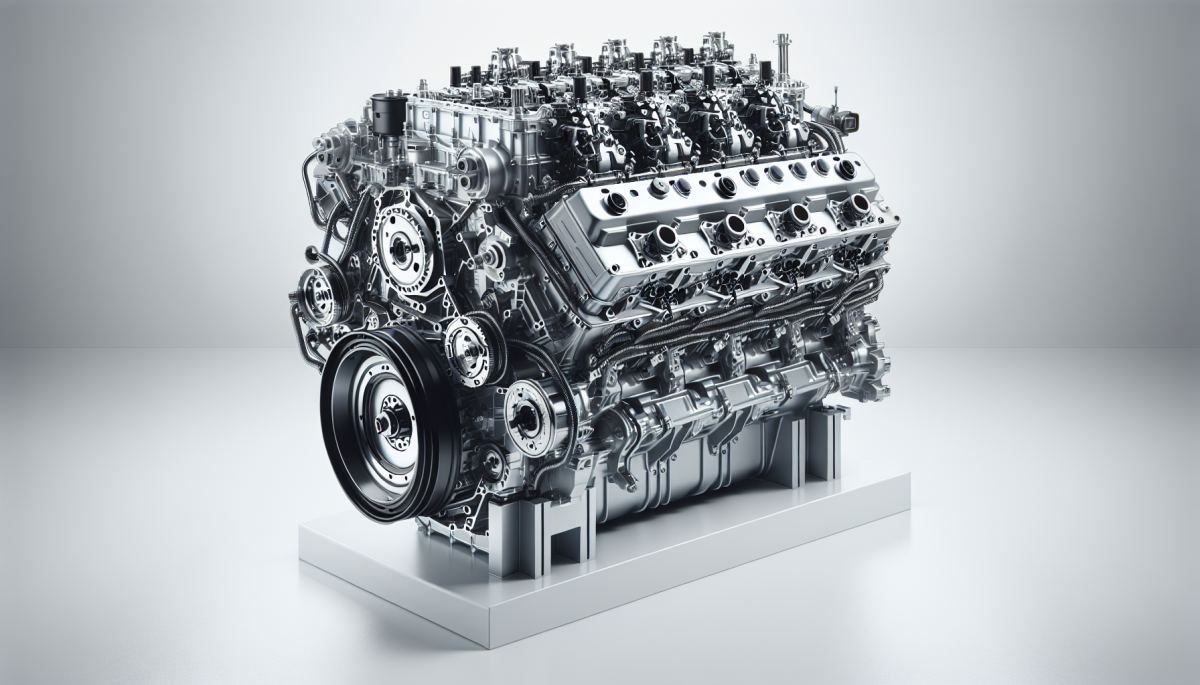
General Motors is doubling down on internal combustion at a moment when the auto industry's electric future looks considerably murkier than it did three years ago. The company has announced a major investment to produce its sixth-generation V-8 engine at its St. Catharines Propulsion Plant in Ontario, Canada, alongside two manufacturing facilities in the United States. The move is a telling signal about where consumer demand actually sits right now, and what automakers are quietly recalibrating behind the scenes.

The St. Catharines plant has long been a cornerstone of GM's powertrain manufacturing in North America. Adding the next-generation V-8 to its production roster is not a small logistical decision. It requires retooling, workforce training, and supply chain alignment across borders, all of which represent a significant capital commitment. GM has not released the full investment figure for the Canadian facility specifically, but decisions of this scale typically run into the hundreds of millions of dollars when infrastructure and labor costs are factored in together.
What makes this investment worth examining closely is its timing. GM spent much of 2021 and 2022 positioning itself as an all-electric company by 2035, pledging to phase out gasoline and diesel passenger vehicles entirely. That narrative has since been quietly revised. EV adoption in the United States has grown, but not at the pace that would justify abandoning combustion infrastructure this decade. Ford made similar recalibrations last year, scaling back EV production targets after its electric vehicle division posted billions in losses. GM's V-8 investment fits into the same pattern: a recognition that the transition is real but nonlinear, and that trucks and performance vehicles powered by large displacement engines still generate the profits that fund everything else.
The sixth-generation V-8 is expected to power GM's most profitable product lines, including full-size trucks and SUVs under the Chevrolet, GMC, and Cadillac nameplates. These vehicles carry margins that smaller cars and even many EVs cannot match. In that sense, the engine investment is not a retreat from electrification so much as a financial bridge, keeping the revenue flowing while battery costs come down and charging infrastructure matures.
Producing the engine across facilities in both Canada and the United States adds a layer of geopolitical complexity that would have seemed routine two years ago but now carries real weight. The renegotiated Canada-United-States-Mexico Agreement governs how auto parts and finished vehicles move across North American borders, and any disruption to that framework, whether through tariff disputes or political pressure to reshore manufacturing entirely to U.S. soil, could affect the economics of a multi-country production strategy. GM is essentially betting that the cross-border manufacturing model remains stable enough to justify the investment, which is itself a statement of confidence in the current trade architecture.
For St. Catharines and the broader Ontario auto corridor, the announcement carries real economic weight. Canada's auto manufacturing sector has faced persistent uncertainty as EV investments have tended to cluster around battery gigafactories rather than traditional powertrain plants. Keeping a major propulsion program in the region preserves skilled trades jobs and supplier relationships that would be extremely difficult to rebuild once lost. The second-order effect here is significant: a healthy combustion manufacturing base in Ontario may actually make it easier, not harder, for Canada to negotiate future EV investment, because it keeps the workforce and industrial ecosystem intact rather than allowing it to atrophy during the transition gap.
There is also a feedback loop worth watching on the consumer side. As long as GM continues investing in and marketing high-performance V-8 trucks and SUVs, it reinforces the cultural and commercial appetite for those vehicles, which in turn justifies further investment. Breaking that loop requires either a dramatic shift in fuel costs, regulatory pressure that raises the price of combustion vehicles substantially, or an EV product that genuinely matches the towing capacity and range that truck buyers expect. None of those conditions are fully in place yet.
What GM's V-8 commitment ultimately reveals is that the auto industry's transition to electrification will be shaped less by announcements and pledges than by the stubborn arithmetic of consumer preference and profit margins. The sixth-generation V-8 will likely still be rolling off the St. Catharines line well into the 2030s, and the question worth asking is not whether that's a failure of ambition, but whether the industry's original timelines were ever grounded in reality to begin with.
Discussion (0)
Be the first to comment.
Leave a comment