
Australia has become the 30th country in the world to receive World Health Organization validation for eliminating trachoma as a public health problem, a milestone that carries genuine weight in global public health circles. Trachoma, caused by repeated infections of the bacterium Chlamydia trachomatis, is the world's leading infectious cause of blindness, and for decades it persisted almost exclusively among Indigenous Australians in remote communities, a fact that made the country's status as a wealthy, developed nation all the more uncomfortable to reckon with.
The disease works slowly and cruelly. Repeated infections cause the inner eyelid to scar, eventually pulling the eyelashes inward so they scrape against the cornea with every blink, a condition called trichiasis. Left untreated, it leads to irreversible blindness. The WHO's elimination threshold requires that active trachoma prevalence in children aged one to nine falls below five percent in every endemic district, and that trichiasis cases unknown to the health system drop below 0.2 per 1,000 people. Australia has now met both benchmarks nationally, a result that required decades of coordinated effort under the SAFE strategy, which combines Surgery, Antibiotics, Facial cleanliness, and Environmental improvement.
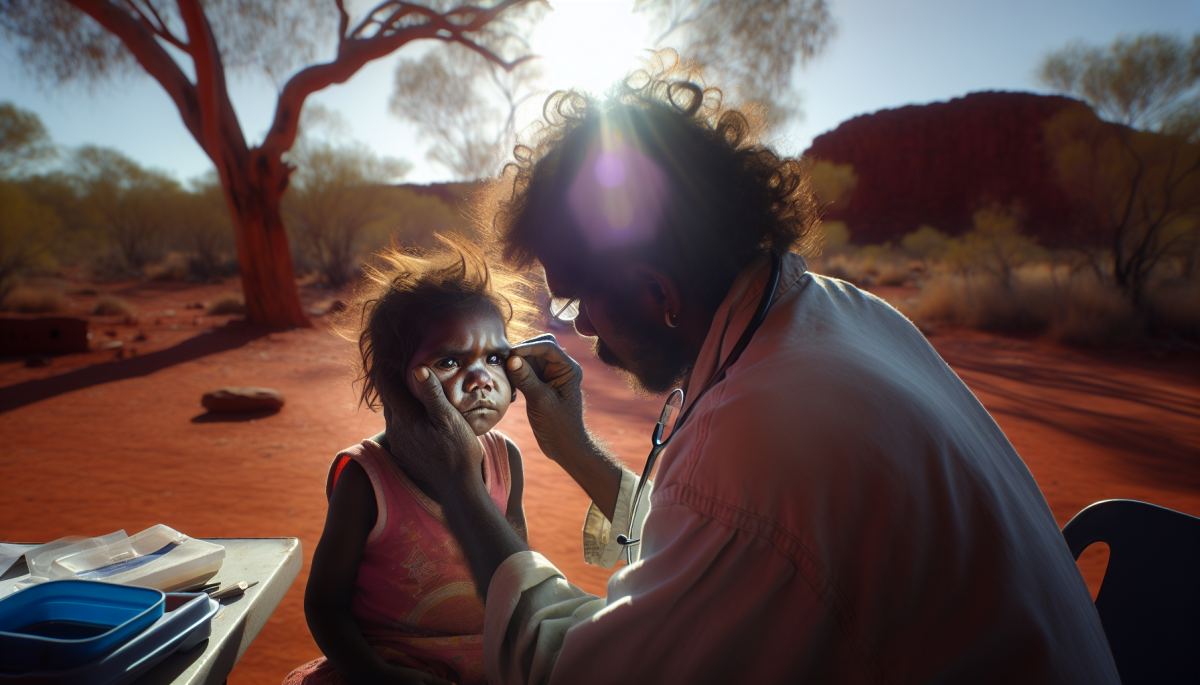
What makes Australia's case so instructive is that trachoma was never a disease of the entire country. It was a disease of dispossession. For most of the 20th century, trachoma was effectively absent from non-Indigenous Australians while remaining endemic in remote Aboriginal and Torres Strait Islander communities in the Northern Territory, South Australia, and Western Australia. The conditions that sustained it, overcrowded housing, limited access to clean water, inadequate sanitation, and underfunded health infrastructure, were not accidents of geography. They were the downstream consequences of policies that had systematically stripped Indigenous communities of land, resources, and self-determination.
This context matters because it reframes what elimination actually represents. It is not simply a virological or epidemiological achievement. It is, at least in part, an acknowledgment that the state finally invested enough in the basic living conditions of Indigenous Australians to interrupt a disease transmission cycle that should never have persisted this long in a country with Australia's per capita wealth. The WHO validation is real and worth celebrating, but it also implicitly indicts the century of neglect that made the achievement necessary in the first place.
Globally, trachoma still affects communities in 44 countries, with the highest burden concentrated in sub-Saharan Africa, particularly in Ethiopia, Nigeria, and South Sudan. The International Coalition for Trachoma Control estimates that roughly 1.9 million people are currently irreversibly blind or visually impaired from the disease, and around 137 million people live in areas where it remains a public health problem. Australia's elimination adds momentum to the broader push under the WHO's NTD road map, which targets the elimination of trachoma as a public health problem globally by 2030.
Australia's validation carries a systems-level lesson that extends well beyond ophthalmology. The SAFE strategy succeeded not because of a single intervention but because it attacked the disease at multiple points simultaneously, clinical, behavioral, and structural. That kind of multi-pronged approach is expensive and slow, which is precisely why neglected tropical diseases remain neglected. Donor fatigue, short political cycles, and the difficulty of measuring incremental progress in remote communities all conspire against the sustained commitment that elimination requires.
The more subtle second-order effect to watch is what happens to the surveillance and health infrastructure that was built to fight trachoma in Indigenous communities. Disease-specific programs have a troubling tendency to dissolve once their target metric is achieved, taking with them the community health workers, the supply chains, the data systems, and the trust relationships that took years to build. If Australia allows that infrastructure to atrophy now that the WHO box is checked, the same underlying conditions that harbored trachoma, overcrowding, water insecurity, inadequate sanitation, will remain fertile ground for the next preventable disease to take hold.
Elimination, in other words, is not the same as eradication, and it is certainly not the same as equity. The communities that carried this disease for generations deserve more than a validation certificate. They deserve the continued investment that transforms the conditions elimination revealed.
References
- WHO (2024) — Trachoma Fact Sheet
- WHO (2021) — Ending the Neglect to Attain the Sustainable Development Goals: A Road Map for Neglected Tropical Diseases 2021–2030
- International Coalition for Trachoma Control (2023) — The Global Trachoma Atlas
- Stocks et al. (2021) — Trachoma in Australia: Progress Toward Elimination




Discussion (0)
Be the first to comment.
Leave a comment