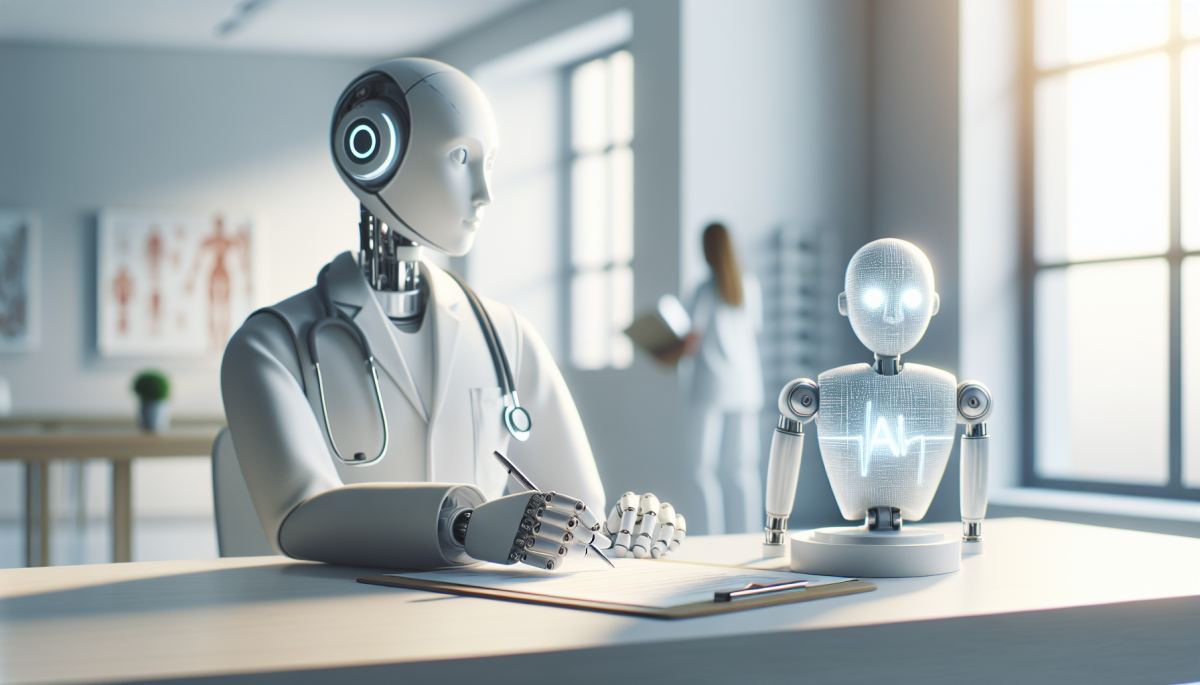
Medicine has always been a profession built on judgment, and judgment has always been constrained by time. A physician seeing thirty patients a day, managing referrals, interpreting labs, and staying current with a literature that produces thousands of new studies every week is not operating at peak human capacity. They are triaging their own attention. The emerging concept of an AI co-clinician, a system designed to work alongside doctors rather than replace them, is premised on a simple but consequential idea: that augmenting clinical judgment could be more transformative than automating it.
The vision being researched by teams at the frontier of applied AI in healthcare imagines a model where an AI system participates actively in the care process, reviewing patient histories, flagging diagnostic possibilities, suggesting treatment pathways, and surfacing relevant evidence in real time. Unlike earlier clinical decision support tools, which were largely passive and often ignored, a true co-clinician would be conversational, context-aware, and integrated into the workflow rather than bolted onto it. The distinction matters enormously. Studies have shown that alert fatigue from poorly designed clinical software is a genuine patient safety problem, with physicians overriding automated warnings at rates that sometimes exceed 90 percent.

The case for AI augmentation rather than replacement rests on what researchers sometimes call complementary cognition. Humans are exceptionally good at reading a room, building trust with a frightened patient, and making intuitive leaps from incomplete information. AI systems, trained on vast datasets, are exceptionally good at pattern recognition across dimensions no single clinician could hold in working memory simultaneously. A co-clinician model tries to capture both. The physician retains authority and accountability. The AI contributes breadth and recall.
This framing is not without its critics. Some researchers argue that the co-clinician model risks creating a new kind of automation bias, where clinicians defer to AI recommendations not because they have evaluated them but because the system projects confidence. There is already evidence from aviation and radiology that human operators become less vigilant when working alongside automated systems, a phenomenon that could be particularly dangerous in medicine where edge cases and rare presentations are precisely the situations most likely to be mishandled by pattern-matching systems trained on historical data.
The liability architecture around AI-assisted clinical decisions also remains largely unsettled. If a physician follows an AI recommendation that turns out to be wrong, who bears responsibility? Current medical malpractice frameworks were not designed with this question in mind, and the legal system is only beginning to grapple with it. Hospitals and health systems considering deployment of co-clinician tools are navigating this uncertainty in real time, often without clear regulatory guidance.
Beyond the exam room, the co-clinician model carries second-order consequences that deserve more attention than they typically receive. One of the most significant involves medical training. If AI systems handle the cognitive load of differential diagnosis and evidence synthesis, what happens to the development of those skills in medical students and residents? Clinical education has always been structured around the idea that trainees build judgment through practice and repetition. A generation of physicians trained alongside AI co-clinicians may develop a different, and potentially shallower, relationship with the underlying reasoning processes that make medicine work.
There is also the question of access and equity. AI co-clinician tools, if they work as advertised, could theoretically extend high-quality diagnostic support to under-resourced settings, rural hospitals, and clinics in low-income countries that lack specialist coverage. But the history of health technology is not especially encouraging on this point. Innovations that promise to democratize care have a persistent tendency to reach well-funded systems first and widen gaps before they narrow them. The infrastructure requirements alone, including reliable connectivity, electronic health record integration, and staff training, create barriers that are not evenly distributed.
The data feedback loop embedded in co-clinician systems also deserves scrutiny. These tools improve by learning from clinical outcomes, which means they need access to patient data at scale. The institutions that generate the most data, large academic medical centers and integrated health systems, will likely produce the best-performing models, reinforcing existing concentrations of medical expertise and influence. Smaller, independent practices may find themselves using tools trained on populations and care patterns that do not reflect their own.
What the co-clinician concept ultimately represents is not just a new piece of software but a renegotiation of what clinical authority means and where it comes from. That renegotiation will play out in hospitals, courtrooms, medical schools, and regulatory agencies simultaneously. The technology may arrive faster than any of those institutions are prepared to handle it.
References
- Topol, E.J. (2019) — High-performance medicine: the convergence of human and artificial intelligence
- Obermeyer, Z. & Emanuel, E.J. (2016) — Predicting the Future — Big Data, Machine Learning, and Clinical Medicine
- Shah, N.H. et al. (2019) — Making Machine Learning Models Clinically Useful
- Goddard, K. et al. (2012) — Automation Bias: A Systematic Review of Frequency, Effect Mediators, and Mitigators




Discussion (0)
Be the first to comment.
Leave a comment