
The Atlantic Meridional Overturning Circulation, known as AMOC, is one of the planet's most consequential and least understood climate systems. It functions like a giant conveyor belt, moving warm surface water from the tropics northward toward Europe and the Arctic, where the water cools, sinks, and returns southward along the ocean floor. This circulation helps regulate temperatures across the Northern Hemisphere, influences monsoon patterns in Africa and Asia, and keeps Western Europe far warmer than its latitude would otherwise allow. Scientists have grown increasingly alarmed that this system is weakening, and a growing body of research suggests that global warming may be pushing it toward a tipping point from which recovery could take centuries.
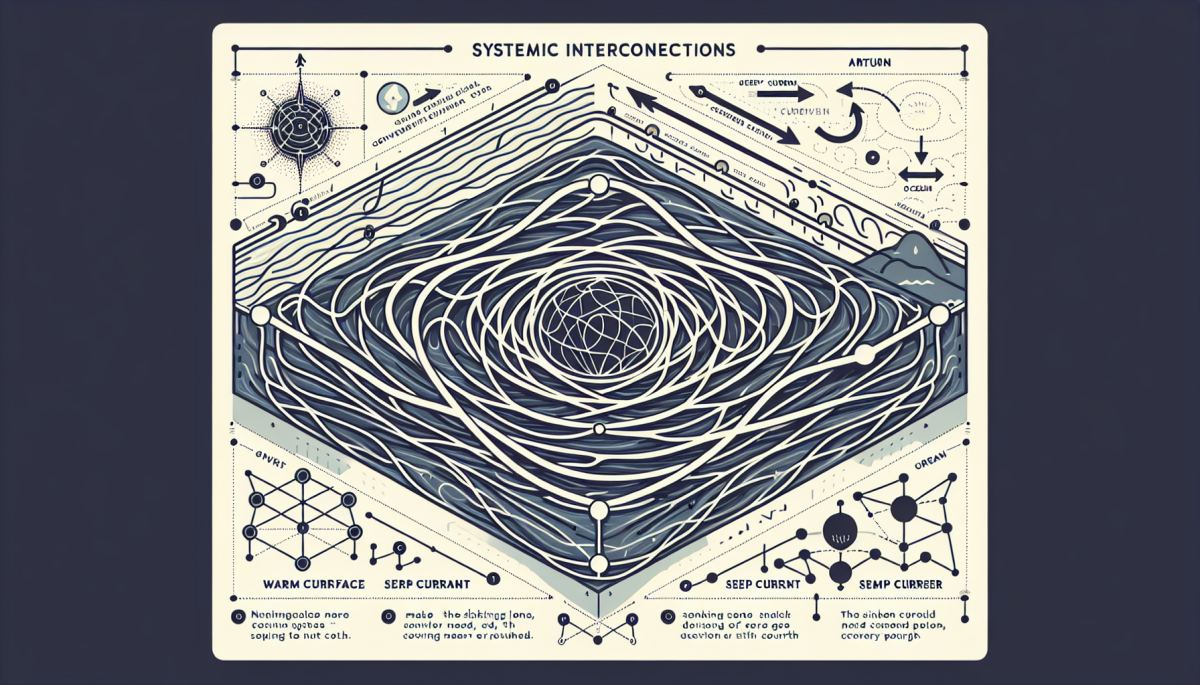
The mechanism behind AMOC's vulnerability is straightforward, even if its consequences are not. The circulation depends on a delicate balance of temperature and salinity. Cold, salty water is dense enough to sink in the North Atlantic, driving the current's deep return flow. But as Greenland's ice sheet melts at an accelerating pace, enormous volumes of fresh water are pouring into the North Atlantic. Fresh water is less dense than salt water, and its influx disrupts the sinking process. The engine, in effect, is being diluted. Research published in Nature Climate Change has used sediment cores and other proxy data to argue that AMOC is now at its weakest point in over a millennium, a claim that remains contested but has gained significant traction in the scientific community.
What makes AMOC particularly dangerous from a systems-science perspective is its nonlinearity. Unlike a gradually dimming light, ocean circulation systems can behave relatively stably for long periods and then shift abruptly once a threshold is crossed. This is the definition of a tipping point, and climate models have long suggested that AMOC possesses one. The difficulty is that scientists disagree sharply about how close that threshold might be. Some modeling studies suggest collapse could occur within this century under high-emissions scenarios. Others argue the system is more resilient and that a full collapse remains unlikely before 2100. The uncertainty itself is a form of risk, because policy decisions are being made in the absence of reliable early-warning signals.
The direct consequences of a significant AMOC slowdown would be severe and geographically uneven. Northwestern Europe would experience dramatic cooling, even as the rest of the planet continues to warm, a paradox that would strain public understanding of climate change. Sea levels along the eastern coast of the United States would rise faster than the global average, because a weaker current would no longer pull water away from the coastline. The Amazon rainforest, already under pressure from deforestation, could see its rainfall patterns disrupted, potentially accelerating dieback. West African monsoons, which hundreds of millions of people depend on for agriculture, could shift southward in ways that would devastate food systems.
The second-order consequence that receives far too little attention is the political and economic instability that would follow from these physical disruptions arriving simultaneously. A cooling Europe, a flooding American coastline, a drying Amazon, and a destabilized West African monsoon are not independent events. They are interconnected shocks that would hit global food markets, insurance systems, and migration patterns at the same time. The 2015 refugee crisis, which reshaped European politics for nearly a decade, was triggered in part by drought and conflict in Syria. A sustained AMOC disruption would generate climate pressures of a categorically larger magnitude across multiple continents at once.
There is also a feedback loop embedded in the geopolitics of the response. The regions most likely to suffer earliest from AMOC disruption, parts of sub-Saharan Africa and South Asia, are the least responsible for the greenhouse gas emissions driving Greenland's melt. The regions with the greatest capacity to reduce emissions rapidly, the United States and Europe, face consequences that are serious but more delayed. This asymmetry has historically weakened the political urgency of climate action, and an AMOC slowdown would deepen rather than resolve that tension.
Scientists are now calling for a dedicated international monitoring network to track AMOC's strength in real time, something that does not yet exist at the scale required. Without better data, the world is essentially watching one of its most critical climate regulators through a foggy window, able to see that something is changing but unable to say precisely how fast or how far. The question is not whether AMOC will continue to weaken. The evidence strongly suggests it will. The question is whether the institutions built to manage global risks can move faster than the currents they are failing to measure.
References
- Caesar et al. (2021) — Current Atlantic Meridional Overturning Circulation weakest in last millennium
- Boers (2021) — Observation-based early-warning signals for a collapse of the Atlantic Meridional Overturning Circulation
- IPCC (2021) — Sixth Assessment Report: The Physical Science Basis
- Lenton et al. (2019) — Climate tipping points — too risky to bet against




Discussion (0)
Be the first to comment.
Leave a comment