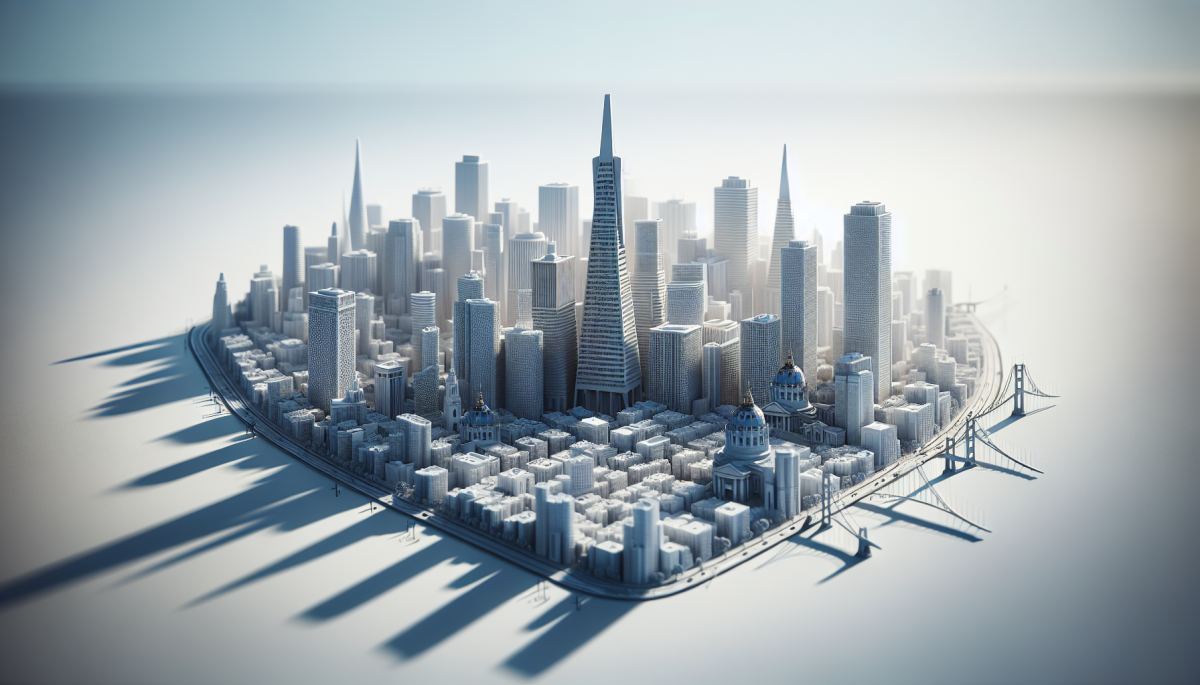
San Francisco sits at the center of the most consequential technological transformation in a generation. OpenAI, Anthropic, and dozens of the most heavily funded AI startups on earth operate within a few miles of each other in a city that has become, by any reasonable measure, the capital of artificial intelligence. And yet, by the metrics that actually describe how an economy feels to the people living inside it, San Francisco is struggling in ways that most AI-boom narratives conveniently skip past.
The paradox is not subtle. The city that is supposedly reshaping the global economy cannot fill its downtown office buildings. Its retail vacancy rates remain among the highest of any major American city. Its population has not recovered to pre-pandemic levels. Tax revenues have been under persistent pressure, forcing difficult conversations about city services. Meanwhile, the companies generating some of the largest private-market valuations in history are headquartered here, minting a narrow class of founders and early employees into centimillionaires while the broader urban economy sputters.
This is not simply a story about inequality, though inequality is certainly part of it. It is a story about the structural mismatch between the kind of wealth that AI generates and the kind of wealth that sustains a city.
Traditional technology booms, for all their distortions, had a certain density. The hardware era created manufacturing jobs. The early internet era created sprawling campuses with thousands of employees who ate lunch somewhere, hired local contractors, and commuted through neighborhoods. Even the social media era, for all its disruptions, generated enough mid-tier employment to keep San Francisco's service economy humming.
AI is architecturally different. The leading AI labs are, by historical standards, extraordinarily small in headcount relative to their valuations and their economic footprint. OpenAI, valued at well over $150 billion, employs roughly 1,500 people. Anthropic, valued at tens of billions, employs fewer still. These are not companies that anchor a neighborhood economy. They do not fill office towers. They do not generate the kind of dense, layered employment that ripples outward into restaurants, dry cleaners, and transit systems.
What they do generate is an intense concentration of very high salaries among a very small number of people, and an enormous amount of capital flowing to investors, many of whom do not live in San Francisco at all. The wealth is real. Its geographic and social distribution is extraordinarily narrow.
This creates a feedback loop that is easy to miss. As AI investment concentrates in a small number of firms with small headcounts, the city's tax base does not grow proportionally. Commercial real estate, already hollowed out by remote work, does not recover because these companies do not need large footprints. The service economy that depends on office workers has fewer customers. And the political pressure to address homelessness, public safety, and infrastructure remains intense, while the fiscal tools to address it remain constrained.
There is a deeper systems consequence here that extends beyond San Francisco's city limits. If AI continues to concentrate economic gains in small, high-skill teams while displacing broader categories of knowledge work, the San Francisco dynamic may become a template rather than an anomaly. A city, a region, or even a national economy can host the headquarters of a transformative industry and still experience net economic stress if that industry's employment multiplier is low enough.
Economists have long studied how different industries generate downstream jobs. Manufacturing, for instance, has historically had a high multiplier: each factory job supports several others in the surrounding economy. The early research on AI's labor market effects suggests the multiplier may run in the opposite direction for certain categories of work, with AI tools allowing small teams to do what previously required large ones.
San Francisco is, in this sense, a living experiment in what that future looks like at the city scale. The results so far are not encouraging for anyone hoping that proximity to the AI boom translates automatically into broad prosperity. The city may yet find ways to capture more of the value being created within its borders, through taxation, zoning, or deliberate policy. But the default trajectory, left unaddressed, points toward a place that is simultaneously the most important city in technology and one that cannot afford to fix its own sidewalks.
The rest of the world is watching, whether it realizes it or not.




Discussion (0)
Be the first to comment.
Leave a comment