
There is something quietly radical about a venture capital firm best known for backing Facebook, SpaceX, and Palantir turning its attention to the necks of grazing cows. Yet Founders Fund, Peter Thiel's storied investment vehicle, has led a $220 million funding round into Halter, a New Zealand-based startup that makes solar-powered GPS collars for cattle. The round values Halter at over $1 billion, and it signals something more consequential than a quirky pivot toward pastoral technology.
Halter's collars do something deceptively simple: they replace fences. Using GPS tracking, audio cues, and mild vibrations, the collars guide cattle across pastures without any physical barriers, allowing farmers to practice what agronomists call "virtual fencing" and precision rotational grazing. Farmers manage their herds through a smartphone app, drawing digital paddocks on a map and letting the system do the rest. The company claims its technology can increase farm productivity by up to 50 percent while simultaneously improving pasture health and reducing the carbon footprint of beef and dairy operations.
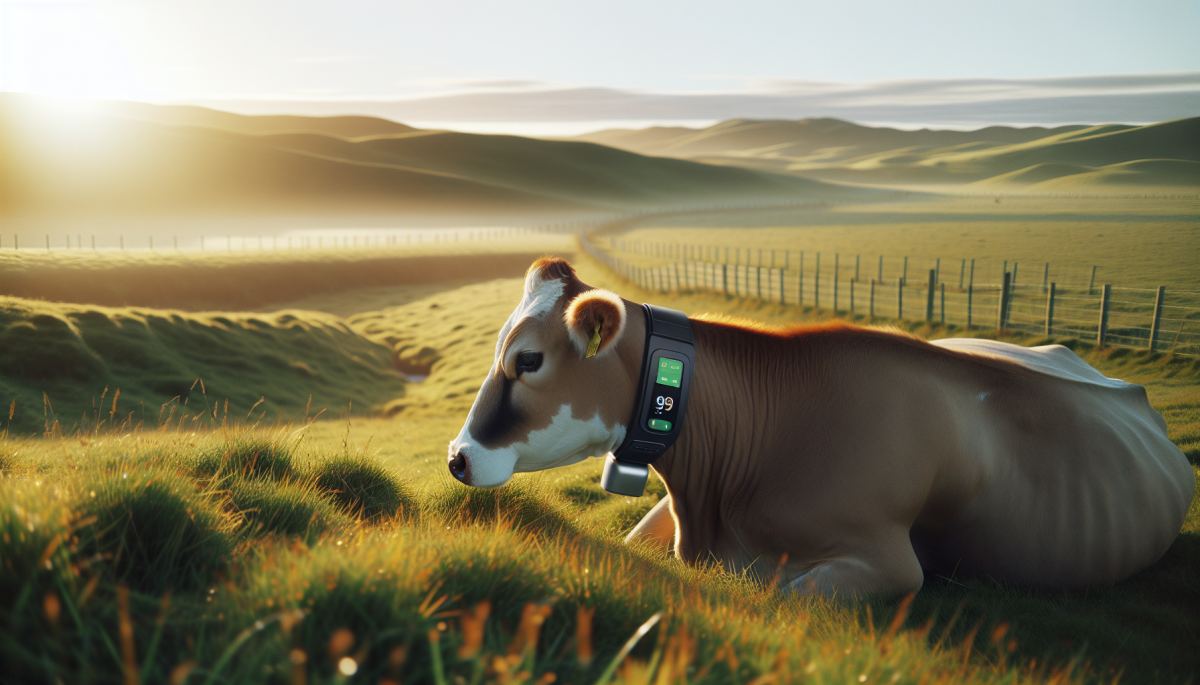
That combination of productivity and sustainability is exactly the kind of pitch that has become catnip for late-stage venture capital. But the Founders Fund investment is notable precisely because Thiel's firm is not known for chasing ESG-friendly narratives. Founders Fund has historically been skeptical of consensus thinking, which suggests the partners see something structurally compelling in Halter's model beyond the green marketing.
To understand why, it helps to think about what fences actually cost. In large pastoral farming economies like New Zealand, Australia, and increasingly the United States, physical fencing represents an enormous capital and labor burden. Miles of wire, posts, maintenance crews, and the sheer inflexibility of fixed infrastructure all add up. More importantly, static fences prevent farmers from optimizing grazing patterns in real time, which means pastures are routinely overgrazed in some areas and undergrazed in others. Soil compaction, reduced biodiversity, and lower long-term productivity follow almost inevitably.
Rotational grazing, where cattle are moved frequently across smaller paddocks to allow pasture recovery, has long been understood as a superior system. The problem has always been the labor and infrastructure cost of implementing it at scale. Halter essentially dissolves that constraint. A single farmer can manage hundreds of cattle across a complex grazing rotation from a phone, without hiring extra hands or stringing new wire. The unit economics, once the collar cost is amortized, can be compelling for large operations.
This is the kind of problem that venture capital is theoretically well suited to solve: a high-friction, labor-intensive process that can be automated through hardware and software at scale. The $220 million raise suggests Halter is preparing for aggressive international expansion, most likely targeting the vast cattle operations of the United States, Brazil, and Australia, where the addressable market dwarfs anything available in New Zealand alone.
The deeper consequences of widespread virtual fencing adoption are worth thinking through carefully. If Halter's technology scales as its backers hope, the effects will ripple well beyond individual farm productivity. One underappreciated dynamic is the potential impact on agricultural labor markets. Farmhands whose primary role involves moving cattle, checking fences, and managing rotations could find that role automated away, continuing a decades-long pattern of labor displacement in agriculture that has already hollowed out rural communities across the developed world.
On the environmental side, the picture is more genuinely complex. Improved rotational grazing can increase soil carbon sequestration, reduce methane emissions per unit of beef produced, and improve watershed health. If Halter's collars deliver on those promises at scale, the technology could become a meaningful input into voluntary carbon markets, where ranchers are increasingly paid for verified soil carbon gains. That creates a potential second revenue stream for farmers and a powerful adoption incentive that goes beyond simple productivity gains.
There is also a data dimension that has received almost no attention. A network of GPS-enabled, sensor-equipped collars on millions of cattle would generate an extraordinary stream of real-time data on animal behavior, pasture conditions, and land use. That data has obvious value for insurance underwriters, commodity traders, and climate researchers. Who owns it, and how it gets used, will be a consequential question that regulators have barely begun to consider.
Founders Fund is not typically in the business of funding incremental improvements. The size of this bet suggests the firm believes Halter is building infrastructure, not just a gadget. Whether the cow collar becomes as foundational to modern agriculture as the tractor once did depends on how quickly the industry is willing to rewire, quite literally, the way it thinks about land.
References
- Halter (2024) — Halter raises $220M to expand virtual fencing globally
- Founders Fund (2024) — Portfolio
- Teague et al. (2016) — The role of ruminants in reducing agriculture's carbon footprint in North America
- Poore & Nemecek (2018) — Reducing food's environmental impacts through producers and consumers



Discussion (0)
Be the first to comment.
Leave a comment