
A decade ago, the United Nations Security Council did something rare: it voted unanimously. Resolution 2286, adopted in May 2016, demanded that warring parties protect medical facilities, personnel, and transport in armed conflict. All fifteen members of the Security Council agreed. It was hailed as a landmark moment for international humanitarian law. Ten years later, the heads of the International Committee of the Red Cross, the World Health Organization, and Médecins Sans Frontières are marking that anniversary not with celebration but with a blunt collective verdict: it has failed.
The joint statement from ICRC President Mirjana Spoljaric, WHO Director-General Tedros Adhanom Ghebreyesus, and MSF International President Christos Christou is striking not just for its candor but for who is saying it. These are not advocacy groups prone to hyperbole. They are the institutions that operate in the places where the resolution was supposed to matter most. Their message is unambiguous: violence affecting medical facilities, transport, and personnel has not diminished. In many contexts, it has intensified.
The resolution itself was a response to a pattern that had become impossible to ignore. Hospitals in Syria were being bombed with disturbing regularity. Aid workers were being killed. Ambulances were being targeted. The Security Council's unanimous vote was meant to signal that the international community would no longer tolerate the weaponization of healthcare as a tactic of war. It called on states to comply with international humanitarian law, to investigate attacks, and to hold perpetrators accountable. What it lacked, as critics noted even at the time, was any enforcement mechanism.
That absence of teeth is not incidental. It reflects a deeper structural problem within the international system: the gap between norm-setting and norm-enforcement. The Security Council can pass resolutions, but when the states most likely to violate those norms are either permanent members themselves or close allies of permanent members, the enforcement machinery grinds to a halt. Syria is the clearest example. Russia's use of the veto has blocked meaningful accountability for years, even as hospitals were struck repeatedly in Aleppo, Idlib, and beyond. The pattern has since repeated in other conflicts, from Yemen to Gaza to Sudan, where healthcare infrastructure has been systematically degraded.
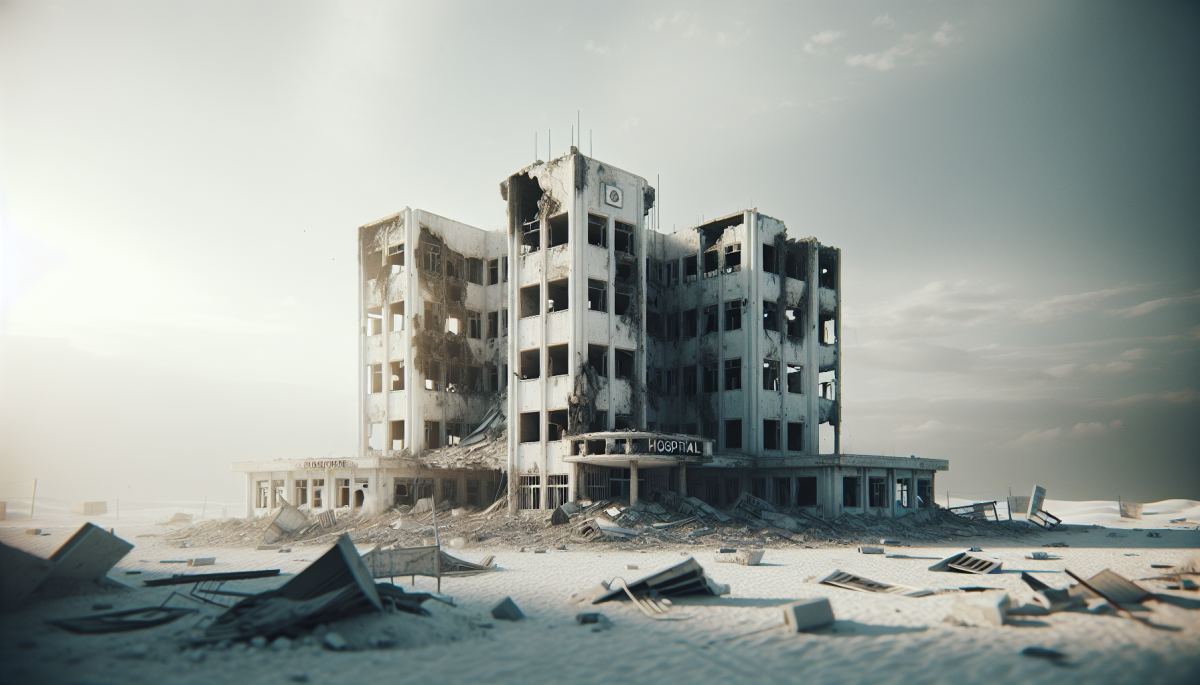
The WHO's own tracking data paints a grim picture. The organization's Surveillance System for Attacks on Health Care, known as SSA, has documented hundreds of attacks annually in conflict zones. In 2023 alone, the WHO verified over 1,700 attacks on health care across more than 20 countries. These are not accidents or collateral damage in any meaningful sense. Many follow recognizable patterns: repeated strikes on the same facilities, targeting of clearly marked ambulances, detention and killing of medical workers.
What makes this a systems problem rather than simply a legal one is the feedback loop it creates. When hospitals are destroyed and doctors flee, the health system of a conflict-affected population collapses. Preventable deaths from treatable conditions multiply. Trauma goes untreated. Infectious disease spreads. The civilian population becomes more desperate, more displaced, and more dependent on external aid, which is itself increasingly difficult to deliver safely. The destruction of healthcare is not just a humanitarian crime. It is a force multiplier for every other form of suffering in a war zone.
The second-order consequences extend beyond the immediate conflict. When medical workers are repeatedly targeted, the pipeline of people willing to serve in high-risk environments narrows. Organizations like MSF have faced a recruitment and retention challenge that rarely makes headlines but quietly erodes the global capacity to respond to future crises. The normalization of attacks on healthcare also degrades the broader architecture of international humanitarian law. Each unpunished violation makes the next one easier to justify, and harder to condemn with any credibility.
The joint call from the ICRC, WHO, and MSF is ultimately a demand for political will that the international system has so far been unable to summon. They are not asking for a new resolution. They are asking for the one that already exists to mean something. That distinction matters enormously. The problem is not a lack of rules. It is a lack of consequences for breaking them.
If the next decade looks like the last, the real casualty will not just be hospitals and health workers. It will be the idea that unanimous Security Council resolutions carry any weight at all.
References
- WHO (2024) — Surveillance System for Attacks on Health Care (SSA)
- UN Security Council (2016) — Resolution 2286 on the Protection of the Wounded, Sick and Medical Personnel in Armed Conflict
- MSF (2024) — Attacks on Healthcare
- ICRC (2024) — Health Care in Danger
- Rubenstein, L.S. (2020) — Perilous Medicine: The Struggle to Protect Health Care from the Violence of War



Discussion (0)
Be the first to comment.
Leave a comment