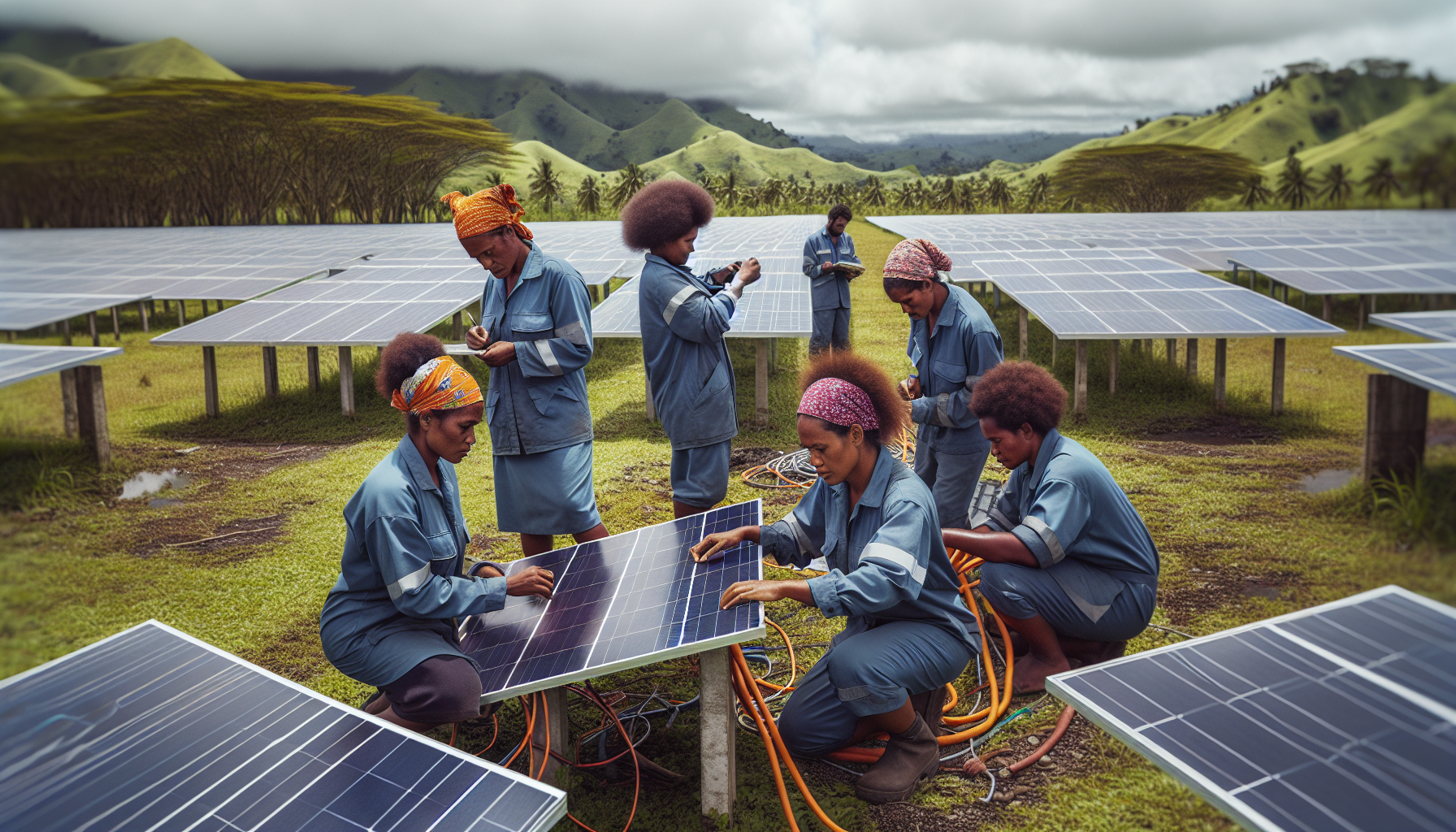
Vanuatu rarely makes international headlines unless a cyclone has just torn through it. The archipelago nation sits near the top of nearly every global climate vulnerability index, and the stories that filter out tend to follow a familiar script: disaster, aid, repeat. But something quieter and more durable is happening on the ground, and it is being driven not by foreign donors or government ministries but by women in communities that the national grid has never reached.
Off-grid solar adoption in rural Vanuatu has become one of the more striking examples of what energy access actually looks like when it is built from the community upward rather than the infrastructure downward. The country's terrain, a scattered chain of more than 80 islands, makes conventional grid extension not just expensive but functionally absurd for many settlements. That geographic reality has, paradoxically, created space for decentralised energy solutions to take root without competing against an incumbent system. Women in these communities have stepped into that space with considerable force.
To understand why this matters, it helps to understand what energy poverty actually costs at the household level. Without reliable light, children study by kerosene flame, which damages lungs and eyes. Without refrigeration, small food businesses spoil their stock. Without phone charging, women running micro-enterprises lose contact with suppliers and customers. The absence of electricity is not merely an inconvenience; it is a compounding tax on productivity, health, and economic participation that falls disproportionately on women because they spend more time in the home and are more likely to run the kinds of small-scale enterprises that depend on it.
When solar panels arrive in this context, the first-order effect is light and phone charging. But the second-order effects are where the real story lives. Women who can charge phones can use mobile money platforms. Women who can refrigerate goods can expand from subsistence to small commerce. Women who are no longer spending hours managing kerosene logistics have time that can be redirected. Energy access, in this framing, is not a welfare intervention. It is a productivity unlock.
What makes the Vanuatu case particularly instructive is that women have not simply been recipients of solar technology. They have been the organisers, the trainers, the fee collectors, and in many cases the technical maintainers of community solar systems. This is a meaningful distinction. Development projects that deliver hardware without building local ownership tend to produce what researchers sometimes call "solar graveyards": panels that work for two years and then sit broken because no one locally knows how to fix them and no one feels responsible for trying. When women are embedded in the system as stakeholders rather than beneficiaries, the maintenance culture changes.
Vanuatu's climate exposure makes the durability of these systems more than an economic question. Cyclone Harold, which struck in 2020 during the early weeks of the COVID-19 pandemic, demonstrated how quickly centralised infrastructure collapses under compound shocks. Communities with distributed solar assets and local technical knowledge recovered energy access faster than those dependent on grid restoration, which required external crews, imported equipment, and bureaucratic coordination across a disaster-stricken landscape.
This points toward a cascading consequence that extends well beyond Vanuatu's borders. As climate disruption intensifies across the Pacific and beyond, the question of which communities can maintain basic function after a major shock is increasingly a question of whether energy infrastructure is centralised or distributed, and whether technical knowledge lives in the community or outside it. The Vanuatu model, imperfect and still evolving, offers a data point that climate adaptation planners in other vulnerable nations would be unwise to ignore.
There is also a feedback loop worth watching. As women in these communities build reputations as energy managers and technical operators, they accumulate a form of social capital that tends to translate into broader decision-making authority. Energy access begets economic participation, which begets political voice, which shapes how future resources are allocated. The transformation is not linear and it is certainly not guaranteed, but the direction of travel in communities where women have led solar adoption appears to be toward greater female agency across multiple domains simultaneously.
The international climate conversation tends to treat Pacific island nations as symbols of what the world stands to lose. That framing, however emotionally resonant, flattens the agency of the people living inside it. What is happening in Vanuatu's off-grid communities is not a story about victimhood. It is a story about who gets to build the infrastructure of the future, and what happens when the answer turns out to be the people who needed it most.



Discussion (0)
Be the first to comment.
Leave a comment