
For decades, Saturn's magnetic field stood out as a quiet anomaly in planetary science. Unlike Earth's field, which tilts about 11 degrees off its rotational axis and produces a relatively predictable geometry, Saturn's appeared almost perfectly aligned with its spin axis yet somehow still asymmetrical in ways that defied easy explanation. Now, scientists working with data from NASA's Cassini spacecraft think they've cracked it, and the answer points to one of the solar system's most geologically active moons.
The research centers on a phenomenon called the cusp, a funnel-shaped region in a planet's magnetic field where solar wind particles can slip through and rain down into the upper atmosphere. On Earth, these cusps sit near the poles and are reasonably well-behaved. On Saturn, the cusp is consistently shifted to one side, creating a measurable skew in what should otherwise be a symmetric magnetic architecture. By combing through years of Cassini's magnetometer readings, scientists identified two compounding forces behind this distortion: Saturn's extraordinarily fast rotation, which completes a full day in roughly 10.5 hours, and a dense, persistent cloud of charged particles originating from Enceladus.
Enceladus, Saturn's sixth-largest moon, has been a source of scientific fascination since Cassini first photographed its towering geysers in 2005. Those plumes, erupting from fractures near the moon's south pole, spray water vapor and ice particles into space at roughly 1,400 kilometers per hour. A significant portion of that material gets ionized by solar radiation and trapped within Saturn's magnetic field, forming what scientists call a plasma torus, essentially a donut-shaped ring of charged particles orbiting the planet.
This plasma doesn't just sit passively. It interacts dynamically with Saturn's magnetic field, and because Saturn spins so fast, the field drags the plasma along with it. The combination of that rapid co-rotation and the sheer density of Enceladus-sourced material appears to push and warp the magnetic field's structure in a way that consistently displaces the cusp. The asymmetry isn't random noise. It's a predictable, repeating consequence of the moon's geological activity feeding into the planet's magnetosphere.
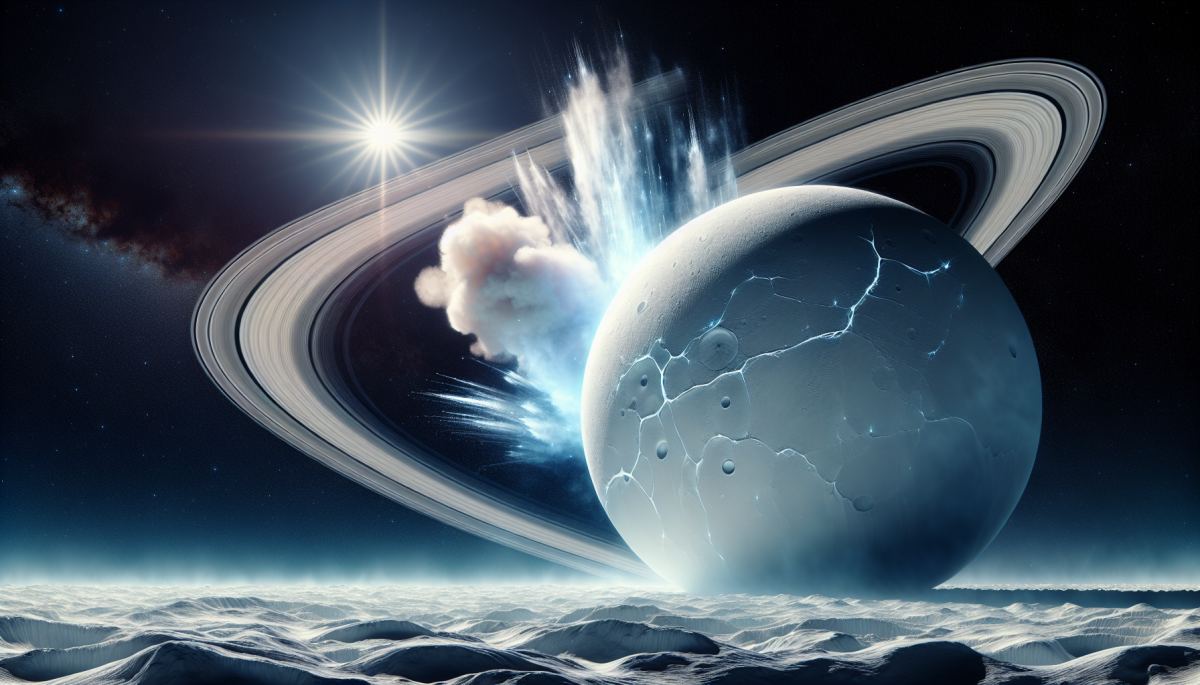
What makes this finding particularly significant is what it implies about the relationship between a moon's interior and a planet's space environment. Enceladus is thought to harbor a subsurface liquid water ocean, kept warm by tidal heating as Saturn's gravity kneads the moon's rocky core. That internal heat drives the geysers, which drive the plasma torus, which distorts the magnetic field of a planet 238,000 kilometers away. It's a cascade of consequences stretching from the ocean floor of a small icy moon to the outermost boundaries of Saturn's magnetosphere.
The Cassini mission ended in 2017 when NASA deliberately plunged the spacecraft into Saturn's atmosphere to avoid contaminating Enceladus or Titan with Earth microbes. But the data it collected continues to yield discoveries years later, a testament to both the mission's scientific depth and the complexity of the system it studied.
For planetary scientists, the Saturn finding carries implications that extend well beyond the ringed planet. Exoplanet research has increasingly focused on moons as potential habitats, and understanding how a geologically active moon can reshape an entire planetary magnetosphere matters for assessing habitability conditions. A distorted magnetic field changes how solar wind interacts with a planet's atmosphere, which in turn affects atmospheric retention over geological timescales. If a moon like Enceladus can produce this kind of structural influence at Saturn, similar dynamics could be operating around gas giants in other star systems, silently shaping whether those environments could sustain life.
There's also a subtler systems-thinking consequence worth watching. As scientists build more sophisticated models of magnetospheric dynamics, the Saturn case suggests that planetary magnetic fields should not be treated as isolated planetary properties. They are, at least in some cases, outputs of an entire moon-planet system, sensitive to the geological state of bodies that orbit within them. A moon going quiet, its geysers fading as its interior cools, could gradually allow a planet's magnetic field to relax back toward symmetry. Conversely, a moon becoming more active could amplify the distortion. Saturn's magnetic field, in other words, may be a real-time readout of Enceladus's interior, a remote sensor for an ocean we've never directly touched.




Discussion (0)
Be the first to comment.
Leave a comment