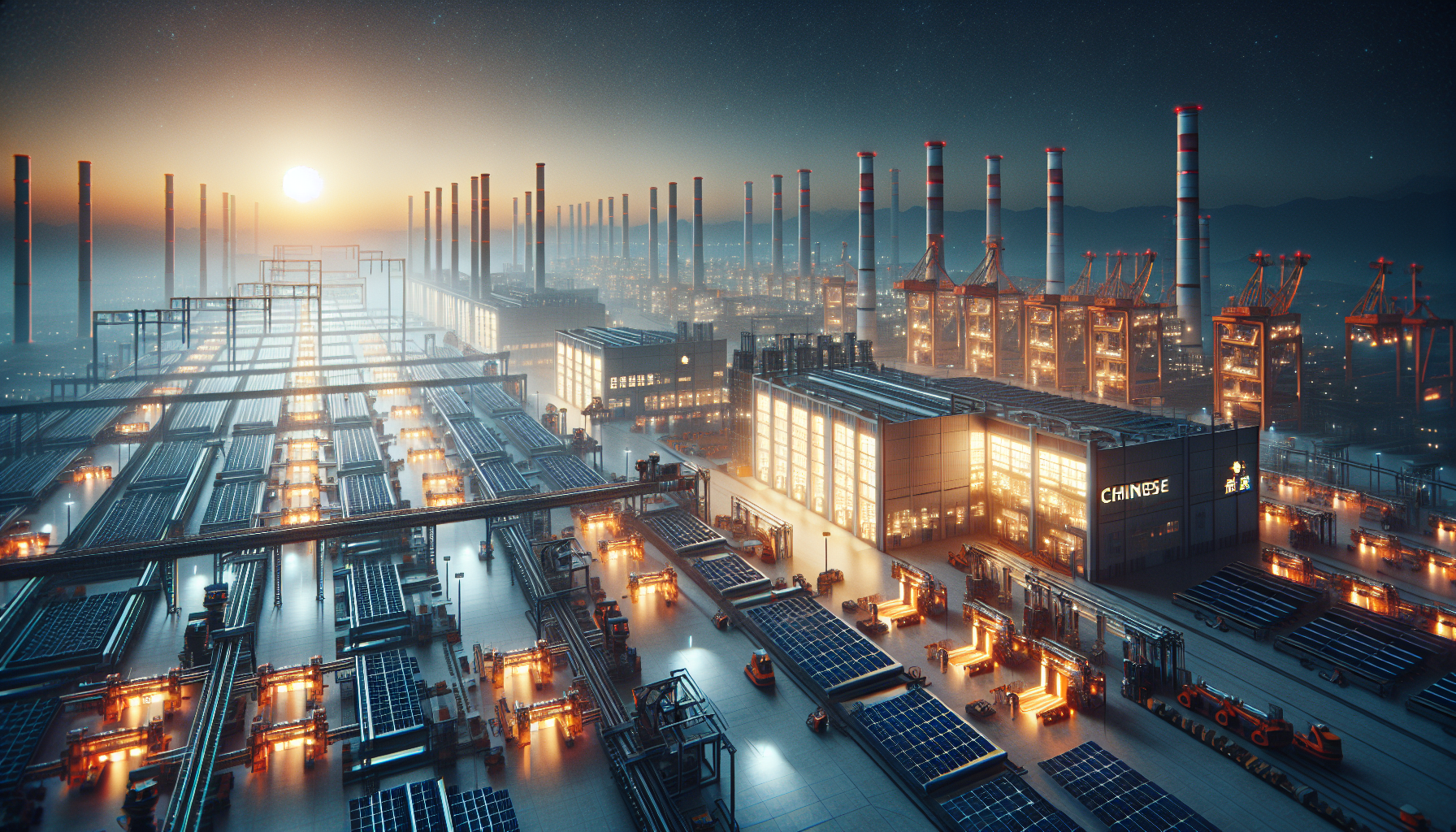
Elon Musk has never been shy about scale, but the numbers attached to Tesla's latest reported move are striking even by his standards. According to a Reuters exclusive, Tesla is in talks to purchase $2.9 billion worth of solar manufacturing equipment from Chinese suppliers as part of a plan to build 100 gigawatts of solar production capacity inside the United States. To put that figure in context, the entire U.S. solar manufacturing base currently produces a fraction of that output. If the deal closes, it would represent one of the most significant single commitments to domestic solar production in American history, and it would do so by routing billions of dollars through the very supply chain that U.S. trade policy has spent years trying to circumvent.
The timing carries its own irony. Tesla effectively shelved its solar ambitions around 2022 and 2023, quietly retreating from a business that had never quite found its footing after the controversial SolarCity acquisition. That deal, which cost Tesla roughly $2.6 billion in 2016, was widely criticized as a bailout of a Musk-affiliated company rather than a strategic masterstroke. Solar became the awkward stepchild of Tesla's energy division, overshadowed by the Powerwall and the far more profitable EV business. Now, less than two years after that retreat, the company is reportedly considering a capital commitment that exceeds the entire original SolarCity purchase price.
What makes this story genuinely complicated is the equipment sourcing itself. Chinese manufacturers dominate the global solar supply chain with a thoroughness that is difficult to overstate. Companies like LONGi, Jinko Solar, and their equipment suppliers have spent two decades building scale advantages that Western competitors have struggled to match. When Tesla reportedly turns to Chinese suppliers for $2.9 billion in manufacturing machinery, it is not making an ideological choice so much as a practical one: the tooling, the precision equipment, and the production expertise for utility-scale solar panel manufacturing are largely concentrated in China.
This creates a feedback loop that U.S. policymakers have been wrestling with since the Inflation Reduction Act passed in 2022. The IRA was designed to onshore clean energy manufacturing by offering generous tax credits for domestic production. It has succeeded in attracting announced investments worth hundreds of billions of dollars. But building a factory in Ohio or Texas still requires buying equipment from somewhere, and that somewhere is often Shenzhen or Suzhou. The law incentivizes where you manufacture, not where you source your capital equipment. Tesla's reported deal exposes that gap with unusual clarity.
There is also a geopolitical dimension that cannot be ignored. The Biden administration spent considerable energy restricting technology transfers and tightening export controls on semiconductors and advanced manufacturing tools flowing between the U.S. and China. The Trump administration has layered tariffs on top of tariffs targeting Chinese goods. Yet here is one of America's most prominent technology companies reportedly negotiating a multi-billion dollar equipment purchase from Chinese firms to build what would be framed as a triumph of American industrial policy. The contradiction is not lost on trade analysts, and it is unlikely to be lost on Capitol Hill.
If Tesla does complete this purchase and begins constructing 100 GW of U.S. solar manufacturing capacity, the downstream effects on the American energy landscape could be profound and not entirely predictable. A single company controlling that much panel production capacity would give Tesla extraordinary pricing power over the utility-scale solar market. Developers, utilities, and independent power producers that currently source panels from a diversified global supply chain would suddenly face a domestic supplier with significant leverage. That concentration of supply could lower costs in the short term through scale, but it introduces fragility of a different kind: single points of failure, potential for margin extraction once competitors are squeezed out, and a manufacturing base whose output is tied to the strategic decisions of one executive.
There is also the question of what this signals for Tesla's broader identity. The company has long insisted it is not just a car company but an energy company. The solar retreat made that claim harder to sustain. A $2.9 billion equipment commitment, whatever its complications, is a serious re-entry bid. Whether the manufacturing ambition translates into actual installed capacity, and whether that capacity reaches American rooftops and solar farms at competitive prices, will determine whether this moment is remembered as a turning point or another chapter in Tesla's long, uneven relationship with the sun.
The deeper question may be whether any company, however well-capitalized, can shortcut the decade-long process of building a competitive manufacturing ecosystem. China's solar dominance was not purchased in a single transaction. It was accumulated through sustained state support, workforce development, and iterative process improvement over a generation. Buying the equipment is the easy part.
References
- Reuters (2025) — Tesla in talks to buy $2.9 billion in Chinese solar equipment for U.S. push
- U.S. Department of Energy (2024) — Solar Manufacturing and the Supply Chain
- BloombergNEF (2024) — Global Solar Supply Chain Report
- Swanson, A. (2023) — How the Inflation Reduction Act Is Reshaping Clean Energy Manufacturing



Discussion (0)
Be the first to comment.
Leave a comment