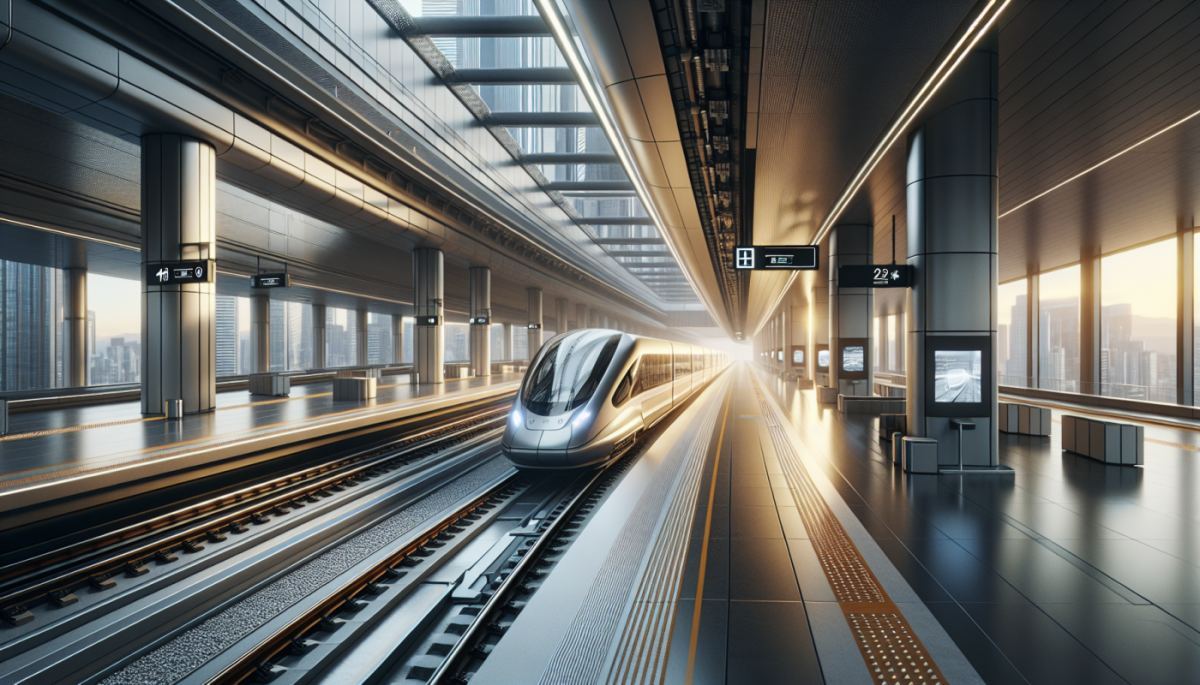
Every year, industry awards function as something more than a pat on the back. They act as a pressure gauge, revealing which technologies, companies, and ideas the sector has decided to bet on. The Railway Technology Excellence Awards 2025, whose winners have just been announced in a 60-plus page report, offer a rare window into the priorities shaping one of the world's most capital-intensive and infrastructure-dependent industries at a moment when rail is under enormous pressure to modernize, decarbonize, and compete.
Rail has been experiencing a quiet renaissance in policy circles. Governments across Europe, Asia, and increasingly North America have been pouring investment into rail networks as part of broader decarbonization strategies. The European Union's Fit for 55 package, for instance, explicitly targets a doubling of high-speed rail traffic by 2030. In the United States, the Bipartisan Infrastructure Law allocated $66 billion to passenger and freight rail, the largest such federal investment in the country's history. Against that backdrop, recognizing excellence in railway technology is not a ceremonial exercise. It reflects where billions of dollars in procurement decisions are likely to flow.
What makes awards like these analytically interesting is not the winners themselves but the categories they compete in. Railway technology has historically moved slowly, constrained by long asset lifecycles, safety regulations, and the sheer complexity of interoperability between national networks. A train bought today may still be running in 2055. That reality creates a peculiar tension: the industry must innovate rapidly enough to meet climate and capacity targets, while managing the risk that comes with deploying unproven technology on infrastructure where failures are measured in lives and economic disruption.
The technologies drawing the most attention in 2025 cluster around a few themes that have been building for years. Digital signaling, particularly the European Train Control System and its successors, promises to dramatically increase network capacity without laying a single new mile of track. Hydrogen and battery traction are advancing as credible alternatives to diesel on routes where electrification is not economically viable. Predictive maintenance, powered by sensor networks and machine learning, is beginning to shift rail operations from reactive to anticipatory, reducing both downtime and the kind of catastrophic failures that make headlines.
Each of these innovations carries second-order consequences that are easy to underestimate. Take digital signaling. Moving from fixed-block to moving-block systems means trains can run closer together, effectively multiplying capacity on congested corridors. But it also means that a cybersecurity breach or software failure can cascade across an entire network almost instantaneously. The more interconnected and software-dependent the system becomes, the more a single point of failure can propagate. Rail operators are, in effect, trading one category of physical risk for a new category of digital risk, and the regulatory frameworks governing that tradeoff are still catching up.
There is also a commercial logic to how these awards function within the industry ecosystem. For suppliers, winning or even being shortlisted in a recognized industry competition provides a form of third-party validation that accelerates procurement conversations. Rail operators, many of them public bodies spending taxpayer money, face intense scrutiny over purchasing decisions. An award from a credible industry publication reduces the perceived risk of choosing a newer or less established vendor, which in turn shapes which companies attract follow-on investment and which technologies achieve the scale needed to drive costs down.
This dynamic has a feedback loop quality to it. Recognition leads to contracts, contracts lead to deployment data, deployment data leads to further refinement and credibility, which leads to more recognition. The companies that win today are, in a meaningful sense, being handed an advantage in the competition to define what railway technology looks like in a decade.
What the 2025 awards ultimately reflect is an industry at an inflection point, one where the decisions being made now about signaling architecture, traction technology, and digital infrastructure will lock in operational realities for the next generation of passengers and freight customers. The full report, spanning more than 60 pages, is worth reading not just as a record of who won, but as a map of where the industry believes the future lies. Whether that future arrives on schedule, as any rail operator will tell you, is always the harder question.


Discussion (0)
Be the first to comment.
Leave a comment