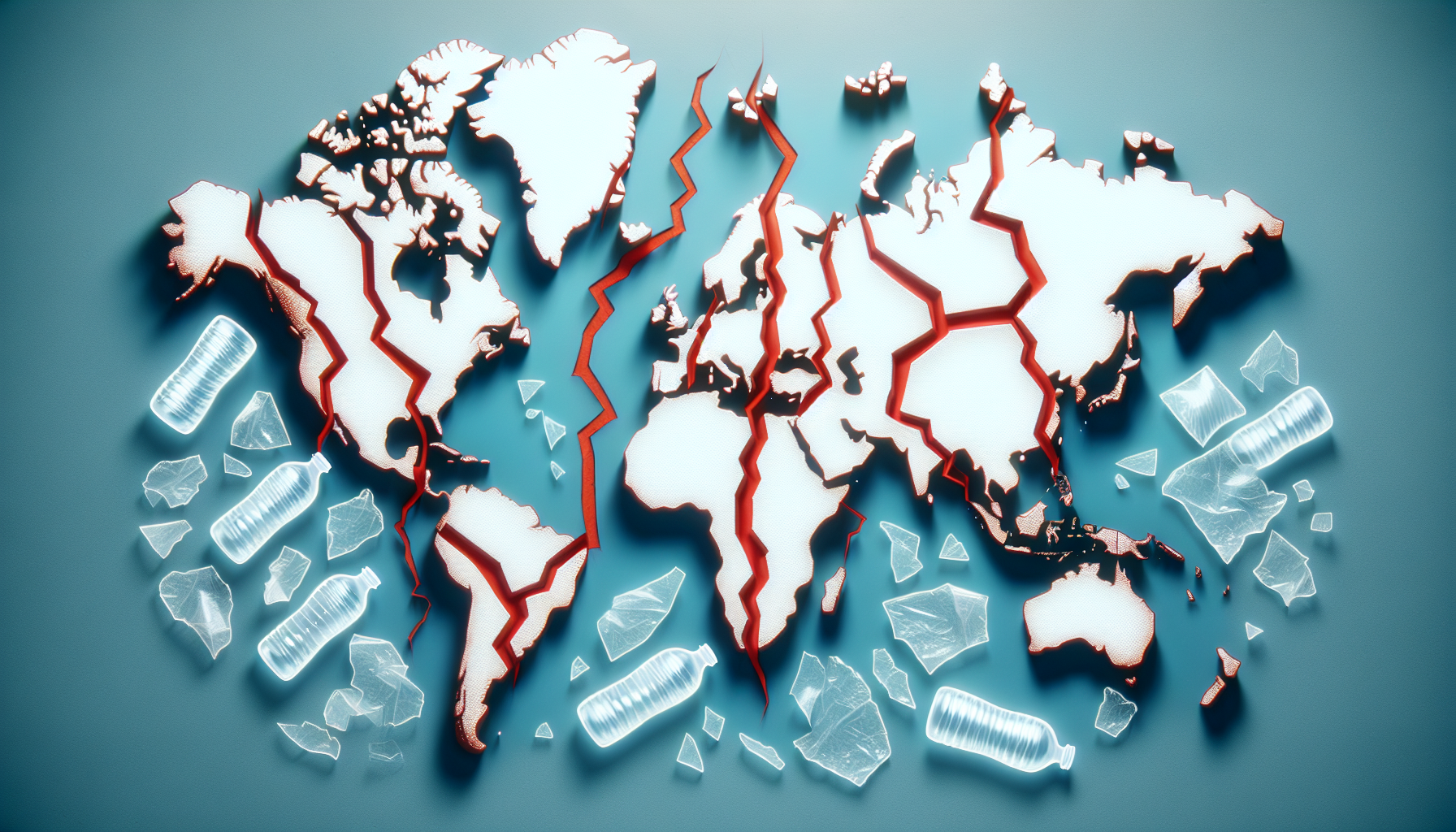
When negotiators gathered again this week for informal talks on a global plastics treaty, the room carried the familiar weight of a process that has repeatedly promised more than it has delivered. The United States moved quickly to signal its displeasure, pushing back against the European Union and Pacific island nations over proposals to cap or reduce plastic production itself. That single flashpoint reveals something much larger than a diplomatic disagreement: it exposes the structural tension at the heart of every serious attempt to regulate a material that has become inseparable from modern industrial capitalism.
The core dispute is not really about plastics. It is about whether international environmental law can reach upstream into production decisions, or whether it will be confined, as it so often has been, to managing waste after the damage is done. The EU and small island states, many of which are drowning in plastic debris they did not produce, are pushing for binding production limits. The United States, home to some of the world's largest petrochemical producers, is resisting that framing with considerable force. The argument from Washington tends to center on flexibility and national sovereignty, but the underlying logic is straightforward: American chemical and fossil fuel companies have invested billions in expanding plastic production capacity, and a treaty that constrains output would threaten returns on those investments directly.
Global plastic production has more than doubled since 2000, reaching roughly 400 million tonnes per year, and projections suggest it could triple by 2060 if current trends hold. The economics driving that growth are not accidental. As the energy transition accelerates and demand for fossil fuels in transport begins to plateau, petrochemical producers have identified plastics as the sector that will absorb the slack. Plastic is, in a very real sense, the oil industry's hedge against decarbonisation. That makes any treaty language targeting production not just an environmental question but an existential one for a significant slice of the global fossil fuel economy.
This is why the divisions in the negotiating room are so durable. Pacific island nations like Samoa and Vanuatu are not simply advocating for a cleaner ocean; they are asking the international community to accept a principle that would structurally disadvantage some of the most powerful industrial lobbies on earth. The EU, for its part, has its own complicated relationship with plastic production, but European industry has broadly accepted that tighter regulation is coming and has begun positioning accordingly, which gives Brussels more room to support ambitious treaty language without facing the same domestic political blowback Washington does.
The immediate risk of these divisions is a weak treaty, one that focuses on waste management and recycling infrastructure while leaving production growth untouched. That outcome would not be neutral. A treaty that legitimises the current production trajectory while creating the appearance of international action could actually accelerate harm by providing political cover for continued expansion. Governments and investors could point to the treaty as evidence that the problem is being addressed, reducing pressure for the more disruptive interventions that scientists say are necessary.
The second-order consequences extend further. If the talks collapse entirely, or produce an agreement so diluted it commands little respect, it would signal to the broader international community that the multilateral system cannot handle problems where powerful industrial interests are directly threatened. That lesson would reverberate well beyond plastics, shaping the political appetite for ambitious negotiations on chemicals, biodiversity, and even climate. The plastics treaty is, in this sense, a stress test for the entire architecture of global environmental governance.
There is also a justice dimension that rarely receives the attention it deserves. The communities bearing the sharpest costs of plastic pollution, coastal populations in the Global South, subsistence fishing communities, low-income urban neighbourhoods near waste sites, have the least leverage in negotiations dominated by wealthy industrial states. The presence of Pacific island delegations arguing for production cuts is a reminder that the treaty's ambition is not merely a technical question but a moral one about whose interests the international system is actually designed to protect.
The informal talks underway now are meant to narrow differences before the next formal session, but the gap between production-limit advocates and production-growth defenders is not the kind of distance that informal consultations typically close. It requires political decisions at the highest levels, and those decisions have not yet been made. Whether they will be made before the window for a meaningful treaty closes is the question that will define not just the fate of this negotiation, but the credibility of international environmental law for a generation.



Discussion (0)
Be the first to comment.
Leave a comment