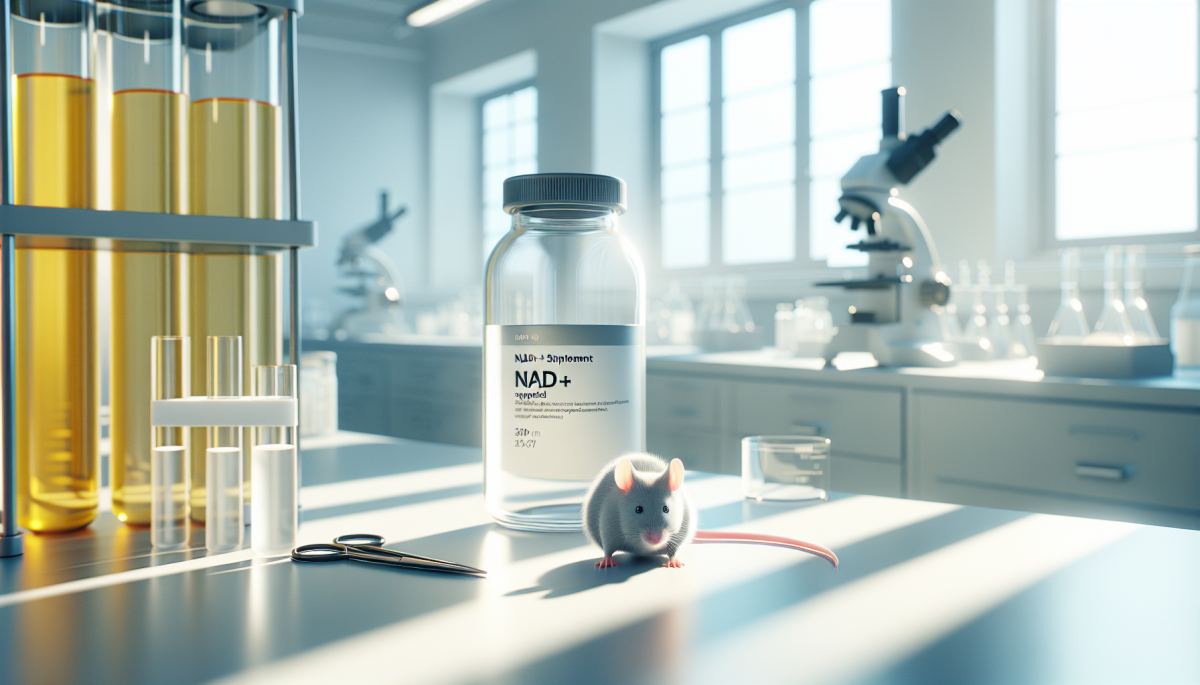
The biology of aging has a bookkeeping problem. Cells spend decades accumulating damage, and one of the clearest ledger entries is the steady decline of NAD+, a coenzyme so central to cellular energy metabolism that without adequate levels, mitochondria falter, DNA repair slows, and tissues begin to lose their structural integrity. Scientists have known about this decline for years, but a new study in mice suggests that the most effective way to address it may not be simply topping up NAD+ levels, but simultaneously plugging the drain through which it disappears.
The research combined two interventions: NMN, or nicotinamide mononucleotide, a precursor that the body converts into NAD+, and apigenin, a flavonoid found naturally in parsley, chamomile, and celery, which inhibits CD38, an enzyme that degrades NAD+ at an accelerating rate as organisms age. The dual approach restored measurable muscle function and bone structure in aged mice, outcomes that neither intervention achieved as effectively on its own. The logic is almost elegantly simple: if you are trying to fill a leaking bucket, you need to both add water and patch the hole.

NAD+ sits at the intersection of nearly every major cellular process that deteriorates with age. It is a substrate for sirtuins, a family of proteins that regulate gene expression, inflammation, and mitochondrial health. It feeds into PARP enzymes responsible for repairing broken DNA strands. When NAD+ levels drop, these systems do not simply slow down in isolation. They interact. Reduced sirtuin activity leads to greater inflammation, which in turn accelerates CD38 expression, which degrades more NAD+, which further suppresses sirtuin function. This is a feedback loop with no natural brake, and it helps explain why aging, once it gains momentum, tends to compound.
CD38 is particularly interesting because it is not just a passive bystander. Its expression is driven upward by chronic low-grade inflammation, sometimes called inflammaging, a condition that becomes nearly universal in older tissues. This means that simply supplementing NMN without addressing CD38 is fighting a battle on one front while losing ground on another. The apigenin component of this study targets that second front directly, and the combination results suggest the two-pronged approach produces effects that are more than additive.
Muscle and bone are not arbitrary endpoints to measure. Sarcopenia, the age-related loss of skeletal muscle mass and strength, is one of the leading contributors to frailty, falls, and loss of independence in older adults. Osteoporosis follows a similar trajectory, quietly reducing bone density until a minor fall becomes a catastrophic fracture. Both conditions are enormously costly to healthcare systems and deeply disruptive to individual lives, yet they remain poorly treated by existing pharmaceuticals.
The obvious caveat is that this is a mouse study, and the graveyard of interventions that worked brilliantly in rodents but failed in humans is long and well-documented. Mouse metabolism differs from human metabolism in ways that matter enormously for NAD+ biology, including lifespan, baseline NAD+ levels, and the relative activity of degradation pathways. What restores a two-year-old mouse to youthful function does not automatically translate to a seventy-year-old human.
That said, the mechanistic logic here is not speculative. Human trials of NMN have already shown that oral supplementation does raise blood NAD+ levels, and CD38 inhibition through dietary flavonoids is biologically plausible in humans as well. The question is not whether the pathway exists in people, but whether the magnitude of effect is clinically meaningful and whether the combination can be delivered safely at relevant doses over long periods.
The second-order consequence worth watching is what happens to the supplement industry and to clinical trial design if this dual-mechanism approach gains traction. NMN is already a multi-hundred-million-dollar market, largely built on single-compound logic. A validated combination strategy would pressure manufacturers to reformulate products, complicate regulatory classification, and potentially open the door to pharmaceutical interest in what has so far been a nutraceutical space. More importantly, it would shift how researchers think about aging interventions generally: not as single-target drugs, but as systems-level corrections that must address multiple nodes of a feedback network simultaneously.
The mice in this study did not know they were part of an experiment in systems biology. But the results suggest that aging, at least in part, is a problem of compounding loops rather than single broken parts, and that fixing it may require thinking the same way.
References
- Yoshino et al. (2018) — NAD+ Intermediates: The Biology and Therapeutic Potential of NMN and NR
- Camacho-Pereira et al. (2016) — CD38 Dictates Age-Related NAD Decline and Mitochondrial Dysfunction through an SIRT3-Dependent Mechanism
- Mills et al. (2016) — Long-Term Administration of Nicotinamide Mononucleotide Mitigates Age-Associated Physiological Decline in Mice
- Covarrubias et al. (2021) — NAD+ metabolism and its roles in cellular processes during ageing


Discussion (0)
Be the first to comment.
Leave a comment