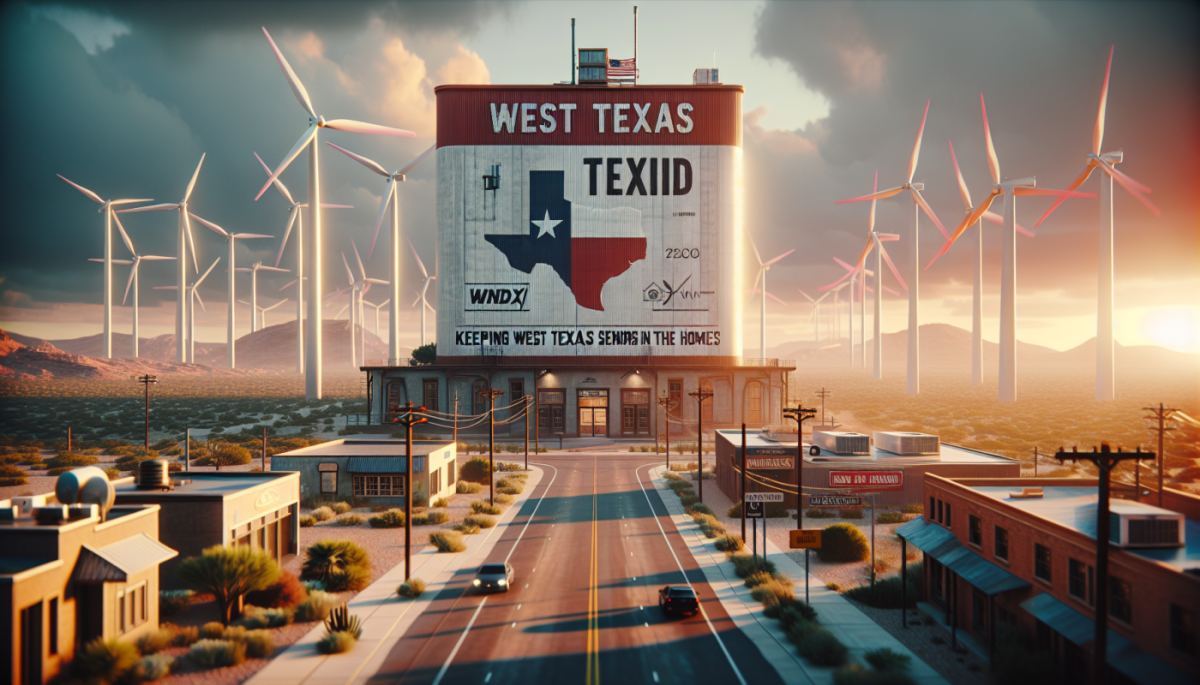
Crockett County, Texas, sits in a stretch of high desert where the wind blows hard and the population is thin. It is not the kind of place that typically attracts policy attention. But something quietly consequential has been happening there: local officials have figured out how to route revenue from wind energy leases into programs that help elderly residents stay in their homes rather than relocate to distant care facilities. The model is modest in scale but striking in its logic, and it points toward a broader question about who actually benefits when the American landscape is converted into an energy asset.
The county has used wind farm lease income to fund services for older residents, including home repairs, transportation assistance, and in-home care support. For a rural community where the nearest major city is hours away, these are not amenities. They are the difference between a person remaining in the community they have lived in for decades and being uprooted entirely. Aging in place, as health researchers have long documented, is associated with better mental health outcomes, stronger social connection, and lower overall healthcare costs. When counties can fund it locally, they are doing something that state and federal programs have struggled to accomplish at scale.
The financial mechanics here matter. Wind developers typically pay landowners and local governments through lease agreements and property tax arrangements. In sparsely populated counties with large tracts of open land, these payments can represent a meaningful share of the local budget. Crockett County covers more than 2,800 square miles and has a population of roughly 3,500 people, which means the per-capita land availability for wind development is enormous relative to more densely settled places. When a county that small captures even a fraction of the value generated by utility-scale wind, it can fund services that would otherwise require state appropriations or federal grants that may never arrive.
This is the kind of fiscal dynamic that gets lost in national conversations about the energy transition. The debate tends to focus on megawatts, grid reliability, and carbon reduction targets. Less attention goes to the distributional question: which communities capture local economic value from renewable infrastructure, and which simply host it while the financial returns flow elsewhere. Crockett County's approach suggests that with deliberate policy choices, rural governments can position themselves as genuine beneficiaries rather than passive backdrops for energy development.
The deeper consequence worth watching is demographic. Rural Texas, like much of rural America, has been losing working-age population for decades. Young people leave for cities; older residents remain. When the elderly population eventually declines through natural attrition and the services built around them disappear, the institutional knowledge, social fabric, and physical infrastructure of those communities can collapse in ways that are very difficult to reverse. Programs that help seniors age in place are, in a real sense, programs that buy time for rural communities to find a sustainable future.
There is also a feedback loop embedded in this story that deserves attention. Wind revenue funds elder care. Elder care keeps older residents in the community. Older residents sustain local businesses, churches, and civic organizations that would otherwise close. Those institutions make the community marginally more attractive to younger residents or returning adults. The loop is fragile and slow-moving, but it exists. Compare that to the alternative trajectory, where seniors leave, institutions close, tax base erodes, and the county becomes less capable of negotiating favorable terms with the next energy developer that comes through.
The risk, of course, is dependency. Wind lease revenue is not guaranteed in perpetuity. Turbines age, contracts expire, and energy markets shift. A county that builds its elder care infrastructure on a single revenue stream is exposed to the same vulnerability as a town that built itself around a single employer. The more durable version of this model would use wind revenue to seed endowments or diversified local funds rather than funding recurring services directly from annual lease payments.
What Crockett County has done is demonstrate that the geography of the energy transition can be made to serve the people who actually live in it. Whether that lesson travels beyond one windswept county in West Texas may depend less on policy than on whether other rural governments are paying close enough attention to notice.
Discussion (0)
Be the first to comment.
Leave a comment