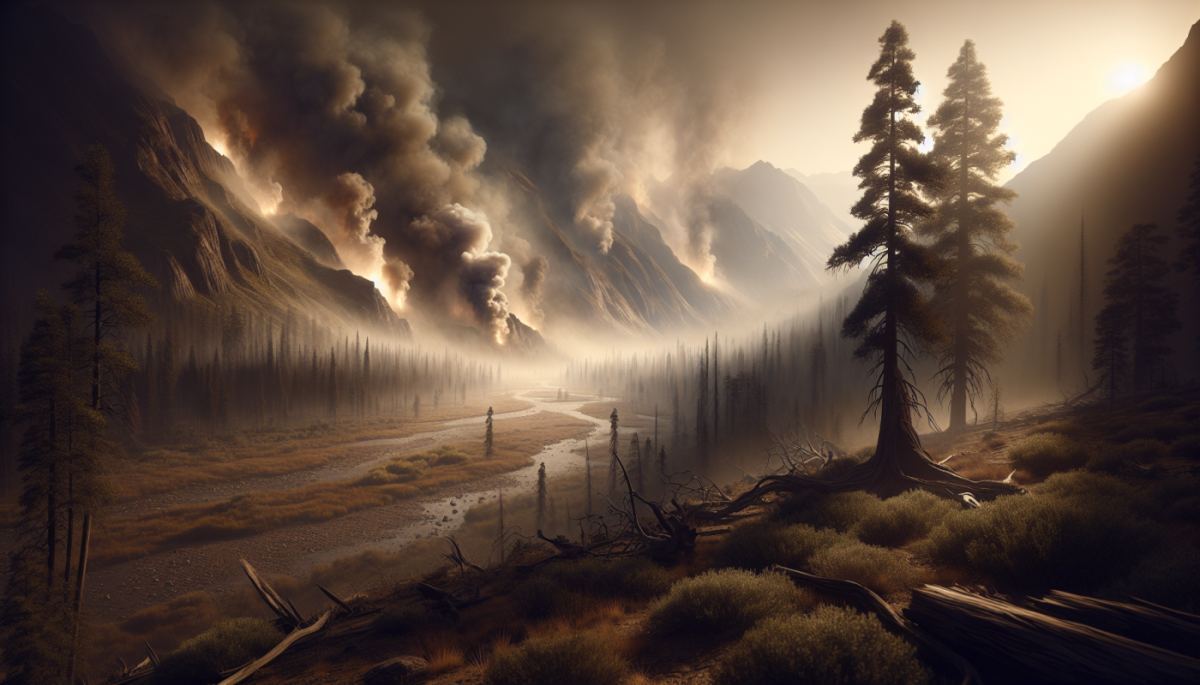
The numbers are grim, and they are getting harder to explain away. According to IQAir's latest annual World Air Quality Report, the vast majority of the world's population is breathing air that fails to meet the World Health Organization's safety guidelines for fine particulate matter, known as PM2.5. What makes this year's findings particularly striking is not just the scale of the problem but its shifting character: climate-driven events, specifically wildfires and dust storms, are increasingly responsible for pushing pollution levels into dangerous territory, even in places that had been making genuine progress on industrial emissions.
PM2.5 particles are small enough to penetrate deep into lung tissue and enter the bloodstream, and long-term exposure is linked to heart disease, stroke, lung cancer, and premature death. The WHO's guideline sets a safe annual average at 5 micrograms per cubic meter of air. Most of the world blows past that threshold by a wide margin. What IQAir's data reveals is that the sources driving those exceedances are becoming less predictable and less controllable through conventional regulatory tools.
For decades, the dominant story of air pollution has been one of industrial output: coal plants, vehicle exhaust, factory emissions. Governments built regulatory frameworks around those sources, and in many wealthy nations, those frameworks worked. Air quality in parts of Europe and North America improved substantially over the late 20th century. But wildfires do not respond to emissions standards. Dust storms do not care about catalytic converters.
The 2023 wildfire season was historically destructive. Canada alone burned through more than 18 million hectares, a record that shattered previous highs by an enormous margin. The smoke from those fires drifted south and east, blanketing major U.S. cities including New York and Washington D.C. in orange haze and pushing air quality indices into ranges typically associated with industrial catastrophe zones. For many urban residents who had grown accustomed to relatively clean air, it was a jarring and visceral introduction to what climate scientists had been warning about for years.

Dust storms, meanwhile, are intensifying across the Sahel, the Middle East, and Central Asia as desertification accelerates and vegetation cover thins. These events carry coarse and fine particulate matter across enormous distances, affecting populations thousands of miles from the source. The feedback loop here is particularly troubling: climate change drives drought, drought kills vegetation, bare soil generates more dust, and that dust, when it settles on snow and ice, accelerates melting by reducing surface reflectivity, which in turn warms the climate further.
The systemic consequence that most air quality policy frameworks are not built to handle is the convergence of these natural and anthropogenic sources. A city that has successfully reduced its industrial PM2.5 emissions by 40 percent over two decades can see all of that progress erased in a single wildfire week. That is not a hypothetical. It happened repeatedly across the western United States and Canada in 2023. The political and public health implications are significant: populations that believed they had solved their air quality problem are discovering that the solution was partial, and that the remaining risk is now largely outside local control.
This creates a perverse dynamic for policymakers. Investing in cleaner industry and transportation still matters enormously, but the return on that investment is increasingly being offset by climate-driven events that require a completely different set of interventions, things like forest management, international climate agreements, and early warning systems. The tools are not the same, the timelines are not the same, and the political constituencies are not the same.
There is also a justice dimension that the aggregate global numbers tend to obscure. The populations most exposed to wildfire smoke and dust storms are frequently those with the least access to healthcare, the least ability to stay indoors with filtered air, and the smallest contribution to the greenhouse gas emissions driving the underlying climate shifts. South Asia, Sub-Saharan Africa, and parts of Latin America consistently appear at the top of the worst-affected regions in IQAir's data, a pattern that reflects both geography and deep structural inequality in global development.
What the IQAir report ultimately signals is that air quality can no longer be treated as a local environmental management problem with local solutions. The atmosphere does not observe jurisdictional boundaries, and the forces now shaping it are planetary in scale. As wildfire seasons lengthen and dust-generating droughts deepen, the gap between what national regulators can control and what their populations actually breathe is likely to widen, making the political pressure to address root causes considerably more urgent than it has ever been.
References
- IQAir (2024) — 2023 World Air Quality Report
- WHO (2021) — WHO Global Air Quality Guidelines
- Natural Resources Canada (2023) — Canadian Wildfire Statistics
- NASA Earth Observatory (2023) — Wildfire Smoke and Air Quality
- Lelieveld et al. (2015) — The contribution of outdoor air pollution sources to premature mortality on a global scale
Discussion (0)
Be the first to comment.
Leave a comment