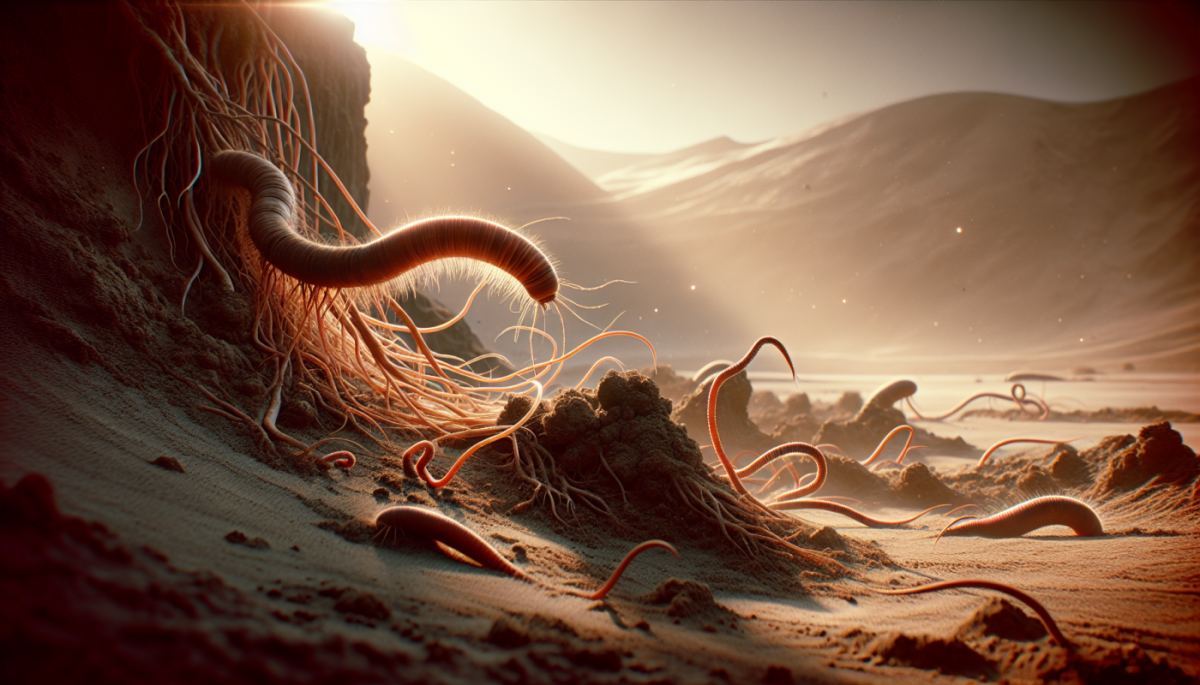
The Atacama Desert has long served as science's favorite stand-in for lifelessness. Stretching across northern Chile, it holds the distinction of being the driest non-polar desert on Earth, with some weather stations recording decades without measurable rainfall. Astrobiologists study it as a proxy for Mars. Photographers chase its alien landscapes. And for most of scientific history, the working assumption was that its soils were, at the microbial margins, essentially dead. That assumption is now crumbling.
A new wave of research into Atacama soil ecology has uncovered something genuinely startling: nematodes, the microscopic roundworms that form the backbone of soil food webs across the planet, are not merely present in the Atacama. They are thriving there in surprising diversity. Scientists examining soil samples across different elevations and moisture gradients found that these organisms have carved out niches even in the desert's most punishing zones, adapting their reproductive strategies and community structures to conditions that would obliterate most multicellular life.
What the research reveals is not a single story of survival but a layered one, shaped by two intersecting variables: moisture availability and altitude. Biodiversity among nematode communities increases meaningfully as moisture levels rise, which tracks with broader ecological theory. Wetter soils support more complex food webs, more bacterial biomass for nematodes to feed on, and more stable conditions for reproduction. But altitude adds a separate dimension, influencing which species dominate and how communities are structured, independent of moisture alone. The Atacama, in other words, is not a uniform wasteland. It is a mosaic of micro-environments, each hosting a distinct biological fingerprint.
Perhaps the most striking finding concerns reproduction. In the most extreme, hyper-arid zones of the desert, where liquid water is essentially absent and ultraviolet radiation is intense, many nematode populations appear to reproduce primarily through parthenogenesis, a form of asexual reproduction in which offspring develop from unfertilized eggs. This is not merely a curiosity. In evolutionary biology, asexual reproduction is often understood as a short-term survival strategy: it allows a single organism to colonize a new or hostile environment without needing a mate, and it can accelerate population recovery after a crash. The tradeoff is reduced genetic diversity, which makes populations more vulnerable to novel stressors over time. That these nematodes have leaned into that tradeoff suggests the environment is so hostile that the immediate cost of finding a mate outweighs the long-term genetic benefits of sexual reproduction.
The discovery carries implications that extend well beyond academic soil ecology. If life in one of Earth's most extreme environments is richer than previously believed, it forces a recalibration of how scientists model biodiversity in arid regions globally. Drylands cover roughly 41 percent of Earth's land surface and are home to more than two billion people. They are also expanding. Climate projections consistently show arid zones growing in extent and intensity across Africa, the Middle East, Central Asia, and the American Southwest. If those regions harbor hidden biological complexity similar to what has now been documented in the Atacama, the ecological losses from desertification may be far larger than current biodiversity accounting suggests.
There is a second-order consequence here that deserves attention. Nematodes are not passive residents of soil ecosystems. They are active regulators, cycling nutrients, controlling bacterial populations, and influencing the conditions that allow plants to establish themselves. In degraded or transitional dryland soils, nematode communities may represent a kind of biological infrastructure, invisible but load-bearing. If climate stress or land use change disrupts these communities before science has even catalogued them, the feedback effects on soil function could be significant and largely irreversible. We would be losing an engineer before we understood what it was building.
The Atacama findings also carry a quieter implication for astrobiology. If nematodes can persist in soils that mimic Martian surface conditions in temperature, aridity, and radiation exposure, the threshold for what counts as a habitable environment may need to be revised upward. Life, it turns out, is less interested in our definitions of the possible than in finding the next available foothold.
As climate models project the Atacama's hyper-arid core expanding in coming decades, the communities scientists are only now beginning to document may face pressures that their asexual reproductive strategies, however clever, were never designed to handle.
References
- Orgiazzi et al. (2016) — Global Soil Biodiversity Atlas
- Pointing & Belnap (2012) — Microbial colonization and controls in dryland systems
- Neilson et al. (2006) — Biodiversity of soil nematodes in the Atacama and Hyperarid Atacama Desert
- Dregne (2002) — Land Degradation in the Drylands
- Wharton (2002) — The Biology of Nematodes

Discussion (0)
Be the first to comment.
Leave a comment