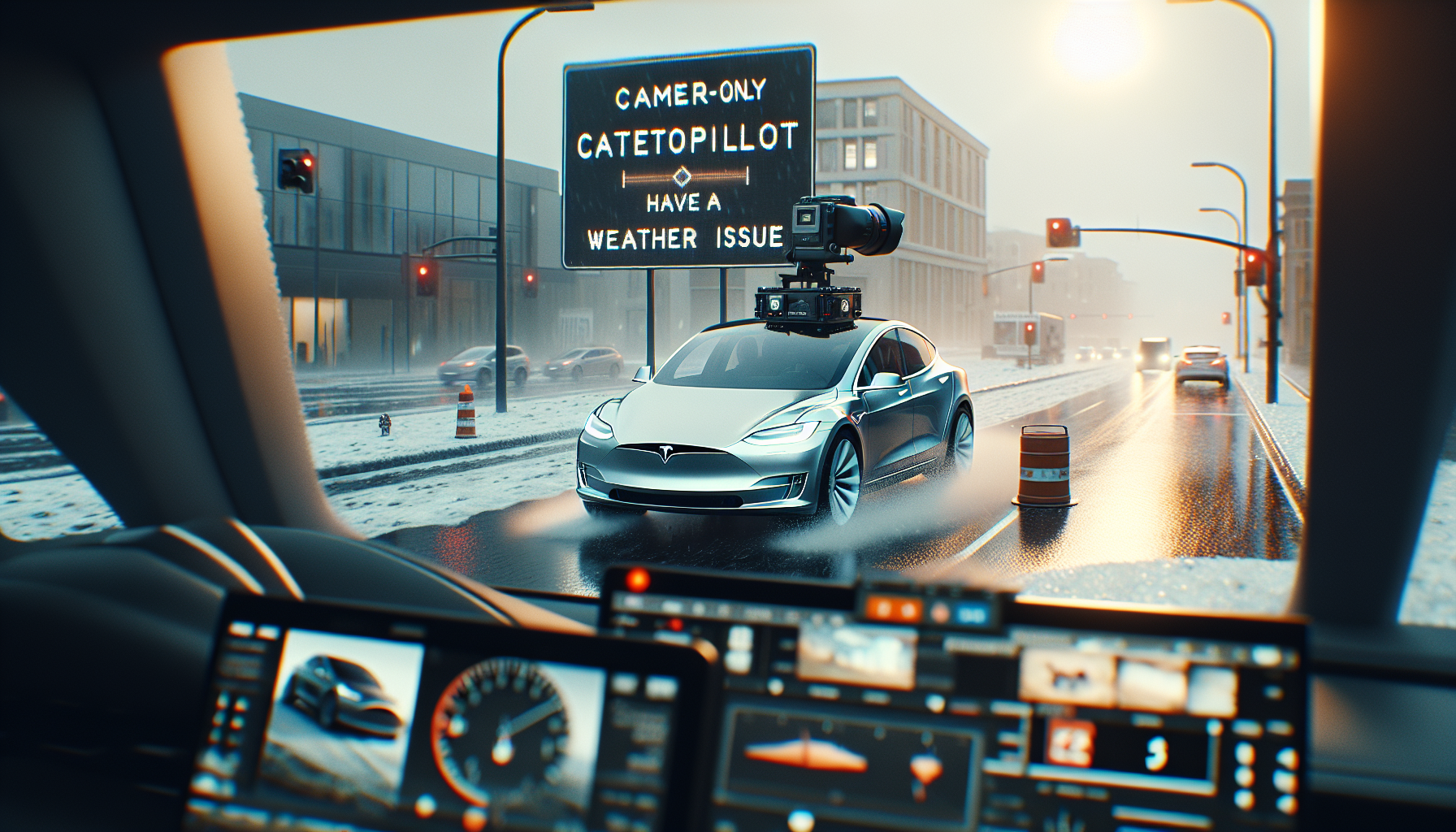
Tesla has spent years making a singular, high-stakes bet: that cameras alone, guided by neural networks powerful enough to mimic human vision, can safely navigate the full complexity of public roads. For a long time, that bet looked audacious but defensible. Now, as Full Self-Driving technology matures and more drivers lean on it in real-world conditions rather than ideal ones, a structural vulnerability is becoming harder to dismiss. Cameras, unlike radar or lidar, are fundamentally optical instruments. And optics fail in weather.
The issue is not new to engineers, but it is newly urgent for consumers. A Tesla Model 3 owner with more than six years of FSD experience recently surfaced what many in the autonomous vehicle research community have quietly acknowledged for years: precipitation, road spray, sun glare, and lens contamination can degrade or outright disable the camera array that Tesla's driver assistance system depends on entirely. When a camera is obscured, the system loses its eyes. There is no redundant sensor modality to fall back on, no radar return to confirm what the camera can no longer see. The car, in effect, goes partially blind.
This is not a fringe scenario. Rain, snow, and low-angle sunlight are not edge cases. They are routine conditions that drivers in most of the United States encounter for months out of every year. In states like Michigan, Minnesota, or upstate New York, winter driving means persistent snow, slush spray from other vehicles, and cameras that can ice over within minutes of highway travel. Tesla's decision to strip radar from its vehicles beginning in 2021, a move the company framed as a step toward a cleaner, more elegant vision-based architecture, now looks like a calculated gamble that removed a meaningful layer of redundancy precisely when the system needed it most.
Radar and lidar operate on wavelengths that pass through rain, fog, and light snow with far less interference than visible light. That is not a minor technical footnote. It is the reason virtually every other major autonomous vehicle program, from Waymo to GM's Cruise to virtually every robotaxi operator currently in commercial service, has retained multi-sensor fusion architectures. These systems use cameras for object classification and scene understanding, while radar or lidar provide reliable distance and velocity data even when optical sensors are compromised. Tesla's argument has always been that a sufficiently trained neural network can compensate for sensor limitations by learning from the vast fleet data its vehicles generate. The company has accumulated more real-world driving miles than any competitor, and that data advantage is genuine. But data cannot change physics. A camera covered in road grime or water droplets is not sending degraded data to the neural network. It is sending no useful data at all.
The deeper systems problem here is one of architecture lock-in. Tesla built its entire FSD value proposition around a camera-only stack, and that decision is now embedded in millions of vehicles already on the road. Retrofitting radar or lidar is not a software update. It requires hardware, which means the existing fleet cannot be upgraded. Every Model 3, Model Y, and Model S currently running FSD on a camera-only platform will carry this limitation for the life of the vehicle. That is not a bug that gets patched. It is a design constraint that compounds over time as consumer expectations for FSD reliability continue to rise.
The regulatory dimension of this problem deserves attention that it rarely receives. The National Highway Traffic Safety Administration has been investigating Tesla's driver assistance systems with increasing frequency, and the question of sensor adequacy in adverse weather is almost certain to become a formal point of scrutiny as FSD moves toward broader deployment. If regulators begin requiring minimum sensor redundancy standards for Level 3 or Level 4 autonomy, Tesla's camera-only architecture could face certification barriers that competitors with multi-sensor systems would not encounter. That would not just slow FSD's commercial rollout. It could reshape Tesla's competitive position in the autonomous vehicle market at exactly the moment when Waymo and others are beginning to scale.
There is also a quieter feedback loop worth watching. As more drivers encounter FSD limitations in bad weather and share those experiences publicly, the reputational cost of each incident compounds. Consumer trust in autonomous systems is fragile and asymmetric: it takes hundreds of successful miles to build and a single alarming failure to erode. Tesla's fleet size, which is its greatest data asset, also means its failures happen at scale and in public. The same visibility that accelerates learning also accelerates scrutiny.
The honest question facing Tesla is not whether cameras can eventually be good enough. They may well be. The question is whether the path to good enough runs through a period of meaningful risk that the company's current architecture cannot adequately contain, and whether drivers, regulators, and the broader public are being asked to absorb that risk without fully understanding it.
Discussion (0)
Be the first to comment.
Leave a comment