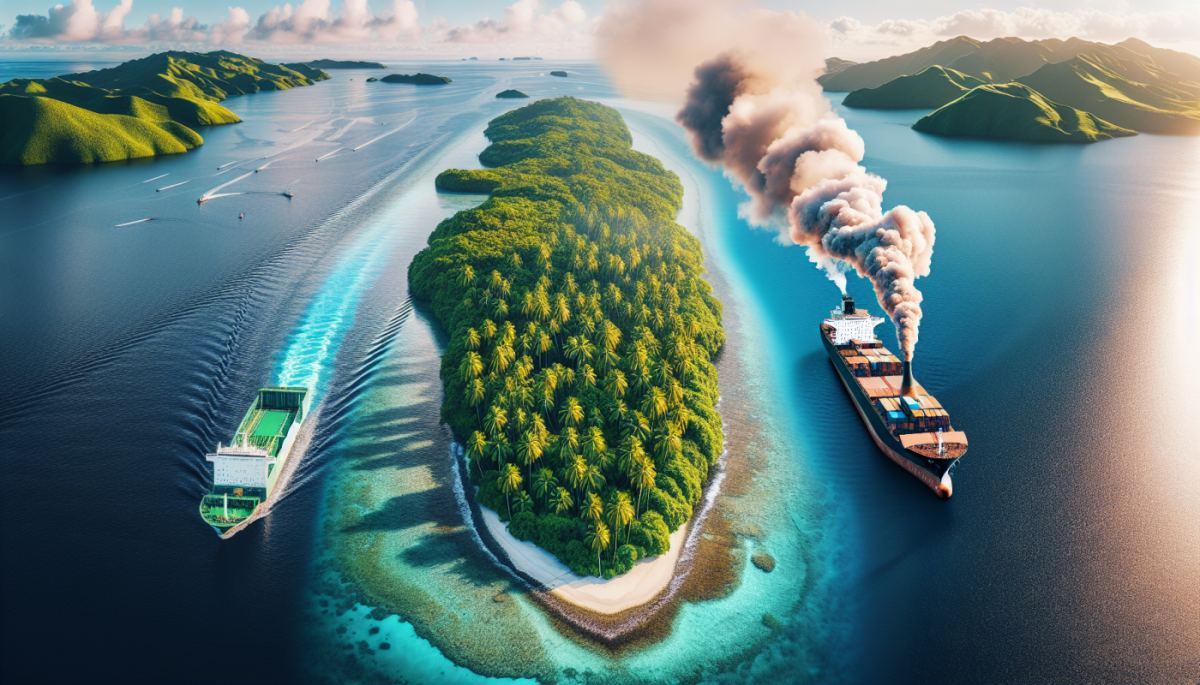
The International Maritime Organization's hard-won Net-Zero Framework, agreed after years of fractious negotiation, may not survive contact with the new Washington. Donald Trump's administration has made clear it wants to revisit the deal, pushing back against what it sees as economically punishing emissions charges on the global shipping industry. But the countries most exposed to the consequences of inaction, the low-lying Pacific island nations whose coastlines are already being swallowed by rising seas, are signalling that any reopening of talks will not be an opportunity for retreat. It will be an opportunity to push harder.
For Pacific delegations, the logic is straightforward and almost brutal in its clarity. They have already made concessions to reach the current framework. They accepted compromise language, diluted timelines, and emissions reduction targets that many of their own scientists and advocates considered insufficient. If the United States wants to tear up that agreement and start again, then the starting position for Pacific nations will not be the last deal. It will be something more ambitious. Higher levies on shipping emissions. Stronger enforcement mechanisms. Faster decarbonisation schedules. The message being sent to Washington and to the major shipping nations aligned with it is that the politics of reopening a negotiation cut both ways.
This is not simply a diplomatic posture. It reflects a genuine asymmetry of stakes that shapes every climate negotiation involving small island developing states. For a country like Tuvalu or Kiribati, the difference between 1.5 degrees of warming and 2 degrees is not an abstraction debated in think-tank papers. It is the difference between a homeland and a memory. Shipping accounts for roughly 3 percent of global greenhouse gas emissions, a share that, if the industry were a country, would make it one of the world's larger emitters. The IMO framework was designed to put that trajectory on a path toward net zero by or around 2050, with interim targets and a levy mechanism intended to make carbon-intensive fuels progressively more expensive relative to cleaner alternatives.
The uncomfortable reality for Pacific nations is that their moral authority in these negotiations has never been matched by structural power. The countries that move the most tonnage, flag the most vessels, and finance the most shipbuilding hold the votes and the economic leverage that ultimately shapes IMO outcomes. The United States, despite not being the dominant shipping nation it once was, carries enormous geopolitical weight inside multilateral institutions. When Washington signals displeasure with a framework, other nations recalibrate.
What Pacific island states are attempting is a form of negotiating judo, using the threat of a more demanding counter-proposal to raise the cost of reopening talks in the first place. The calculation is that if the Trump administration and its allies genuinely want a weaker deal, they will have to fight for it against a bloc of nations who will demand a stronger one, turning any renegotiation into a prolonged and politically costly process rather than a quick administrative reversal. Whether that strategy holds depends on how many other countries, particularly the European Union and climate-aligned middle powers, are willing to stand with the Pacific bloc rather than quietly accommodating American pressure.
The second-order effects of a weakened or collapsed IMO framework extend well beyond the Pacific. The shipping industry is in the middle of a generational investment cycle. Decisions being made right now about vessel design, fuel systems, and port infrastructure will lock in emissions profiles for the next two to three decades. Regulatory certainty, even imperfect regulatory certainty, is what allows shipowners and fuel producers to commit capital to green methanol, ammonia, and other low-emission alternatives. If the IMO framework unravels or is significantly diluted, that investment signal weakens. Projects stall. The window for an orderly transition narrows, and the eventual adjustment, when physical climate impacts make inaction untenable, becomes sharper and more disruptive.
There is also a precedent effect that worries climate diplomats more broadly. The IMO framework was one of the few recent examples of a genuinely global sectoral agreement on emissions. If it can be unpicked under political pressure from a single powerful government, it raises questions about the durability of every other multilateral climate commitment. The Paris Agreement's architecture depends partly on the assumption that sectoral deals can hold even when political winds shift.
What happens next at the IMO will be a test not just of shipping policy but of whether multilateral climate governance retains any structural resilience when the world's largest economy decides it would prefer a different answer. Pacific nations, with everything to lose, are betting that the cost of dismantling the deal can be made high enough to deter the attempt. It is a wager placed by people who have no safer option.
Discussion (0)
Be the first to comment.
Leave a comment