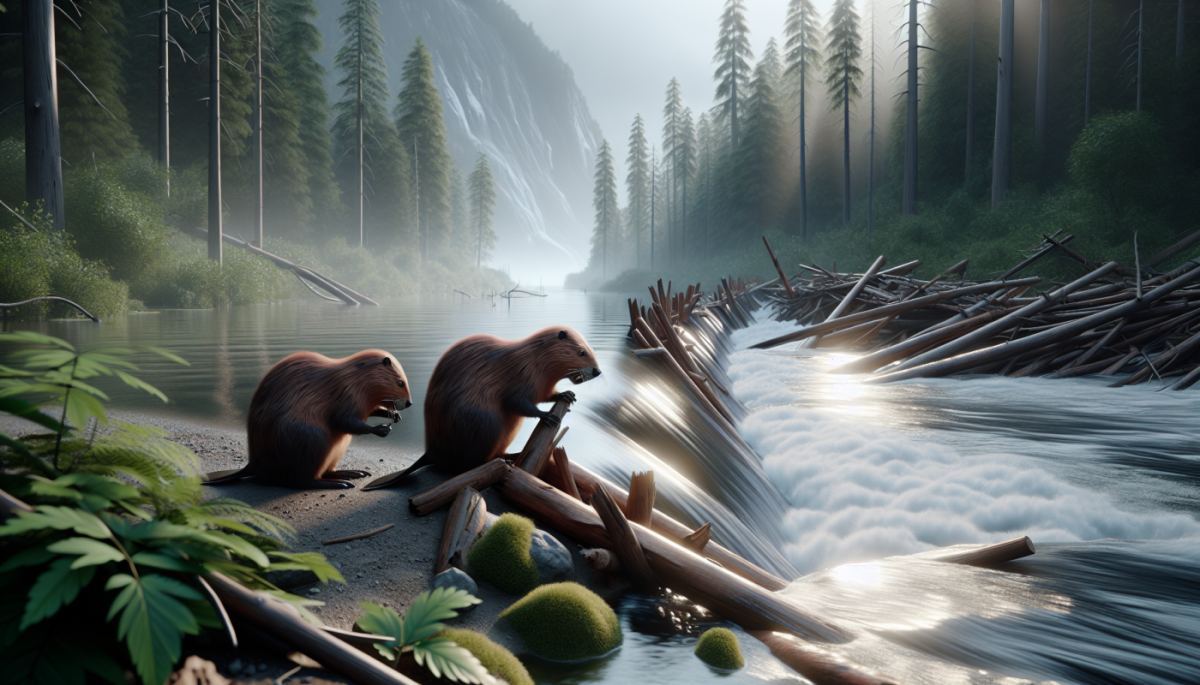
A single beaver colony in Switzerland spent 13 years doing what no carbon offset scheme, reforestation initiative, or government subsidy could replicate at the same cost: it turned a modest stretch of stream into a wetland that locked away over a thousand tonnes of carbon. That figure, drawn from new research into beaver-engineered landscapes, is not just impressive on its own terms. It is roughly ten times the carbon storage achieved by comparable areas without beaver activity. For a planet still struggling to find scalable, affordable climate solutions, that gap deserves serious attention.
Beavers are, at their core, hydrological engineers. When they build dams, they do not simply slow water down. They fundamentally reorganize the relationship between a landscape and its water table. Streams back up into ponds. Floodplains saturate. Soils that were once dry and aerobic, meaning they released carbon dioxide through microbial decomposition, become waterlogged and anaerobic. In that oxygen-poor environment, organic matter breaks down far more slowly. Carbon that would otherwise escape into the atmosphere instead accumulates in sediment, in peat, in the dense mat of decaying plant material that builds up over years and decades beneath the water's surface. The beaver does not intend any of this. It is simply trying to build a home. The carbon sequestration is a byproduct, and a staggering one.

What makes beaver wetlands particularly interesting from a systems perspective is the self-reinforcing nature of the process. As a beaver pond matures, it attracts more vegetation, which produces more organic matter, which sinks and adds to the carbon store, which deepens the anaerobic layer, which further slows decomposition. The system feeds itself. This is not a linear intervention like planting trees, where you put carbon in and hope it stays. It is a dynamic, self-sustaining feedback loop that compounds over time, provided the beavers remain and the dam holds.
That durability matters enormously. One of the persistent criticisms of nature-based carbon solutions is that they are fragile. Forests burn. Restored grasslands get plowed. But beaver wetlands, once established, tend to be resilient. The animals actively maintain their infrastructure, repairing dams after floods and expanding their pond systems as resources allow. In regions where beavers were hunted to local extinction and are now being reintroduced, as is happening across parts of the United Kingdom, Scotland, and continental Europe, the ecological memory of these landscapes can reassert itself with surprising speed.
Europe's beaver population was reduced to fewer than 1,200 individuals by the early 20th century, the result of centuries of hunting for fur, castoreum, and meat. Since legal protections were introduced and reintroduction programs began, numbers have rebounded to an estimated 1.5 million across the continent. Each new colony is, in effect, a small carbon project that requires no management budget, no verification audits, and no corporate sponsor.
The second-order consequences of taking beaver-led carbon storage seriously could ripple well beyond conservation policy. If wetland carbon accounting were formally integrated into national greenhouse gas inventories, countries with recovering beaver populations would have a measurable, nature-driven asset on their climate balance sheets. That could shift the political economy of reintroduction debates, which have historically been dominated by conflicts with farmers and landowners worried about flooding and crop damage. When a beaver colony becomes a quantifiable carbon sink rather than just an ecological curiosity, the cost-benefit calculation for tolerating or even encouraging their presence changes.
There is also a harder question lurking here about what we choose to value and how late we are in asking it. Beavers were reshaping watersheds and building carbon stores for millions of years before humans arrived to drain wetlands, straighten rivers, and pave floodplains. The landscapes that remain are impoverished versions of what once existed. The Switzerland study is not really a discovery about beavers. It is a measurement of what we lost.
As climate policy increasingly turns toward natural carbon removal, the beaver offers a rare combination: a solution that is self-deploying, self-maintaining, and ecologically generative all at once. The more interesting question now is not whether beavers can help, but whether the institutions designed to fight climate change are flexible enough to let a rodent lead.

Discussion (0)
Be the first to comment.
Leave a comment