
There is something quietly paradoxical about flying thousands of miles to stand on a glacier. The carbon burned to get there accelerates the very melting that makes the visit feel urgent. And yet glacier tourism is growing, driven by a phenomenon researchers have started calling "last chance tourism" — the impulse to witness something before it vanishes forever. The ice is retreating. The crowds are arriving. And the two facts are not unrelated.
Glaciers that were once remote, inaccessible features of the high-altitude world have become bucket-list destinations. In Iceland, the Vatnajökull ice cap draws hundreds of thousands of visitors annually. In Patagonia, the Perito Moreno glacier in Argentina has become one of South America's most visited natural sites. In Alaska, cruise ships deposit passengers at the foot of tidewater glaciers that are visibly smaller than they were a decade ago. The tourism industry has built infrastructure — walkways, viewing platforms, guided ice-climbing experiences — around landscapes that are actively collapsing. It is, in the most literal sense, building on melting ground.
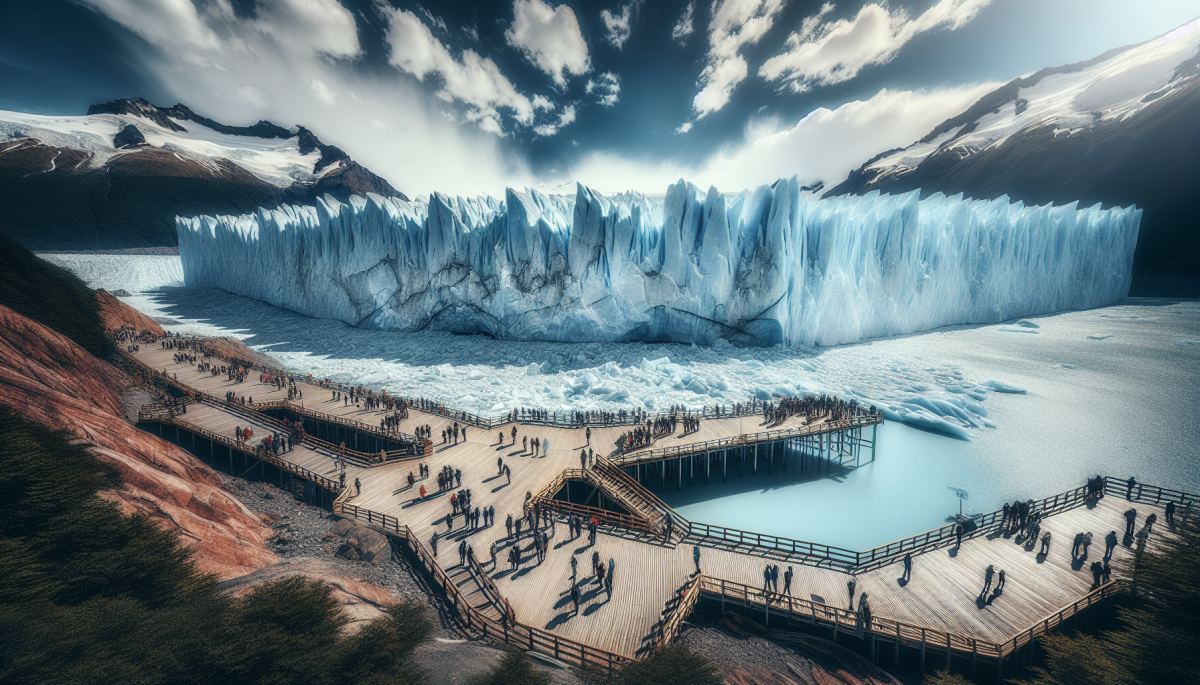
The appeal is understandable. Glaciers are among the most visually arresting environments on Earth, and the knowledge that they are disappearing gives a visit an emotional weight that a trip to, say, a stable mountain range simply cannot match. A 2011 study in the journal Tourism Geographies helped formalize the concept of last-chance tourism, noting that operators were explicitly marketing the impermanence of destinations as a selling point. "See it before it's gone" is not just a tagline — it is a business model.
The systems problem here is not subtle. Long-haul air travel is one of the most carbon-intensive activities an individual can undertake, and aviation accounts for roughly 2.5 percent of global CO2 emissions — a figure that climbs considerably when non-CO2 warming effects like contrail formation are included, according to research published by the International Council on Clean Transportation. Every flight to Reykjavik or Queenstown or Anchorage adds incrementally to the atmospheric warming that is shrinking the very ice people came to see. The feedback loop is almost elegant in its cruelty: the more people want to see glaciers before they disappear, the faster the glaciers disappear.
Beyond the carbon math, physical visitation carries its own costs. Foot traffic on glacial surfaces can accelerate surface melting through the darkening effect of deposited particulates — dust, soot, and organic material carried in on boots and gear. Helicopter tours, popular at destinations like Franz Josef Glacier in New Zealand, deposit exhaust directly into high-altitude glacial environments. The infrastructure built to accommodate tourists — roads, lodges, parking areas — fragments the surrounding ecosystems and introduces heat-absorbing surfaces into landscapes that depend on reflectivity to stay cold.
Local economies, of course, have become deeply dependent on this traffic. In communities near major glaciers, tourism revenue funds schools, hospitals, and public services. Telling those communities to simply stop is not a policy — it is a wish. The incentive structures are locked in, and the people most economically exposed to the loss of glaciers are often the same people most economically dependent on visitors coming to see them.
The second-order consequences of glacier retreat extend well beyond tourism economics. Glaciers serve as freshwater reservoirs for hundreds of millions of people across Asia, South America, and the American West. As they shrink, the seasonal meltwater pulses that feed rivers and irrigation systems become erratic and eventually insufficient. The Intergovernmental Panel on Climate Change has documented this risk extensively, warning that "peak water" — the point at which glacial melt contribution to river systems begins to decline — has already been reached in some regions.
What glacier tourism rarely confronts is this downstream reality. The experience is framed as aesthetic and personal — a communion with wild nature — rather than as a visit to critical infrastructure that is failing. A traveler standing on the Athabasca Glacier in Canada's Columbia Icefield is standing on a water source for prairie rivers that stretch thousands of miles south. The interpretive signs note the glacier's retreat. They are less likely to note that farmers in Alberta are already adjusting to reduced summer flows.
The tourism industry will eventually be forced to reckon with a world in which the product it is selling no longer exists. Some operators are already pivoting — offering "glacier memory" experiences at sites where ice has already vanished, or reframing visits around climate education rather than spectacle. Whether that pivot happens fast enough to matter is an open question. What seems more certain is that the generation of travelers currently booking glacier trips may be among the last to have the option, and the choices they make about how to get there will help determine how quickly that window closes.
References
- Piggott-McKellar et al. (2019) — Last chance tourism and the climate crisis
- Lee et al. (2021) — Contribution of aviation to climate change
- IPCC (2019) — Special Report on the Ocean and Cryosphere in a Changing Climate
- Dawson et al. (2011) — Last-chance tourism: The boom, doom, and gloom of visiting vanishing destinations

Discussion (0)
Be the first to comment.
Leave a comment