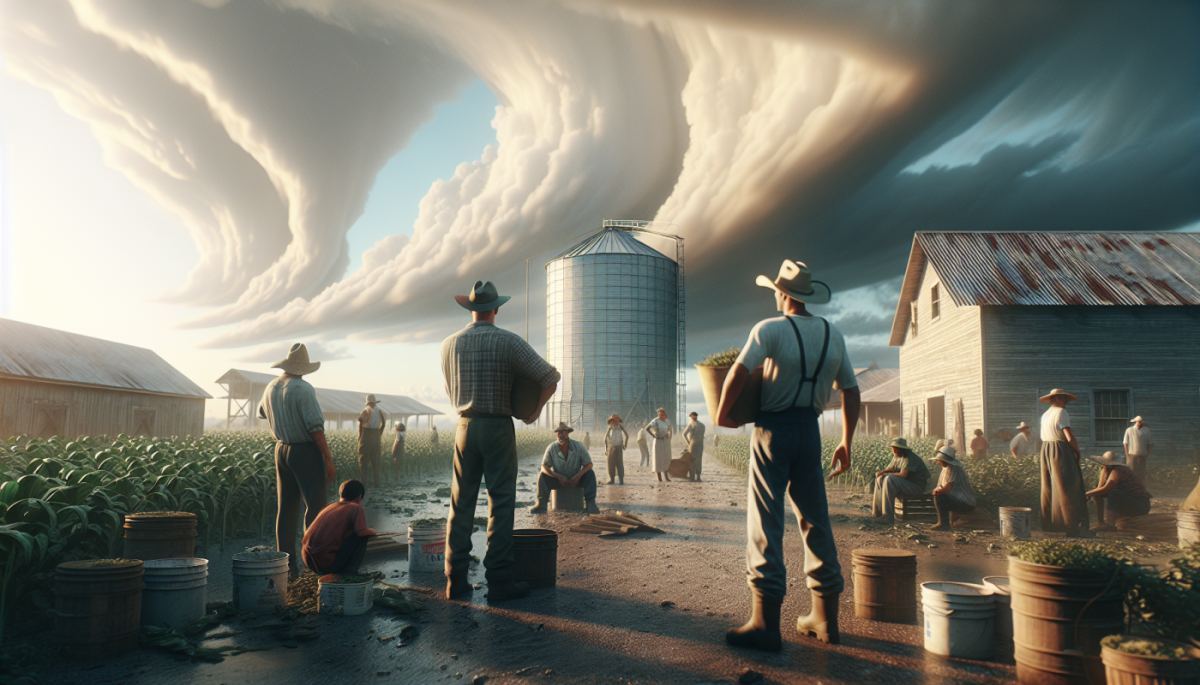
When Hurricane Helene tore through Georgia's agricultural heartland in the fall of 2024, it didn't just flatten crops. It exposed the structural fragility of a federal disaster relief architecture that was never designed to move at the speed of a farming calendar. Months later, as planting seasons turned and financial pressure mounted, the relief that growers desperately needed is finally arriving — but the delay itself tells a story worth examining.
Georgia's agricultural economy is one of the most diverse in the American South, anchored by pecans, blueberries, cotton, peanuts, and poultry. Helene struck at harvest time, which agronomists and farmers alike will tell you is the worst possible moment. Crops that had absorbed an entire season's worth of labor, water, and input costs were either destroyed outright or rendered unmarketable. The losses were described by state officials and agricultural groups as "once-in-a-generation" — a phrase that carries particular weight in Georgia, because the state used it once before, after Hurricane Michael devastated the same farming communities in 2018.
That repetition is not incidental. It is the central tension of this story.
The relief now reaching Georgia farmers flows primarily through the Emergency Relief Program, a federal mechanism administered by the U.S. Department of Agriculture's Farm Service Agency. ERP was designed as a backstop for exactly these kinds of catastrophic, widespread losses that standard crop insurance doesn't fully cover. The problem is that the program requires congressional authorization and USDA rulemaking before funds can move, and that process takes time that farmers, operating on thin margins and borrowed capital, often don't have.
What made Helene's damage particularly complicated was the nature of Georgia's signature crops. Pecans, for instance, are a perennial tree crop with a production cycle measured in decades, not seasons. When a storm knocks out a mature pecan orchard, a farmer isn't just losing this year's harvest — they're potentially losing ten or fifteen years of future income while replacement trees mature. Standard commodity programs aren't calibrated for that kind of loss, which is why Georgia's congressional delegation and state agriculture officials pushed hard for a tailored approach. The same fight had to be waged after Michael in 2018, and the fact that it had to be waged again after Helene in 2024 suggests the policy architecture hasn't kept pace with the new climate reality.
Federal crop insurance, the first line of defense for most growers, covers a meaningful share of losses for row crops like cotton and peanuts. But coverage gaps widen significantly for specialty crops, and they widen further when infrastructure damage — irrigation systems, storage facilities, farm roads — compounds the direct crop losses. Helene delivered all of the above.
The months-long lag between disaster and disbursement carries consequences that don't show up in the relief program's final accounting. Farmers who can't access capital quickly enough make decisions under duress: they sell equipment, draw down savings, take on high-interest operating loans, or in the hardest cases, begin the process of exiting farming altogether. Each of those decisions reshapes the agricultural landscape in ways that persist long after the disaster headlines fade.
There is a feedback loop embedded in this system that deserves attention. When experienced farmers exit after a disaster, the institutional knowledge they carry — about local soil conditions, pest pressures, water management — exits with them. Younger or less capitalized farmers who might otherwise enter the sector look at the recovery timeline and recalibrate their risk assessment. Over time, repeated disaster cycles without rapid relief can quietly consolidate farmland into fewer, larger operations that have the balance sheets to absorb the waiting period. That consolidation, in turn, reduces the agricultural diversity that makes regional food systems more resilient to the next shock.
Georgia officials and farm groups have been vocal about the need for faster-moving federal mechanisms, and there is growing bipartisan recognition in Congress that the current timeline is untenable. Whether that recognition translates into structural reform — pre-authorized funding pools, streamlined damage assessment protocols, or standing specialty crop provisions — remains the open question.
Hurricane season begins again in June. Georgia's farmers, many of them still rebuilding from Helene, will be watching the Atlantic with the particular attention of people who have learned that "once-in-a-generation" is no longer a reliable unit of measurement.
References
- USDA Farm Service Agency (2024) — Emergency Relief Program
- University of Georgia College of Agricultural and Environmental Sciences (2024) — Hurricane Helene Agricultural Impact
- Congressional Research Service (2023) — Federal Crop Insurance: A Primer
- USDA Economic Research Service (2023) — Specialty Crops: Overview
Discussion (0)
Be the first to comment.
Leave a comment