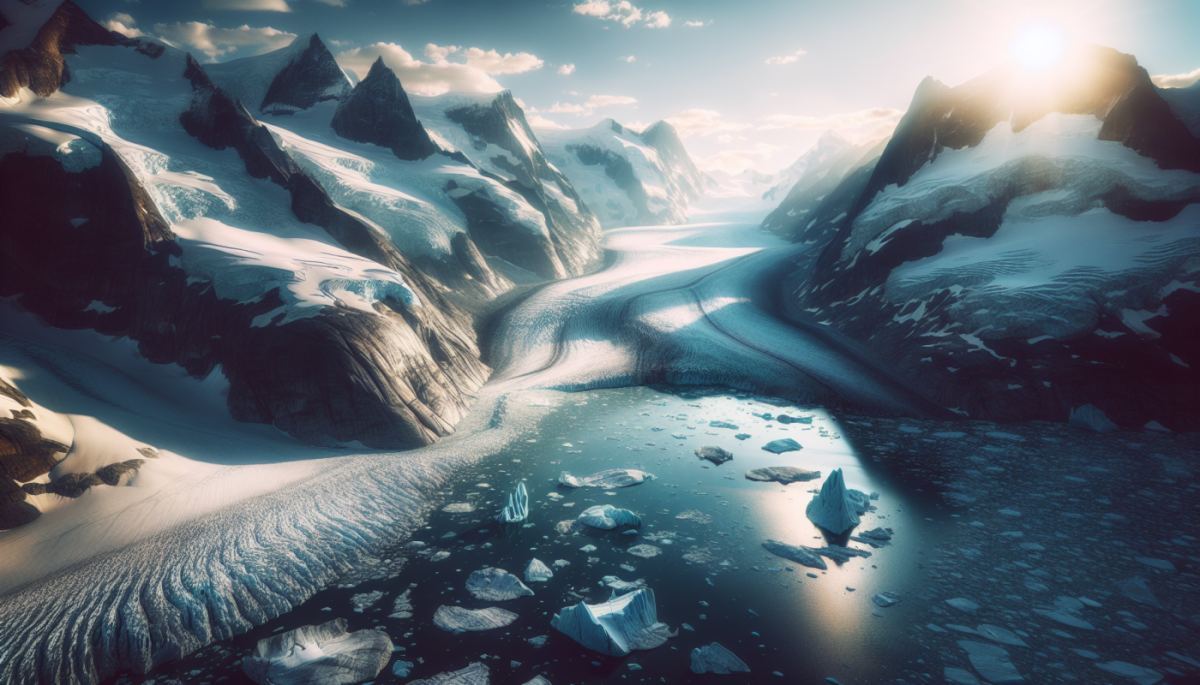
The ice is leaving before anyone has had a chance to fully listen to it. Across the Alps, the Pyrenees, and the Arctic archipelagos that fall under European stewardship, glaciers that took tens of thousands of years to form are now retreating at a pace that has outrun the scientific infrastructure built to study them. Researchers are not merely watching a landscape change. They are watching an archive burn.
Glacier ice is, in the most literal sense, a record. Each layer captures the atmospheric chemistry of its era: trapped air bubbles preserve ancient concentrations of greenhouse gases, dust particles carry signatures of distant volcanic eruptions, and isotopic ratios within the ice itself encode temperature data going back hundreds of thousands of years. This is not metaphor. It is stratigraphy. And as warming accelerates, the upper layers of many glaciers, the most recent and in some ways most urgent chapters of that record, are melting away first.
The urgency has pushed a loose international coalition of glaciologists into what amounts to a triage operation. Teams are prioritizing which ice cores to extract before the melt makes extraction impossible or the data irretrievably compromised. Drilling into a glacier is expensive, logistically demanding, and time-sensitive. The window for clean, uncontaminated cores from some Alpine sites is narrowing to years, not decades.
The scientific value of ice cores is difficult to overstate. The data extracted from cores drilled at sites like Dome C in Antarctica and Summit in Greenland have provided the foundational evidence for understanding how Earth's climate has shifted across glacial and interglacial cycles. But those polar archives, while threatened in the long run, are not the immediate crisis. The mountain glaciers of Europe are. They sit at lower altitudes, in warmer latitudes, and they are disappearing with a speed that has surprised even pessimistic projections.
Some of the most critical sites are in the Alps, where glaciers like the Mer de Glace in France and the Aletsch in Switzerland have been retreating visibly for decades. The Aletsch, the largest glacier in the Alps, has lost roughly three kilometers in length since the mid-19th century, and the rate of loss has accelerated sharply since the 1980s. What makes this particularly painful for researchers is that Alpine glaciers often preserve records of human-era pollution, including lead from Roman smelting, industrial soot, and the chemical fingerprints of 20th-century agriculture. These are not just climate records. They are civilization records.
The scramble to preserve this data has led to the creation of frozen archives, physical repositories where extracted ice cores are stored at minus 50 degrees Celsius or colder, effectively freezing the archive in place even as the glacier itself disappears. The Ice Memory Foundation, a Franco-Italian scientific initiative, has been among the most active in this effort, extracting cores from threatened glaciers and depositing duplicates at a facility in Antarctica, where the cold is reliable and the politics are relatively stable.
But there is a systems-level consequence to this crisis that gets less attention than the raw loss of ice. As glaciers vanish, so does the baseline against which future climate models are calibrated. Ice core data is not just historical curiosity. It feeds directly into the models that governments use to project sea level rise, precipitation shifts, and temperature trajectories. Degrade the input data, and you degrade the projections. Degrade the projections, and you degrade the policy responses built on top of them.
This is a feedback loop with real political weight. Climate adaptation funding, infrastructure planning, and agricultural policy in Europe increasingly depend on regional climate models that are themselves dependent on paleoclimate data. If the glacier record is incomplete, the models carry wider uncertainty bands. Wider uncertainty bands give political actors more room to delay or dilute action. The melting ice does not just represent a loss of the past. It actively narrows the clarity of the future.
There is also the question of what happens to communities downstream, both literally and figuratively. Alpine glaciers regulate river flow across much of Central Europe, buffering against summer droughts by releasing meltwater when rainfall is scarce. As they shrink, that buffer shrinks with them. The Po Valley in Italy, one of Europe's most productive agricultural regions, already faces intensifying summer water stress. The glacier is not just a data source. It is infrastructure.
The researchers drilling cores in shrinking ice fields are doing something that feels almost archaeological, recovering what they can before the site is lost. The difference is that archaeologists work in the past. Glaciologists are working against a future that is arriving faster than their funding cycles.
References
- Jouzel et al. (2007) — Orbital and Millennial Antarctic Climate Variability over the Past 800,000 Years
- Zemp et al. (2019) — Global glacier mass changes and their contributions to sea-level rise from 1961 to 2016
- Gabrielli et al. (2021) — Early atmospheric contamination on the top of the Himalayas since the onset of the European Industrial Revolution
- Ice Memory Foundation (2023) — Preserving glacier ice for future generations
- Huss et al. (2017) — Global-scale hydrological response to future glacier mass loss
Discussion (0)
Be the first to comment.
Leave a comment