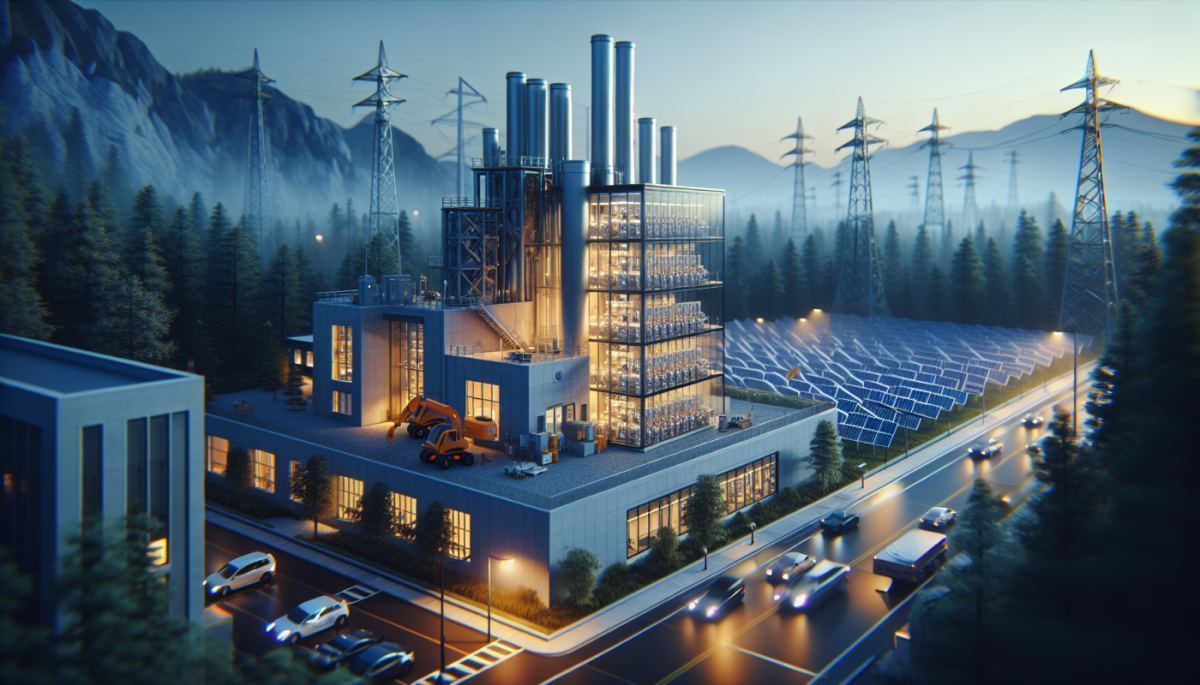
Ann Arbor, Michigan, has grown tired of waiting. While investor-owned utilities across the country continue to balance shareholder returns against the slow, politically complicated work of decarbonizing their grids, this mid-sized college city of roughly 120,000 people has decided to stop asking permission and start building its own answer. The city is developing a new municipal clean energy utility, one designed to run alongside the existing investor-owned provider rather than replace it entirely. It is a dual-service model, and if it works, it could become a template that other cities are watching very closely.
The core frustration driving Ann Arbor's move is one that urban climate planners across the country share: investor-owned utilities operate under a regulatory and financial logic that is structurally misaligned with aggressive decarbonization. These companies earn returns on capital investment, which means they have an incentive to build and maintain infrastructure, not necessarily to retire it. Natural gas pipelines, peaker plants, and legacy distribution systems represent sunk costs that utilities and their regulators are reluctant to strand. The result is a pace of transition that consistently lags behind what climate science demands and what many cities have formally committed to in their own climate action plans.
Ann Arbor adopted a goal of community-wide carbon neutrality by 2030, one of the more ambitious municipal targets in the Midwest. Achieving that goal while depending entirely on a utility whose own transition timeline stretches well beyond that date creates an obvious structural problem. The city's solution is to layer a new public energy institution on top of the existing system, one that can procure renewable power directly, potentially build or contract local generation, and offer residents and businesses a cleaner electricity product without waiting for the incumbent utility to catch up.
The dual-service approach Ann Arbor is pursuing is not without precedent, but it is genuinely uncommon. Community Choice Aggregation programs in California, Illinois, and a handful of other states have allowed municipalities to pool their buying power and source electricity from cleaner suppliers while still using the existing utility's wires for delivery. Ann Arbor's model draws on that lineage but is being designed with more municipal ownership and control baked in from the start. The city wants to be more than a bulk buyer. It wants to be an energy institution.
That ambition creates real friction. Incumbent utilities do not typically welcome competition, even partial competition, and Michigan's regulatory environment will shape how much room Ann Arbor actually has to maneuver. The Michigan Public Service Commission oversees utility operations in the state, and any new municipal energy entity will need to navigate a thicket of rules around service territories, cost allocation, and interconnection. There is also the question of stranded costs: if Ann Arbor pulls load away from the incumbent utility, that utility may argue that remaining customers should not bear the fixed costs of infrastructure that was built to serve everyone. These arguments have derailed or diluted similar efforts elsewhere.
The financing question is equally consequential. Building or contracting new renewable generation, developing local storage capacity, and standing up the administrative infrastructure of a new utility all require capital. Municipal bonds are one path. Federal funding through the Inflation Reduction Act's clean energy provisions, including direct pay tax credits that now extend to public entities, opens another lane that simply did not exist a few years ago. The IRA's extension of investment and production tax credits to tax-exempt entities is arguably the single biggest structural change that makes projects like Ann Arbor's more financially viable than they would have been before 2022.
If Ann Arbor succeeds, the most significant downstream effect may not be the kilowatt-hours it generates or the emissions it avoids, meaningful as those would be. The more consequential outcome could be demonstrating that a mid-sized American city can build functional energy infrastructure outside the investor-owned utility model, and survive the legal and regulatory resistance that follows. That proof of concept would matter enormously to the dozens of other cities that have adopted ambitious climate targets but lack a credible mechanism for achieving them.
There is also a subtler feedback loop worth tracking. As municipalities develop their own energy capacity, they accumulate technical expertise, regulatory experience, and political confidence. Cities that start as clean energy buyers tend to become more sophisticated actors over time, pushing harder on interconnection rules, land use decisions, and building codes in ways that reshape the broader energy landscape from the bottom up. Ann Arbor is not just trying to clean up its own grid. It is, perhaps without fully intending to, stress-testing the boundaries of what local government energy authority can look like in the United States.
The incumbent utilities are watching. So are the regulators. And so, quietly, is every other mid-sized American city that has promised its residents a future the existing grid was never designed to deliver.
References
- Trabish, H. (2023) — Community Choice Aggregation Is Spreading. Here's Why Utilities Are Worried
- U.S. Department of Energy (2023) — Inflation Reduction Act Summary: Energy and Climate Provisions
- City of Ann Arbor (2022) — A2Zero Carbon Neutrality Plan
- Caspary, G. et al. (2021) — Municipal Utilities and the Energy Transition
Discussion (0)
Be the first to comment.
Leave a comment