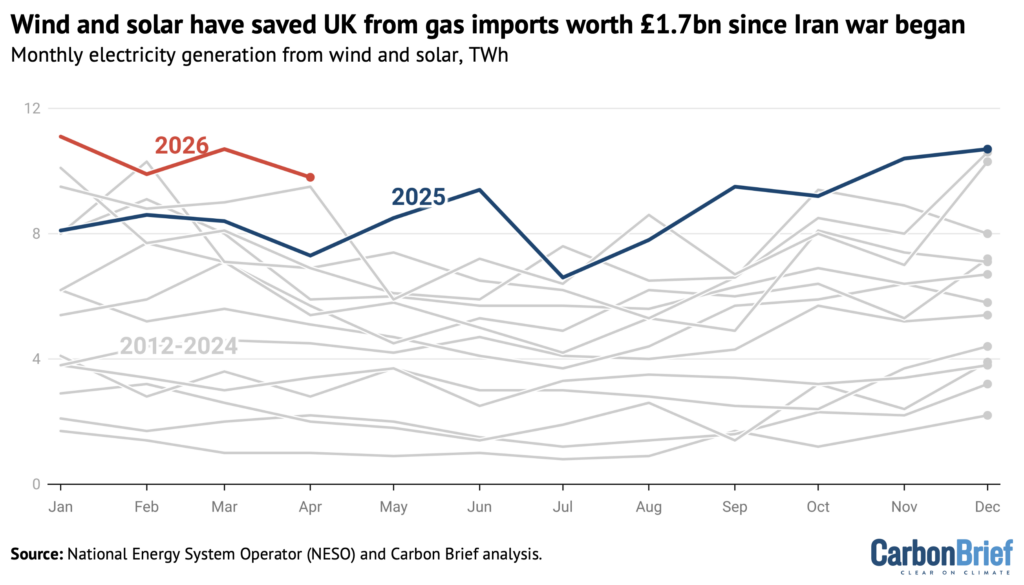
Britain's wind and solar farms saved consumers an estimated £1.7 billion in energy costs over a recent period, according to figures highlighted in Carbon Brief's weekly briefing. That number is striking not just as a data point but as a rebuttal to years of political argument that renewable energy is an expensive indulgence. When the wind blows and the sun shines, wholesale electricity prices fall, and that relief flows, at least partially, to households and businesses. The savings are a direct consequence of renewables having near-zero marginal costs once built: every unit of wind or solar power displaces a unit of gas generation, and gas has been the price-setter in Britain's electricity market for years.
The timing of this figure matters. The UK is in the middle of a politically charged debate about energy bills, with affordability dominating headlines far more than decarbonization targets. Renewable advocates have long argued that the transition would eventually pay for itself, and the £1.7 billion figure is the kind of concrete, household-level evidence that can shift that conversation. It reframes wind turbines and solar panels not as green luxuries but as functioning cost-control infrastructure.
While Britain counts its savings, the European Union appears to be moving in a more complicated direction. Carbon Brief's briefing flagged that EU policymakers are eyeing potential exemptions for fossil fuels, a development that deserves more scrutiny than it typically receives in the daily churn of climate news. The details remain fluid, but the direction of travel is significant. Exemptions, once written into law, tend to persist. They create constituencies, lock in infrastructure investment, and generate legal expectations that make future tightening politically costly.
The pressure behind this shift is not hard to identify. European industry has spent the past two years lobbying hard against what it calls "carbon leakage," the risk that strict EU climate rules push manufacturers to relocate to jurisdictions with weaker standards. Energy-intensive sectors, from steel to chemicals, have found receptive ears in Brussels, particularly as the EU's Competitiveness Compass, shaped in part by former Italian prime minister Mario Draghi's influential 2024 report on European competitiveness, has elevated industrial survival as a policy priority alongside decarbonization. The result is a regulatory environment where climate commitments and industrial policy are increasingly in tension, and where fossil fuel exemptions can be dressed up in the language of economic necessity.
The second-order consequence here is worth dwelling on. If the EU softens its fossil fuel rules, it sends a signal to capital markets that European climate policy is negotiable under pressure. That signal could slow the flow of private investment into clean energy across the continent, precisely at the moment when the EU needs to accelerate it. Regulatory certainty is one of the most important inputs investors use when deciding where to deploy long-term infrastructure capital. Uncertainty, or worse, visible backsliding, raises the risk premium on green projects and makes fossil fuel assets look comparatively safer. The exemption debate, in other words, is not just a political story. It is a story about investment flows that could shape Europe's energy system for decades.
The week's third major thread involves the Amazon, where scientists are again raising warnings about a potential tipping point. The Amazon rainforest has been under sustained pressure from deforestation, drought, and fire, and researchers have been tracking whether cumulative stress is pushing parts of the system toward a threshold beyond which forest gives way to savanna-like conditions. A tipping point in this context is not a metaphor. It refers to a specific dynamic: a system that has absorbed incremental stress can reach a state where self-reinforcing feedbacks take over, and recovery becomes extremely difficult even if the original stressors are removed.
The Amazon produces roughly half its own rainfall through a process called transpiration, where trees release water vapor that cycles back as precipitation. Lose enough trees, and the moisture recycling weakens, making the remaining forest more vulnerable to drought, which kills more trees, which weakens the cycle further. This is a feedback loop with potentially continental consequences, affecting agriculture, river systems, and regional climate patterns across South America.
What connects these three stories is a shared underlying tension: the gap between what the science says is necessary and what political and economic systems are currently delivering. The UK's renewable savings show that the energy transition can produce tangible, near-term benefits. The EU's fossil fuel exemption debate shows how quickly those gains can be undermined by short-term industrial politics. And the Amazon's trajectory is a reminder that some of the systems at stake do not offer second chances.
The question that follows from all three is whether the institutions making these decisions are operating on timescales that match the urgency of what they are deciding.
Discussion (0)
Be the first to comment.
Leave a comment