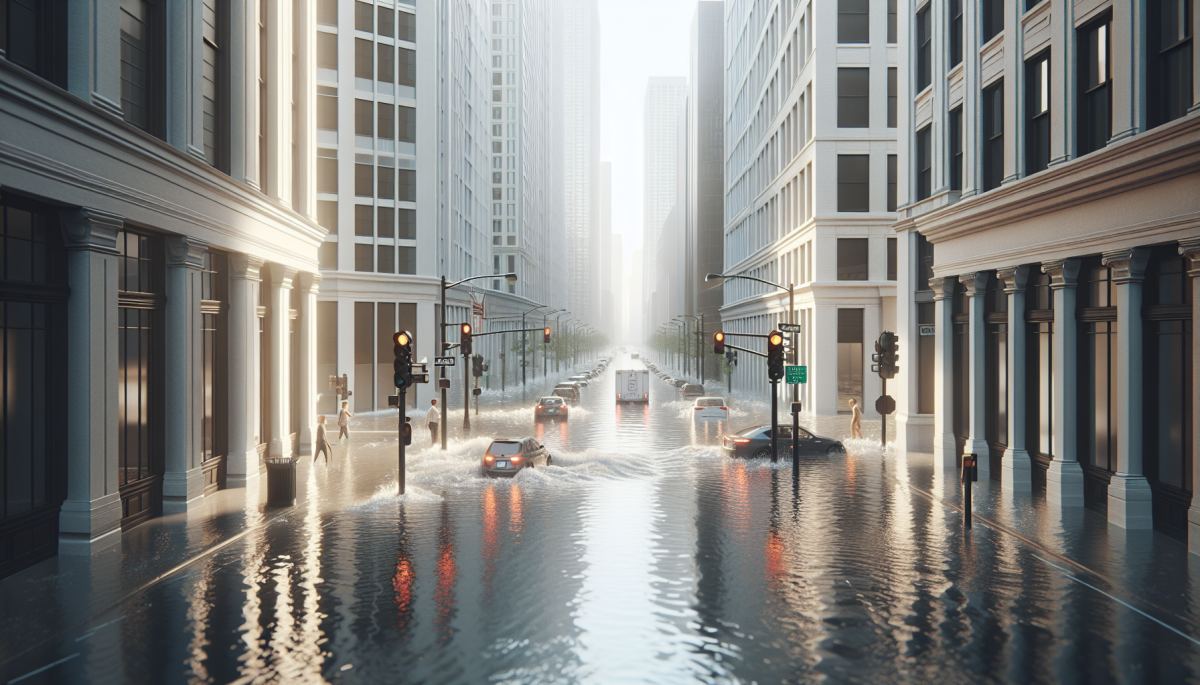
Chicago has always had a complicated relationship with water. The city reversed the flow of its own river in 1900, a feat of engineering audacity that still astonishes. But the infrastructure built to manage water in the 20th century was designed for a climate that no longer exists, and the consequences of that mismatch are now arriving in basements, on expressways, and in the city's most vulnerable neighborhoods with increasing regularity.
Early last year, University of Illinois researchers released what they called "Bulletin 76," a technical memo that didn't make many front pages but carried an alarming message: intense rainfall events, already worsening due to climate change, are projected to become significantly more severe over the next 25 years. What the region's stormwater systems were engineered to handle, the bulletin warned, may no longer be adequate. The infrastructure that once defined the margin of safety is now operating at or beyond its design limits, and the storms haven't finished intensifying.
This is not simply a story about rain. It is a story about compounding systems failures, where decisions made across decades, from zoning choices to infrastructure investment timelines to municipal budget priorities, have locked Chicago into a cycle of flood damage that grows more expensive and more inequitable with each major storm.
Chicago's combined sewer system, which carries both stormwater and sewage in the same pipes, was largely built in the mid-20th century. The Metropolitan Water Reclamation District's Tunnel and Reservoir Plan, known locally as the "Deep Tunnel," was an ambitious fix begun in 1975 and only completed in its final phase in 2006. It can hold an enormous volume of water, but it was sized for historical storm patterns. As precipitation events grow more intense and more frequent, the system increasingly gets overwhelmed before the tunnels can absorb the surge.
The problem is amplified by the urban landscape itself. Chicago and its suburbs are heavily impervious: rooftops, parking lots, roads, and sidewalks shed water rather than absorbing it. Every new development that replaces green space with concrete adds a small increment of runoff to a system already straining. Individually, each increment seems trivial. Collectively, they represent a slow-motion reconfiguration of the watershed that no single agency fully tracks or controls.
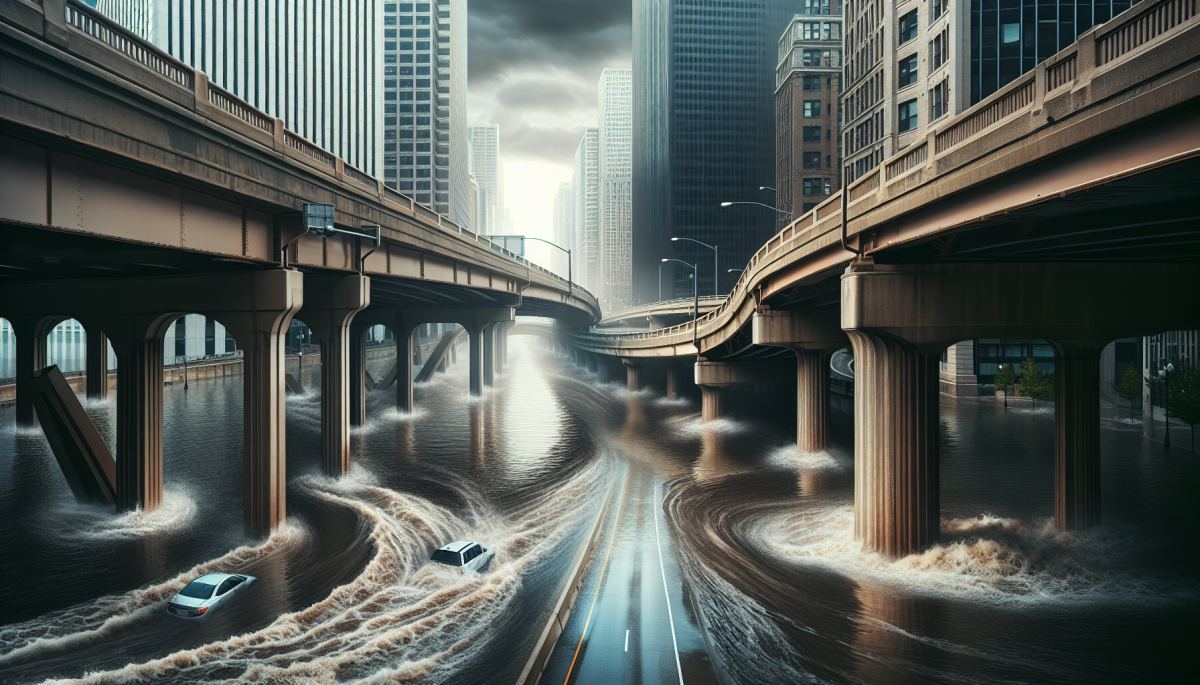
Meanwhile, the maintenance backlog for aging sewer infrastructure across Illinois municipalities runs into the billions of dollars. Federal funding through the Infrastructure Investment and Jobs Act has provided some relief, but the scale of need outpaces the scale of investment. Cities are essentially running to stand still, repairing yesterday's failures while tomorrow's are being built in.
Flooding in Chicago is not experienced equally. Research on urban flood risk consistently shows that lower-income neighborhoods and communities of color bear disproportionate exposure, a pattern driven by decades of discriminatory housing policy that concentrated Black and Latino residents in lower-lying areas with older housing stock and less political leverage to demand infrastructure upgrades. When a basement floods, the financial hit falls hardest on households with the least capacity to absorb it, many of whom are renters without flood insurance and homeowners whose primary asset is suddenly a liability.
The second-order consequences here are significant and underappreciated. Repeated flooding depresses property values, which shrinks the local tax base, which reduces the municipal revenue available for the very infrastructure repairs that would reduce flooding. It is a feedback loop that tightens with each storm cycle. Neighborhoods that flood frequently also see insurance markets retreat: as private insurers reprice or withdraw flood coverage in high-risk urban areas, the financial exposure shifts onto individuals and ultimately onto public disaster relief programs.
What Bulletin 76 implies, though its authors stated it in the careful language of engineering science, is that this loop is about to accelerate. If the rainfall intensities projected for the next quarter-century arrive as modeled, the gap between what Chicago's infrastructure can handle and what the sky will deliver is going to widen faster than any realistic repair schedule can close it.
The deeper question is whether the city and state treat this as an infrastructure problem, which implies a solution through capital investment, or as a systems problem, which requires rethinking land use, development incentives, green infrastructure policy, and the distribution of flood risk all at once. The first framing is politically easier. The second is the one that might actually work. Chicago reversed a river once. The challenge now is less dramatic but considerably harder: changing the systems of governance and incentive that keep making the problem worse.
References
- University of Illinois (2023) — Bulletin 76: Frequency Distributions of Heavy Precipitation in Illinois
- Metropolitan Water Reclamation District of Greater Chicago — Tunnel and Reservoir Plan
- EPA (2023) — Climate Change and Urban Flooding
- First Street Foundation (2023) — The 9th National Risk Assessment: Flood
Discussion (0)
Be the first to comment.
Leave a comment