
The ocean has always been a buffer. For decades, it has quietly absorbed the overwhelming majority of the excess energy accumulating in Earth's climate system, sparing the atmosphere from even more dramatic warming than we've already witnessed. But buffers have limits, and the consequences of pushing this one so hard are now rippling outward in ways that touch something far more immediate than sea level projections or storm intensity charts: what people eat, and whether they can afford it.
Scientists estimate that the ocean absorbs more than 90 percent of the excess heat trapped by greenhouse gases. That number sounds like a success story until you consider what absorbing that much energy actually does to a body of water. Oceans are warming at accelerating rates, with the past several years registering record sea surface temperatures. Marine heat waves, once rare, are now recurring events across the Pacific, the Atlantic, and the Indian Ocean. These aren't just ecological curiosities. They are structural disruptions to the biological systems that underpin global food supply.
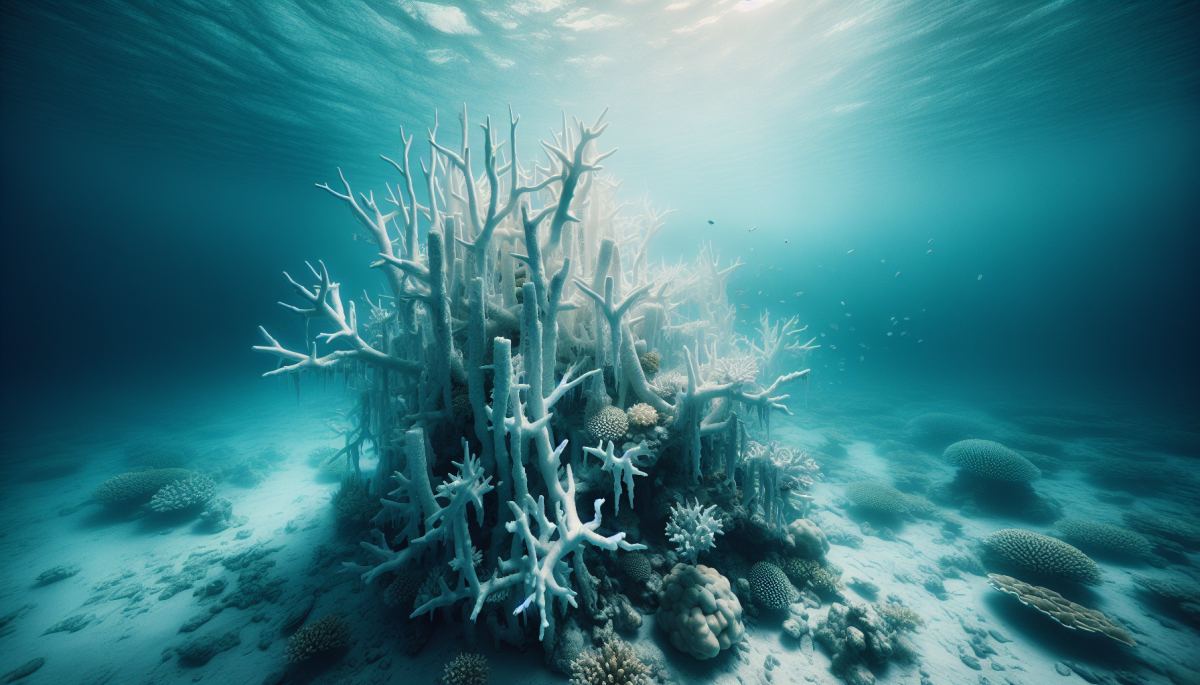
Fish don't simply swim in water. They exist within finely tuned thermal envelopes, and so does the plankton they depend on, and the krill that depend on the plankton, and the larger species that depend on all of it. When ocean temperatures shift even modestly, these relationships break down. Species migrate poleward or to deeper, cooler water, leaving traditional fishing grounds depleted. Coral reefs, which support roughly a quarter of all marine species and provide food security for hundreds of millions of people in coastal and island communities, bleach and die when temperatures spike even briefly above their tolerance thresholds.
The 2023 marine heat wave in the North Atlantic was particularly striking, with temperatures running several degrees above historical averages for months at a stretch. Researchers noted disruptions to fish spawning patterns and plankton blooms, the kind of foundational ecological events that cascade upward through entire food webs. Meanwhile, the Gulf of Maine has warmed faster than roughly 99 percent of the world's oceans, and the lobster and groundfish industries there are already contending with the consequences.
Beyond fisheries, ocean warming is altering precipitation patterns and monsoon systems that terrestrial agriculture depends on. The ocean and atmosphere are not separate systems. They exchange heat, moisture, and energy constantly, and a warmer ocean means a more energetically charged atmosphere, one prone to more intense droughts in some regions and catastrophic flooding in others. The agricultural belts of South Asia, Sub-Saharan Africa, and Central America are particularly exposed to these shifts, and these are precisely the regions where food insecurity is already most acute.
What makes this situation genuinely alarming from a systems perspective is the feedback architecture embedded within it. As ocean warming disrupts fisheries, coastal communities that relied on fish protein shift pressure onto terrestrial food systems, which are themselves under stress from altered rainfall and heat extremes. That pressure accelerates land clearing and agricultural intensification, which releases more carbon, which traps more energy, which the ocean absorbs, which warms further. The loop is not hypothetical. It is already running.
There is also an economic feedback worth naming. As fish stocks decline or migrate, the cost of seafood rises. Higher food prices disproportionately affect lower-income populations, who then have fewer resources to adapt, whether by switching protein sources, relocating, or investing in climate-resilient agriculture. Food insecurity and poverty are themselves destabilizing forces, capable of generating political instability and migration pressures that strain governance systems in ways that make coordinated climate response harder, not easier.
The ocean's role as Earth's primary heat sink has bought humanity time, but it has also obscured the urgency of what is happening. Because so much warming has been sequestered in deep water rather than expressed as scorching air temperatures, the full energy imbalance of the climate system has remained somewhat invisible to everyday experience. That invisibility is ending. The heat is now expressing itself through the systems people depend on most directly, and food is the most direct of all.
If current trajectories hold, the question facing food systems planners, fisheries managers, and agricultural policymakers is not whether ocean-driven disruption will intensify, but how quickly institutions can reorganize around a fundamentally different ocean than the one that shaped every food system currently in operation.
References
- Cheng et al. (2023) — Another Record: Ocean Warming Continues through 2022
- IPCC (2022) — Climate Change 2022: Impacts, Adaptation and Vulnerability
- Smale et al. (2019) — Marine heatwaves threaten global biodiversity and the provision of ecosystem services
- FAO (2022) — The State of World Fisheries and Aquaculture
- Pershing et al. (2015) — Slow adaptation in the face of rapid warming leads to collapse of the Gulf of Maine cod fishery
Discussion (0)
Be the first to comment.
Leave a comment