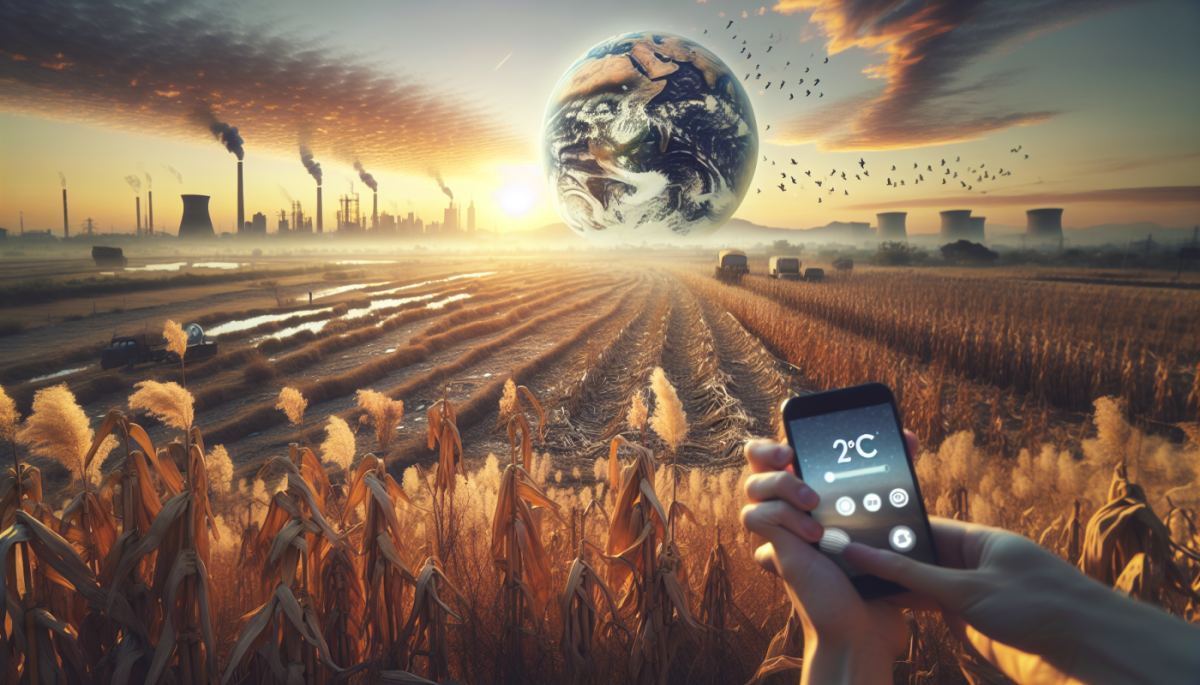
The number of countries tipping into critical food insecurity could nearly triple, jumping from roughly 9 to 24, if global average temperatures rise by 2 degrees Celsius above pre-industrial levels. That finding, drawn from new analysis by the International Institute for Environment and Development (IIED), is striking not just for its scale but for what it reveals about the architecture of vulnerability baked into the global food system.
The IIED research makes a point that aggregate climate projections tend to obscure: the damage will not be distributed evenly. Food systems in low-income nations are projected to deteriorate seven times faster than those of wealthy countries as temperatures climb. That ratio is not a coincidence or a quirk of geography. It is the compounded output of decades of underinvestment in agricultural infrastructure, limited access to climate-adaptive technologies, dependence on rain-fed farming, and the near-total absence of the fiscal buffers that allow richer governments to subsidize food supplies when harvests fail.
To understand why poorer nations are so much more exposed, it helps to think about food security not as a single variable but as a system with multiple interlocking parts: crop yields, supply chains, purchasing power, storage capacity, and trade access. Wealthy countries have redundancy built into almost every one of those components. When drought hits a region of the United States, federal crop insurance programs, deep commodity markets, and diversified import relationships absorb the shock. When drought hits the Sahel or the Horn of Africa, those buffers simply do not exist at the same scale.

The 2-degree threshold matters because it is the upper limit that the Paris Agreement committed signatories to avoid, and because the nonlinear nature of climate impacts means the difference between 1.5°C and 2°C is not merely incremental. Coral reef systems, monsoon patterns, and soil moisture regimes can shift in ways that are difficult or impossible to reverse once certain temperature bands are crossed. For agricultural systems already operating close to their thermal limits, that nonlinearity translates directly into yield collapse.
The IIED analysis also implicitly highlights a feedback loop that rarely gets enough attention in mainstream climate coverage. As food insecurity deepens in low-income countries, governments there face mounting pressure to clear forests and expand agricultural land, which releases more carbon, which accelerates warming, which further degrades the food systems those governments were trying to protect. It is a loop with no natural brake unless external financing and policy intervention interrupt it.
The geopolitical ripple effects of 24 countries in simultaneous food crisis deserve serious consideration. The period between 2010 and 2012 offered a preview: a combination of drought in Russia, flooding in Pakistan, and speculative pressure on global grain markets contributed to food price spikes that researchers have linked to social unrest across North Africa and the Middle East. That was a partial, temporary disruption. A world in which nearly two dozen countries face chronic food system failure simultaneously would generate migration pressures, regional instability, and humanitarian financing demands that dwarf anything the international system has previously managed.
There is also a quieter second-order effect worth naming. When food insecurity becomes endemic rather than episodic, it reshapes human capital formation. Children experiencing chronic undernutrition suffer measurable cognitive deficits that persist into adulthood, reducing the productive capacity of entire generations. The economic literature on this is robust and sobering. Countries that lose that human capital do not simply recover it when food supplies stabilize; the damage compounds across decades, making it harder for those nations to build the resilience they need to withstand the next climate shock.
The IIED findings arrive at a moment when international climate finance commitments remain well below what analysts say is needed to help vulnerable nations adapt. The gap between what wealthy countries have pledged and what low-income nations require to protect their food systems is itself a kind of policy feedback loop, one in which inadequate adaptation investment today guarantees larger humanitarian and economic costs tomorrow.
If the trajectory does not change, the question facing the international community will not be whether to respond to cascading food crises but whether it has the institutional capacity to respond to that many of them at once.
References
- IIED (2024) — Climate crisis and food systems vulnerability analysis
- IPCC (2022) — Sixth Assessment Report: Impacts, Adaptation and Vulnerability
- Diffenbaugh & Burke (2019) — Global warming has increased global economic inequality
- FAO (2023) — The State of Food Security and Nutrition in the World
- Hsiang et al. (2017) — Estimating economic damage from climate change in the United States
Discussion (0)
Be the first to comment.
Leave a comment