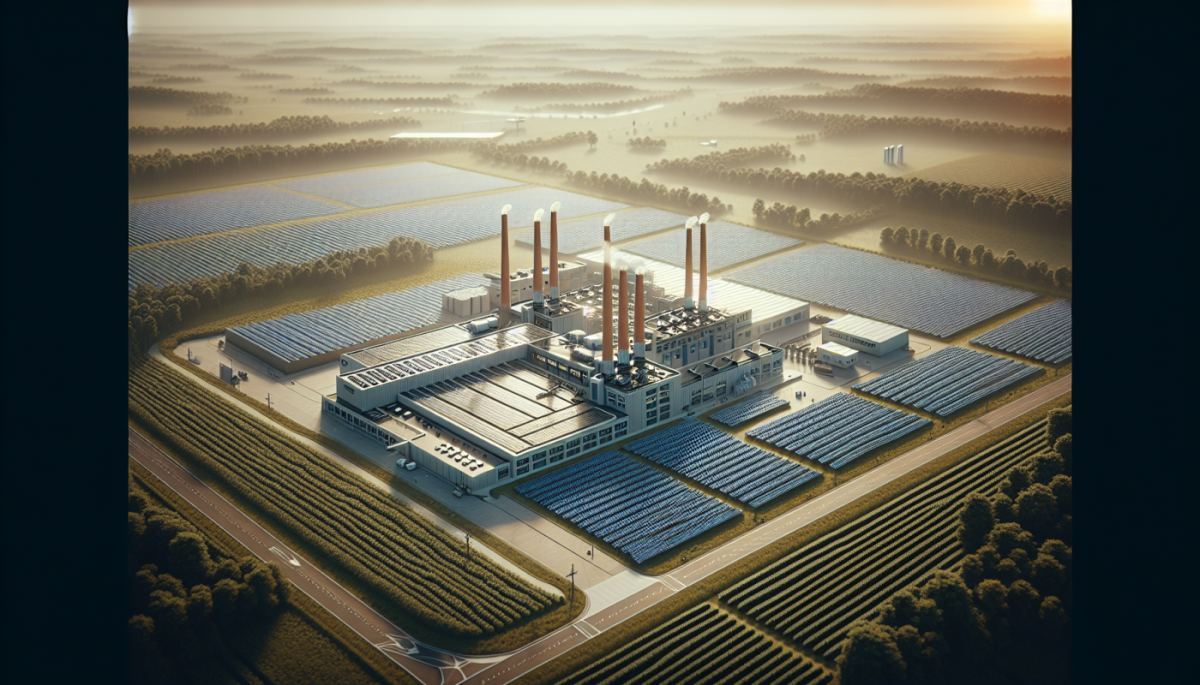
When LEGO broke ground on its massive manufacturing facility in Chesterfield County, Virginia, the company was already thinking beyond the assembly lines. Now, as construction progresses, the Danish toymaker is installing a large solar array directly at the site, with the explicit goal of powering the factory entirely on renewable energy. It is a significant commitment, and one that carries implications well beyond the company's carbon accounting.
The Chesterfield plant represents LEGO's first owned and operated manufacturing facility in the United States, a strategic move driven by the company's desire to shorten supply chains, reduce shipping emissions, and get closer to its largest consumer market. The US is LEGO's biggest market by revenue, and for years the company has shipped finished products across the Atlantic from factories in Denmark, Hungary, Mexico, and China. Building domestically changes that calculus entirely, but it also introduces a new question: how do you decarbonize industrial manufacturing in a country where the grid is still heavily dependent on fossil fuels?
LEGO's answer, at least in part, is to stop waiting on the grid and generate power on-site. The solar installation at Chesterfield is designed to feed directly into the factory's operations, reducing the facility's dependence on Virginia's electricity mix, which, while improving, still draws significantly from natural gas. On-site generation gives the company a degree of energy independence that purchasing renewable energy certificates simply cannot match. RECs are an accounting tool; solar panels on the roof are a physical fact.
There is a deeper systems logic at work here that goes beyond environmental optics. LEGO has made sweeping public commitments to reach zero carbon emissions across its operations by 2050, with significant interim targets along the way. The company has also pledged to invest around $400 million in environmental initiatives through 2025. Embedding renewable infrastructure into a brand-new factory, rather than retrofitting an older one, is dramatically more cost-effective and architecturally cleaner. LEGO is essentially writing sustainability into the factory's DNA from day one, which avoids the expensive and disruptive process of decarbonizing legacy infrastructure later.
The choice of Virginia is also notable from an energy policy standpoint. The Virginia Clean Economy Act, passed in 2020, mandates that Dominion Energy, the state's dominant utility, reach 100% renewable energy by 2045. That regulatory tailwind makes Virginia a more attractive location for manufacturers with clean energy goals than many other US states. LEGO is, in effect, betting that the policy environment will continue to support its energy strategy, and that the grid it connects to will itself get cleaner over time, compounding the benefit of its on-site solar.
The more interesting question is what happens if this model works. Large consumer brands with manufacturing ambitions in the US are watching closely. If LEGO demonstrates that a purpose-built, solar-integrated factory can operate competitively on cost while meeting aggressive emissions targets, it creates a replicable template. Industrial developers, economic development agencies, and utilities all have incentives to package that template and sell it to the next company considering a US manufacturing investment.
There is also a workforce dimension that rarely gets discussed in these announcements. Factories that invest heavily in on-site energy infrastructure tend to attract a different caliber of facilities management talent, and they generate local jobs in solar installation and maintenance that extend beyond the factory floor itself. Chesterfield County, which has actively courted the LEGO investment, stands to benefit from that secondary employment effect in ways that a conventional factory would not produce.
The risk, of course, is that on-site solar alone cannot fully power a large-scale injection molding and assembly operation, which is energy-intensive by nature. LEGO will almost certainly need to supplement with grid power and potentially with renewable energy procurement agreements to close the gap between what the solar array generates and what the factory actually consumes. How the company bridges that gap, and how honestly it reports on it, will determine whether this initiative is genuinely transformative or a well-branded partial measure.
What is clear is that the era of building a factory without a serious energy strategy is ending. The companies that figure out how to integrate generation, storage, and procurement into their physical infrastructure from the start will carry a structural advantage into a future where carbon costs, whether regulatory or reputational, are only going one direction.
Discussion (0)
Be the first to comment.
Leave a comment