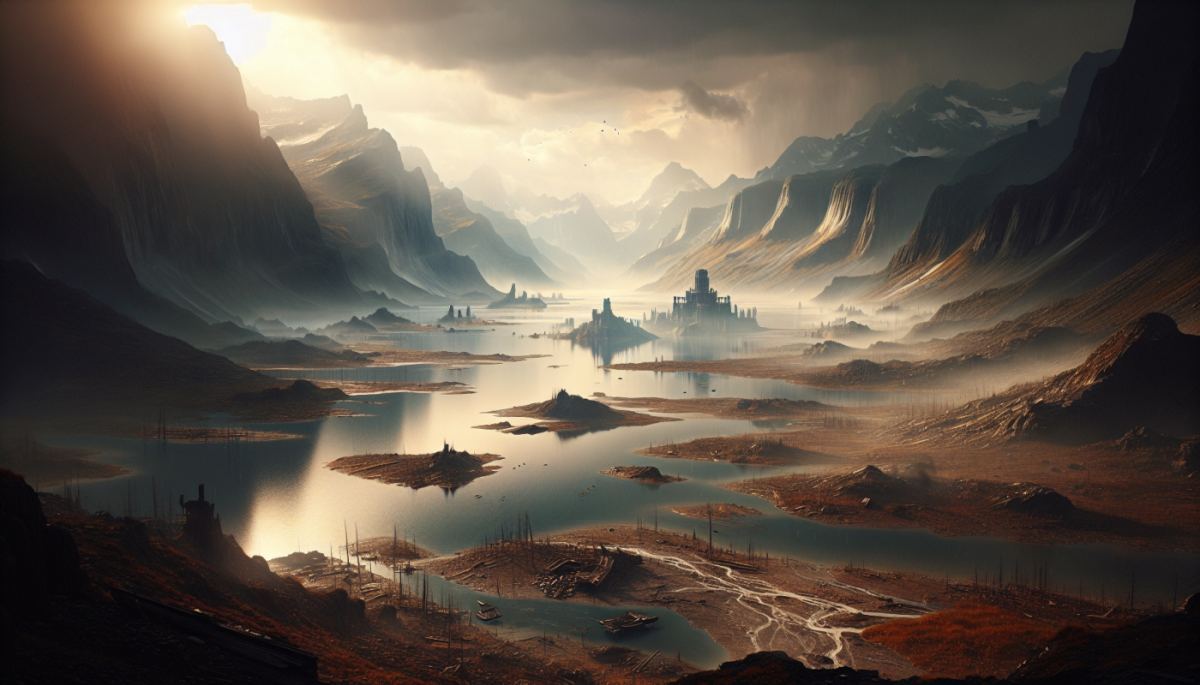
The lakes of K'gari have a reputation for permanence. Perched high above sea level in sand dunes on the world's largest sand island, off the coast of Queensland, Australia, they look like something nature would never willingly give up. Lake McKenzie's bleached silica shores and crystalline water have drawn visitors for generations. But new research has quietly dismantled the idea that these lakes are fixtures of the landscape. Around 7,500 years ago, several of them simply disappeared — and the most unsettling part is that it happened during a period of high rainfall.
The finding, drawn from sediment core analysis of K'gari's lake beds, suggests that the lakes dried up not because the sky stopped delivering water, but because the wind stopped delivering it to the right place. Researchers believe shifting atmospheric circulation patterns redirected rainfall away from the island during the mid-Holocene, even as broader regional precipitation remained elevated. The lakes on K'gari are what scientists call "window lakes" — they exist where the water table intersects the surface of the dune, meaning they are exquisitely sensitive to groundwater levels. If recharge slows, even slightly and even temporarily, the lakes can vanish entirely.
Understanding why this matters requires understanding what K'gari actually is. The island, listed as a UNESCO World Heritage Site, is not underlaid by rock or clay. It is built almost entirely from sand, accumulated over hundreds of thousands of years. The lakes have no rivers feeding them and no hard basin holding them. They survive because rainfall percolates through the dunes, builds up a freshwater lens within the sand, and rises to the surface in low-lying areas. It is one of the more improbable hydrological systems on Earth, and it functions only because the inputs — rain, wind, and the slow movement of groundwater — remain in balance.
What the new research reveals is that this balance has broken before, and broken in ways that defy intuition. The mid-Holocene was not a dry age globally. In many parts of the world, monsoon systems were stronger and wetter than they are today. Yet on K'gari, the lakes dried up. The culprit, scientists suspect, was a reorganization of wind patterns that altered where precipitation actually fell. Rain that might have recharged the dunes was, in effect, redirected elsewhere. The lakes didn't drain — they were starved.
This is a meaningful distinction. It means that total rainfall figures, the kind most climate projections lead with, may be a poor proxy for what actually happens to systems like K'gari's lakes. A region can get wetter on average while specific, wind-dependent ecosystems within it get drier. The signal that matters is not volume but delivery.
Climate projections for subtropical Queensland are not uniformly alarming in terms of raw precipitation, but they do point toward increased climate variability and shifts in the behavior of large-scale circulation systems, including the patterns that govern where rainfall lands across eastern Australia. If the mid-Holocene episode is any guide, the lakes of K'gari could be vulnerable not to a future that is simply drier, but to one that is differently organized — where the rain falls somewhere else, or falls in the wrong season to effectively recharge the dune aquifer.
The second-order consequence here is worth sitting with. K'gari's lakes are not just ecological features. They are the foundation of a tourism economy, a freshwater source for the island's ecosystems, and a cultural landmark for the Butchulla people, the island's traditional custodians, for whom K'gari carries deep spiritual significance. If the lakes were to shrink or disappear, the effects would ripple outward through all of those systems simultaneously. Tourism revenue would collapse. Ecosystems dependent on the freshwater lens, including rare plant communities found nowhere else, would face pressure. And a place that has held meaning for tens of thousands of years would be altered in ways that no management plan could easily reverse.
The research also raises a quieter challenge for conservation science more broadly. Protected area status, which K'gari holds in abundance, is designed to shield landscapes from human interference. It does very little to shield them from atmospheric reorganization. The boundary of a World Heritage Site does not stop a wind pattern from shifting.
What the sediment cores from K'gari ultimately tell us is that stability, in Earth systems, is often an illusion maintained by a narrow set of conditions. Those conditions held for thousands of years. They broke once before. The question scientists are now asking is not whether they could break again, but whether the warning signs, buried in layers of ancient sand, arrived early enough to matter.

Discussion (0)
Be the first to comment.
Leave a comment