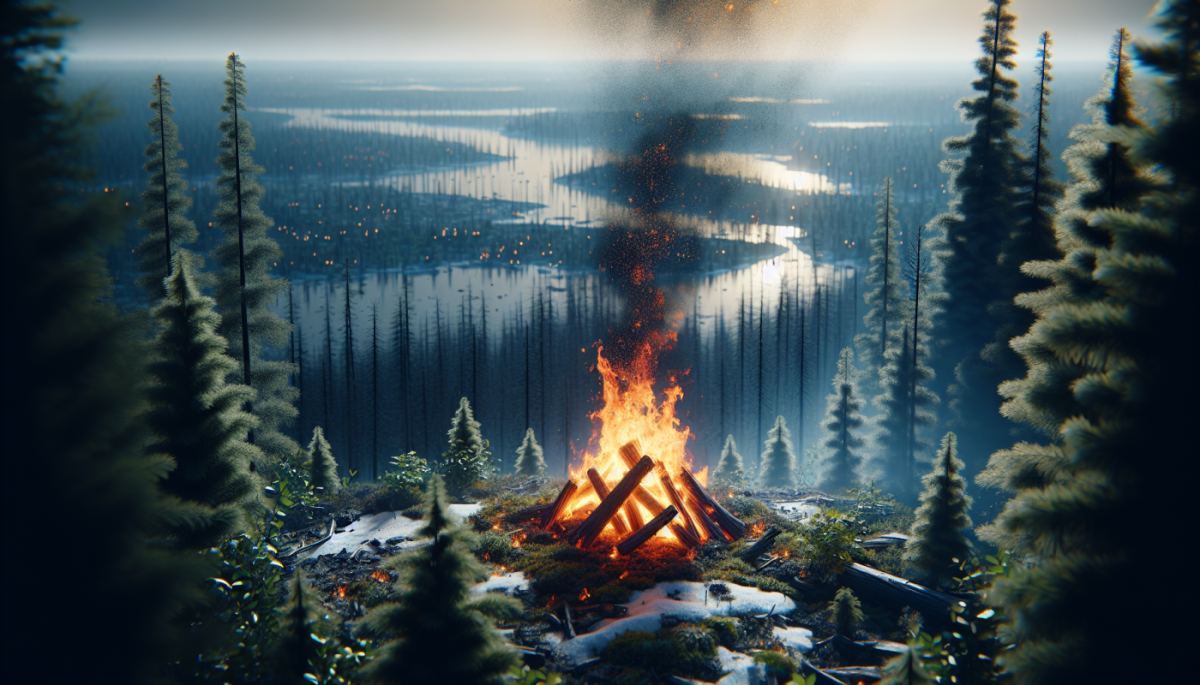
The satellites don't lie, exactly. They just don't see everything. When a wildfire tears through Canada's boreal forest or across the Siberian taiga, the infrared sensors overhead measure heat and flame with reasonable accuracy. What they miss is what's happening underground, where ancient peat deposits, some of them thousands of years old, smolder for days or weeks at temperatures too low to register as dramatic fire events. New research suggests this blind spot isn't a minor calibration issue. It may represent one of the most significant gaps in how humanity understands its own carbon budget.
Researchers studying boreal wildfires have found that fires burning into deep peat layers release carbon that has been locked away since long before the Industrial Revolution, in some cases since the last ice age. These aren't the roaring crown fires that generate dramatic footage and emergency evacuations. They are slow, creeping combustion events that chew through organic soil at a pace that looks almost inert from orbit. Because climate models rely heavily on satellite-derived fire radiative power to estimate emissions, they systematically undercount what these smoldering fires are actually putting into the atmosphere.
The implications are uncomfortable. If the models are wrong about boreal peat emissions, they are also wrong about how much carbon the land surface is absorbing versus releasing, which means projections about remaining carbon budgets and the pace of warming could be off in ways that are difficult to correct without fundamentally rethinking how fire emissions are measured.
Peat is not ordinary soil. It is partially decomposed organic matter that accumulates over millennia in waterlogged conditions, essentially a slow-motion archive of dead vegetation that never fully broke down. The boreal zone, which stretches across Canada, Russia, Scandinavia, and Alaska, holds an estimated 30 to 40 percent of all terrestrial carbon, much of it stored in these peat deposits. For most of human history, the cold and wet conditions of the north kept that carbon stable. Climate change is now disrupting both of those conditions simultaneously.
As temperatures in the Arctic and subarctic rise at roughly two to four times the global average rate, peatlands are drying out. Drier peat burns. And when it burns, it doesn't just release the carbon from this season's plant growth. It releases carbon that accumulated over centuries. A single severe fire season in a peat-rich region can effectively undo decades of carbon sequestration in a matter of weeks, and the climate models tracking that process are, by the researchers' own account, not capturing the full picture.
The measurement problem compounds the policy problem. Carbon offset markets, national emissions inventories, and international climate agreements all depend on reasonably accurate accounting of what is being emitted and what is being absorbed. If boreal fire emissions are being systematically undercounted, then countries and corporations purchasing forest-based carbon offsets may be buying credits against a carbon sink that is quietly becoming a carbon source.
The second-order consequence here is where the systems thinking gets genuinely alarming. Warmer temperatures dry out peat. Dry peat burns more readily and more deeply. Deep peat fires release ancient carbon. That carbon warms the atmosphere further. Which dries out more peat. The feedback loop is not hypothetical. It is already running, and the models that policymakers rely on to understand its speed and scale are, by the evidence of this research, underestimating the emissions that drive it.
There is also a governance dimension that rarely gets discussed. The boreal zone is vast, sparsely populated, and largely unmonitored at ground level. Russia alone holds more peatland than any other country, and its fire reporting infrastructure is, to put it diplomatically, inconsistent. Canada's northern territories are better monitored but still face enormous logistical challenges in tracking subsurface combustion across millions of hectares. The satellites that climate scientists depend on were not designed to detect slow smoldering in organic soils. Retrofitting the global carbon monitoring system to account for what's happening underground is not a quick fix.
What this research points toward is a reckoning that the climate science community has been approaching for years but has not yet fully absorbed: the land surface, long treated as a partial buffer against human emissions, may be shifting into a new regime where ancient stored carbon becomes a net contributor to warming. The models will eventually catch up. The question is whether the peat will wait.
References
- Turetsky et al. (2015) — Global vulnerability of peatlands to fire and carbon loss
- Walker et al. (2020) — Increasing wildfires threaten historic carbon sink of boreal forest soils
- Scholten et al. (2021) — Overwintering fires in boreal forests
- Hugelius et al. (2020) — Large stocks of peatland carbon and nitrogen are vulnerable to permafrost thaw
Discussion (0)
Be the first to comment.
Leave a comment