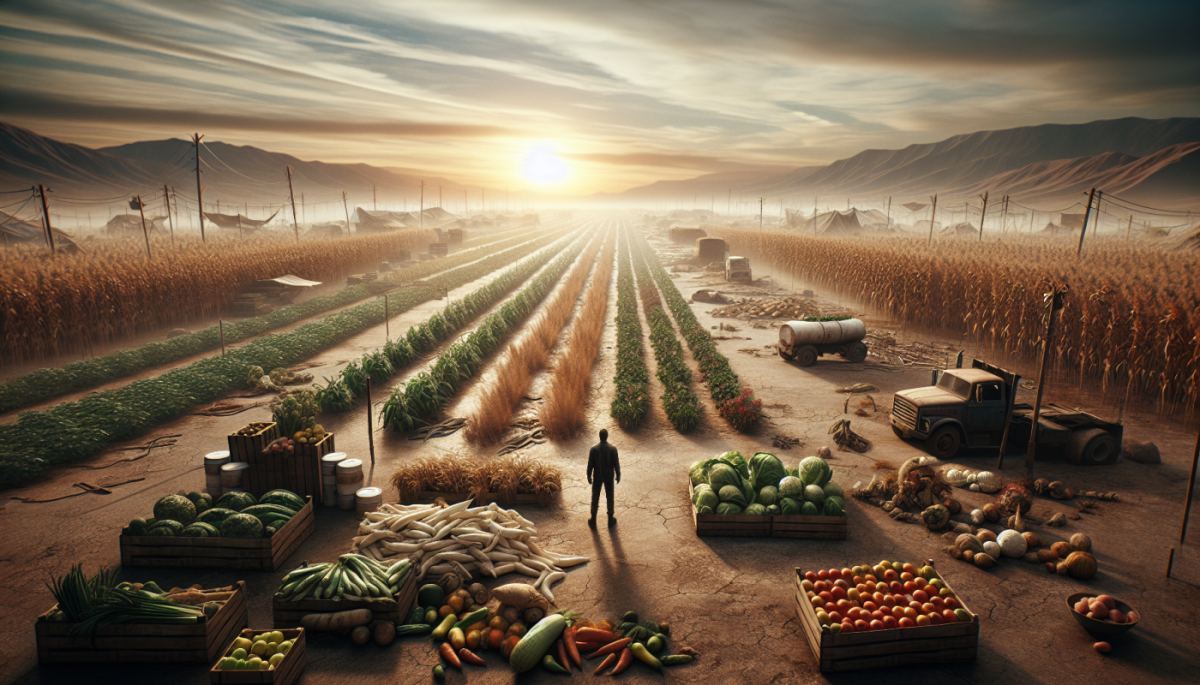
The Persian Gulf is not just a corridor for oil tankers. It is, quietly and consequentially, a lifeline for the world's food supply. Farmers from the American Midwest to the Indian subcontinent depend on nitrogen-based fertilizers synthesized from natural gas, and a significant share of the precursor chemicals and finished products that feed that system move through waters that would become a war zone the moment conflict with Iran escalates beyond airstrikes and into sustained naval confrontation. The geography of modern agriculture and the geography of modern conflict have never been more dangerously overlapped.
The connection between fossil fuels and food is older than most people realize. The Haber-Bosch process, developed in the early twentieth century, converts atmospheric nitrogen into ammonia using natural gas as both a feedstock and an energy source. Without it, roughly half the global population could not be fed. That process runs on natural gas, and natural gas moves through pipelines and tankers that are deeply entangled with Gulf infrastructure. Qatar, one of the world's largest exporters of liquefied natural gas, sits less than 200 miles from the Iranian coastline. Saudi Arabia's petrochemical exports, which include ammonia and urea fertilizers, pass through the Strait of Hormuz, a chokepoint so narrow that Iran has repeatedly threatened to close it during periods of tension.
A sustained disruption to Hormuz traffic would not just spike energy prices. It would compress the global fertilizer supply at exactly the moment when farmers in the Northern Hemisphere are making planting decisions. Fertilizer markets are notoriously inelastic in the short term. You cannot substitute your way out of a nitrogen shortage mid-season. Crops go in the ground on a schedule dictated by climate, not geopolitics, and if the inputs are not available or affordable at planting time, the yield loss is locked in months before any harvest.
The 2022 disruption caused by Russia's invasion of Ukraine offered a preview of what fertilizer scarcity looks like at scale. Russia and Belarus together account for roughly 40 percent of global potash exports, and when sanctions and logistics chaos hit those supply chains, fertilizer prices spiked to historic highs. Farmers in sub-Saharan Africa and South Asia, who operate on thin margins and cannot absorb input cost shocks, cut application rates. Yields fell. Food insecurity worsened in countries that had no direct stake in the conflict. The World Food Programme documented the downstream effects across dozens of nations that had never heard a shot fired in Ukraine.
An Iran conflict would trigger a structurally similar cascade, but potentially faster and wider. Unlike the Russia-Ukraine disruption, which unfolded over weeks as sanctions were debated and logistics rerouted, a naval confrontation in the Gulf could freeze shipping almost overnight. Insurance markets would reprice risk instantaneously. Tanker operators would divert or pause. The spot price for urea, the most widely used nitrogen fertilizer, would reflect that panic before most governments had convened an emergency session.
What makes this particularly dangerous is the compounding effect on countries already operating at the edge. Egypt, which imports roughly half its wheat and subsidizes bread for 70 million people, is also a major fertilizer consumer. Pakistan, which is still recovering from catastrophic 2022 floods that damaged agricultural infrastructure, depends heavily on imported urea. Indonesia, a country of 270 million people, has built its rice self-sufficiency on fertilizer subsidies that are themselves sensitive to global price swings. These are not peripheral economies. They are large, politically volatile nations where food prices have historically preceded social unrest.
There is a second-order effect that rarely enters the strategic conversation around Iran: the way a food crisis feeds back into the conflict itself. Governments facing domestic hunger have historically made erratic foreign policy decisions. Regimes under food-price pressure seek scapegoats, restrict exports to protect domestic supplies, and sometimes accelerate military adventurism as a distraction. A Gulf war that triggers a food crisis in a dozen vulnerable countries does not stay contained to the Gulf. It creates new instabilities that generate their own pressures, their own refugee flows, their own demands on international institutions already stretched thin.
The world has spent decades building a global food system that is extraordinarily productive and extraordinarily brittle. It runs on cheap energy, open shipping lanes, and the assumption that the major chokepoints of global trade will remain accessible. That assumption has never been seriously stress-tested in the age of precision missiles and drone swarms. The next planting season may be the one that tests it.
References
- Erisman et al. (2008) — How a century of ammonia synthesis changed the world
- World Food Programme (2022) — Global Food Crisis Report
- U.S. Energy Information Administration (2023) — Strait of Hormuz is a critical world oil chokepoint
- FAO (2022) — The importance of Ukraine and the Russian Federation for global agricultural markets
Discussion (0)
Be the first to comment.
Leave a comment