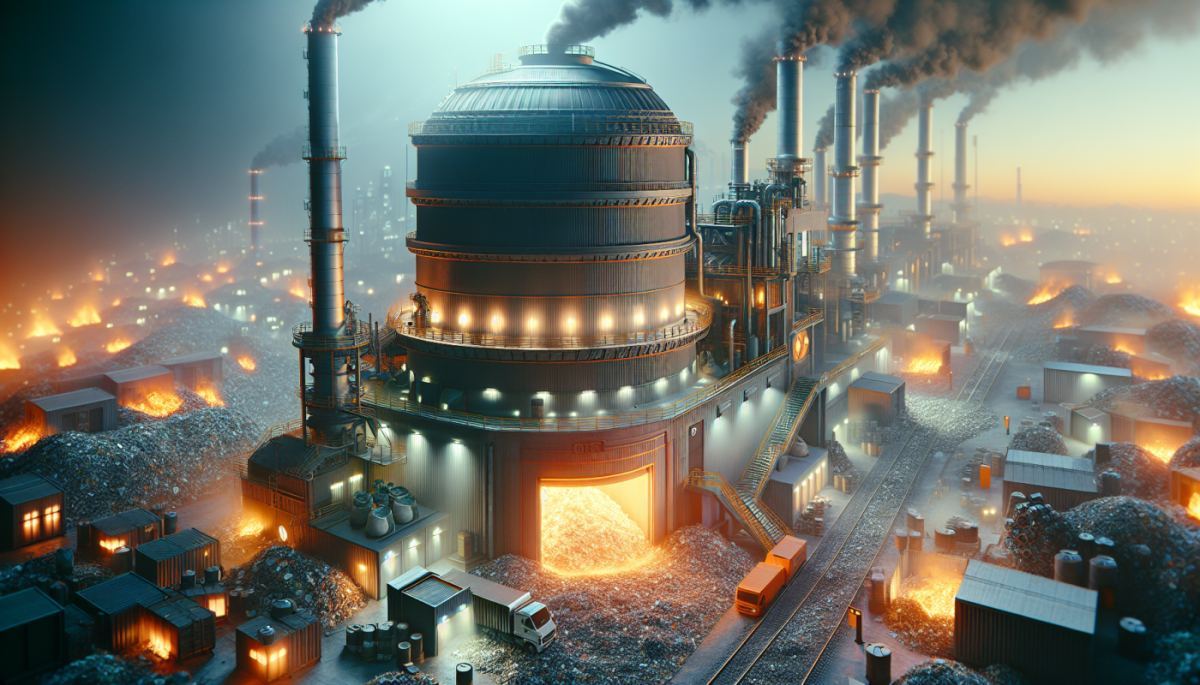
For decades, the economics of waste incineration in Europe have rested on a quiet subsidy: the right to emit carbon dioxide without paying for it. Across the continent, hundreds of facilities burn millions of tons of municipal solid waste each year, releasing greenhouse gases into the atmosphere at no direct cost to the operators. Brussels is now weighing whether to change that, by folding refuse incineration into the EU Emissions Trading System, the bloc's flagship carbon pricing mechanism. The implications, if it happens, would ripple far beyond the incinerator gates.
The EU ETS is built on a foundational principle that has guided European climate policy since the system launched in 2005: the polluter pays. Heavy industry, power generation, and aviation have all been brought under its cap-and-trade umbrella, obligating emitters to purchase allowances for every ton of CO2 they release. Waste incineration has remained a conspicuous exception. The sector burns not just food scraps and garden trimmings but enormous volumes of plastics, textiles, and packaging, all of which carry embedded carbon that gets released as combustion gases. The carbon footprint of European waste management is not trivial, and the absence of a price signal has meant operators have faced little structural incentive to reduce it.
Carbon pricing works by making emissions expensive enough that businesses change behavior. When steel producers face a carbon cost, they invest in cleaner furnaces. When airlines pay for allowances, they have reason to retire older, less efficient aircraft sooner. The logic is straightforward, but its application to waste is complicated by the fact that incineration operators do not control what goes into the waste stream. A facility burning mixed municipal waste is, in a sense, downstream of thousands of consumer and producer decisions made long before the truck arrives at the gate.
This is where the second-order consequences become genuinely interesting. If incinerators are brought into the ETS and face rising carbon costs, the most immediate effect would be higher gate fees, the charges municipalities pay to dispose of waste. Those costs would eventually flow back to local governments and, through them, to households and businesses. That pressure, in turn, could accelerate demand for better upstream sorting, reduced packaging, and more aggressive recycling infrastructure. In systems terms, the carbon price would function not just as a penalty on incineration but as a signal that reverberates back through the entire waste value chain, potentially reshaping producer responsibility frameworks and municipal procurement decisions alike.
Critics of the proposal argue that timing matters enormously. Europe's recycling infrastructure is uneven. In some member states, incineration is the dominant form of waste processing precisely because alternatives are underdeveloped. Imposing carbon costs before adequate recycling capacity exists could simply raise costs without meaningfully reducing emissions, a regressive outcome that would hit lower-income municipalities hardest. Proponents counter that this is precisely the argument that has been used to delay action for years, and that without a price signal, the investment in alternatives will never materialize at the necessary scale.
There is a broader structural irony embedded in this debate. The EU has spent years building out its circular economy agenda, pushing for extended producer responsibility, stricter packaging rules, and higher recycling targets. Yet the absence of a carbon price on incineration has quietly undermined those efforts by keeping the cost of burning waste artificially low relative to recycling it. When incineration is cheap, the economic case for investing in sorting facilities, reprocessing plants, and secondary materials markets weakens. The ETS gap has, in effect, been a slow leak in the circular economy's hull.
Bringing waste incineration into the carbon market would not solve the circular economy challenge on its own. But it would close a logical inconsistency that has persisted for two decades, and it would do so by using the market mechanism Europe has already built rather than layering on new regulation. The polluter pays principle, applied consistently, tends to generate the kind of durable behavioral change that mandates alone rarely achieve.
What happens next will depend heavily on political will and on how the transition provisions are structured. Phased implementation, free allowances during an adjustment period, and investment support for recycling infrastructure could blunt the most regressive effects while preserving the directional signal. The design details will matter as much as the decision itself. But if Brussels moves forward, the waste sector's long exemption from the basic rules of European climate policy will finally come to an end, and the feedback loops that follow could prove more consequential than the headline number on any carbon price.
References
- European Commission (2023) — EU Emissions Trading System (EU ETS)
- European Environment Agency (2023) — Waste and climate change
- European Commission (2022) — Fit for 55: Delivering the EU's 2030 Climate Target on the Way to Climate Neutrality
- Zero Waste Europe (2023) — Why Incineration Should Be Included in the EU ETS
Discussion (0)
Be the first to comment.
Leave a comment