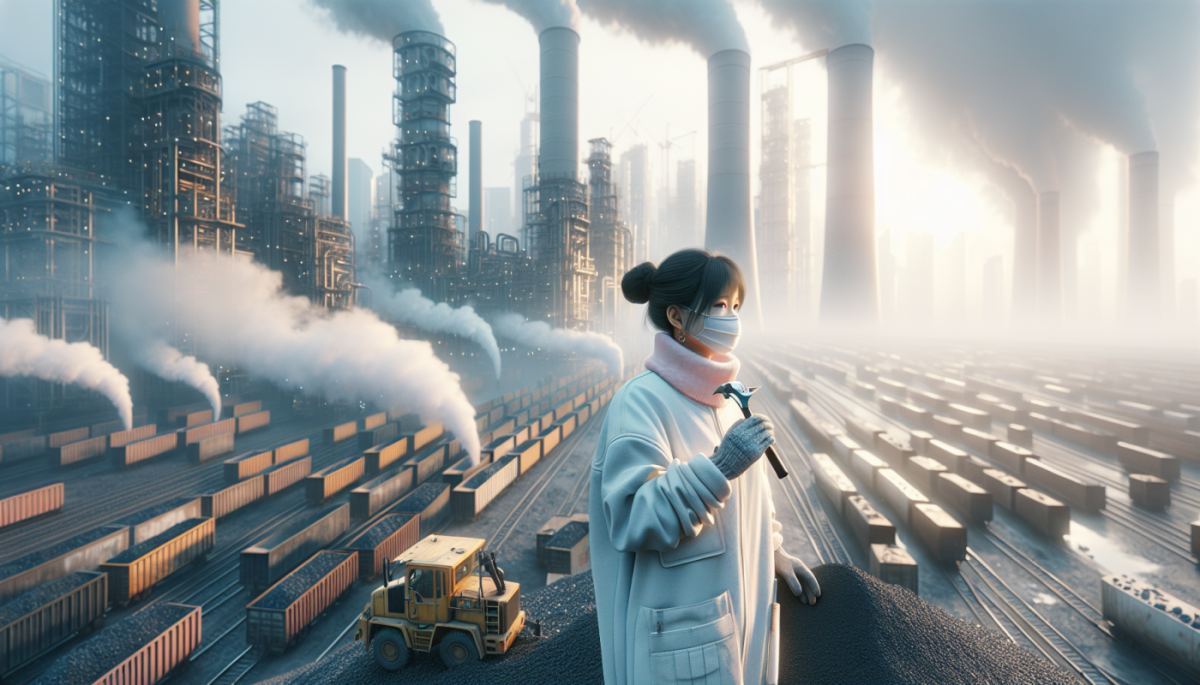
Methane rarely gets the headline attention that carbon dioxide does, but its climate punch is far more immediate. Over a 20-year timeframe, methane is roughly 80 times more potent as a greenhouse gas than CO2, and it is responsible for approximately 30% of the global temperature increase observed since the industrial era began. That makes what happens inside China's coal mines a matter of global consequence, not just domestic energy policy.
China is the world's largest coal producer, and coal mining is one of the most significant sources of methane emissions on the planet. As miners dig deeper to extract coal, they release methane that has been trapped in the seams for millions of years. The scale of China's coal sector means that even incremental shifts in how, where, and how deeply the country mines can send measurable ripples through the global methane budget.
The structural changes reshaping China's coal industry over the past decade are not simply a story of more or less coal. They are a story of different coal. China has been consolidating its mining sector, shutting down thousands of small, shallow mines that were deemed unsafe or inefficient, and shifting production toward larger, deeper operations. On the surface, this looks like modernization. Underground, it carries a significant atmospheric cost.
Deeper mines tend to have higher methane concentrations. The gas is under greater pressure, more abundant, and harder to manage. While larger, more modern mines are better equipped with ventilation systems designed to dilute and release methane safely, that process does not destroy the gas. It vents it directly into the atmosphere. Methane capture and utilization technology exists, and some Chinese mines do employ it, but deployment has been uneven and the economics have not always favored investment in capture infrastructure over raw production capacity.
The consolidation drive also had a geographic dimension. Production shifted toward coal-rich regions like Shanxi, Shaanxi, and Inner Mongolia, areas where coal seams are known to be gassier. This geographic concentration compounded the emissions intensity problem even as the total number of operating mines fell.
There is a systems-level irony embedded in China's coal transition that deserves careful attention. The country's push to close unsafe, inefficient mines was driven partly by genuine safety concerns and partly by a desire to rationalize an industry plagued by overcapacity. The policy achieved real gains in worker safety and productivity. But by concentrating production in deeper, gassier seams, it may have inadvertently increased methane emissions per unit of coal produced, even as the overall number of mining operations shrank.
This is a classic second-order effect: a policy optimized for one outcome, safety and efficiency, generating an unintended consequence in a domain, atmospheric methane, that was not part of the original calculus. It illustrates why sectoral reforms in heavy industry cannot be evaluated in isolation. The climate system does not respect the boundaries between a labor ministry's safety mandate and an environmental agency's emissions targets.
The global implications extend beyond China's borders. Methane is a short-lived climate pollutant, meaning that reducing emissions now produces relatively fast climate benefits compared to CO2 reductions. International frameworks like the Global Methane Pledge, which over 150 countries signed at COP26, have set a target of reducing global methane emissions by at least 30% from 2020 levels by 2030. Whether that target is achievable depends heavily on what happens in Chinese coal country.
Satellite-based methane monitoring has matured considerably in recent years, with instruments like the European Space Agency's Sentinel-5P and commercial platforms from GHGSat now capable of detecting emission plumes from individual mining complexes. This growing observational capacity means the gap between reported emissions and actual atmospheric concentrations is narrowing, creating new pressure on national inventories that have historically relied on bottom-up estimates with wide uncertainty ranges.
If China's methane emissions from coal mining are higher than official figures suggest, the implications cascade outward. Global temperature projections become harder to model accurately. The credibility of national climate commitments comes under scrutiny. And the case for aggressive methane capture investment, already economically marginal in many contexts, becomes simultaneously more urgent and more politically complicated.
The deeper question is whether the world's methane accounting systems are sophisticated enough to catch these structural shifts in real time, or whether policymakers will continue making decisions based on inventories that lag years behind the physical reality happening a kilometer underground.
Discussion (0)
Be the first to comment.
Leave a comment