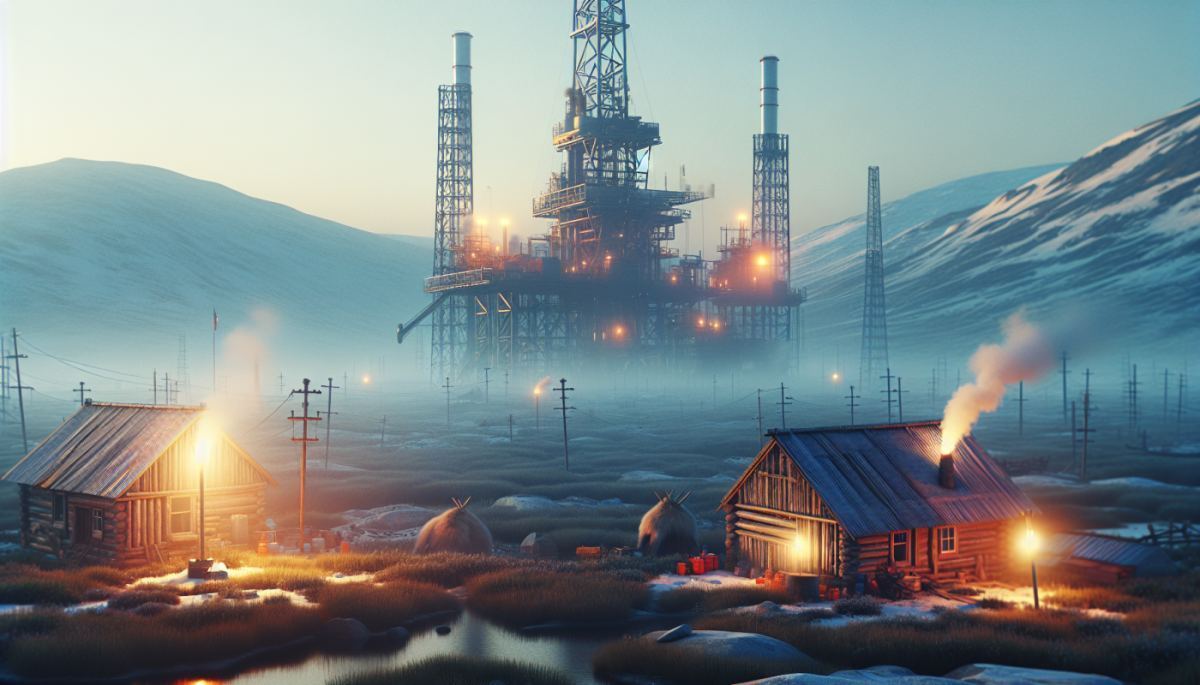
The federal government auctioned off more than 1.3 million acres of Alaskan Arctic land to oil companies this week, reopening a frontier that had been largely closed to drilling since 2019. The sale was the first of its kind in the region in six years, and it landed with particular force on Alaska Native communities whose subsistence hunting grounds and culturally significant landscapes sit directly within the newly leased territory. For those communities, this was not an abstract policy dispute. It was a transaction conducted over their objections, on land they have depended on for generations.
The Trump administration framed the sale as a straightforward act of energy development, consistent with its broader push to expand domestic fossil fuel production across federal lands and waters. But the acreage involved is not ordinary terrain. Portions of it had been designated for conservation, and local Alaska Native leaders had specifically flagged certain areas as critical to wildlife corridors and the subsistence practices that remain central to Indigenous life in the region. The tension here is not simply between environmentalists and industry. It is between two entirely different frameworks for what land is for.
Lease sales like this one do not emerge from nowhere. They are the downstream product of a regulatory and political system that has, over decades, been engineered to accelerate extraction. The National Petroleum Reserve in Alaska, which encompasses much of the land involved, was established precisely to serve as a strategic energy reserve. That original mandate creates a legal and institutional gravity that pulls toward drilling even when administrations change. When a new administration arrives with the will to accelerate that pull, the machinery moves quickly.
What makes this particular sale notable is the scale and the timing. The Biden administration had worked to restrict drilling in parts of the Arctic, including placing conservation overlays on sensitive habitat within the petroleum reserve. The Trump administration moved to reverse those restrictions, and Wednesday's auction was the result. More than 1.3 million acres now carry active leases, meaning companies have the legal right to begin the long process of exploration and eventual extraction. That process takes years, but the legal foundation is now in place.
The oil industry's interest in the Arctic has always been complicated by economics as much as politics. Drilling in remote, frozen terrain is extraordinarily expensive, and the price of oil has to remain high enough for a long enough period to justify the capital investment. Some of the acres sold this week may never see a drill bit, not because of regulation, but because the math does not work. That uncertainty, however, offers little comfort to the communities whose land is now under lease.
The most underreported consequence of this sale may not be the drilling itself, but what the leasing signals to the broader system of federal land management. When conservation designations are reversed and lease sales proceed over Indigenous objections, it recalibrates the expectations of every future negotiation. Alaska Native tribes and advocacy organizations have spent years building legal and political frameworks to assert greater influence over land-use decisions in their ancestral territories. Each rollback of those frameworks does not just affect the immediate acreage. It weakens the precedent that Indigenous consultation is a meaningful check on federal action rather than a procedural formality.
There is also a climate feedback dimension that rarely gets the attention it deserves. The Arctic is warming at roughly four times the global average rate, according to National Oceanic and Atmospheric Administration data. That warming is already destabilizing the permafrost, shifting animal migration patterns, and threatening the ice-dependent ecosystems that subsistence hunters rely on. Expanding oil infrastructure in that environment adds emissions that accelerate the very changes making traditional life harder to sustain. The communities most harmed by the drilling are, in many cases, the same communities already absorbing the costs of a warming Arctic.
What happens next will depend partly on legal challenges, which Alaska Native groups and environmental organizations are almost certain to pursue, and partly on oil prices, which will determine whether companies actually develop the leases they have purchased. But the more durable question is whether the federal government's relationship with Arctic Indigenous communities will be reshaped by this moment, or whether it will simply continue a pattern that has repeated itself across American history: resources extracted, objections noted, promises deferred.
The Arctic does not forgive quickly. Neither, historically, do the people who have lived there the longest.
Discussion (0)
Be the first to comment.
Leave a comment