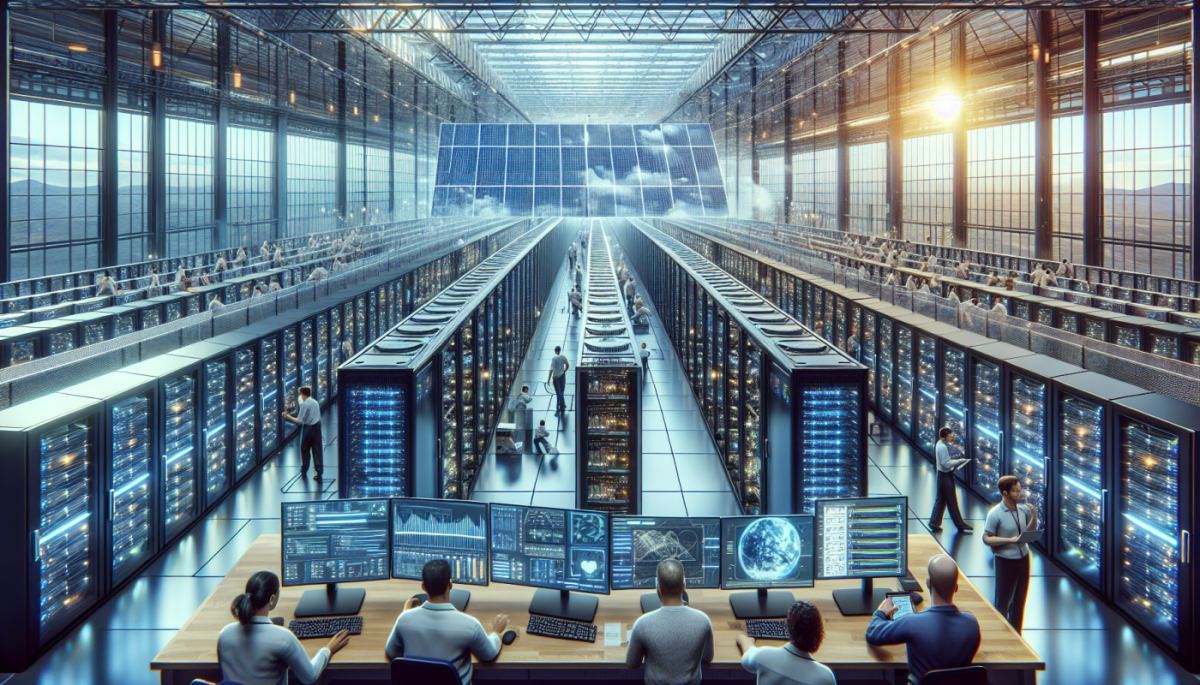
The electricity grid was not built for this. Decades of infrastructure planning assumed a gradual, manageable climb in power demand, punctuated by efficiency gains that would soften the slope. Then came the large language models, the GPU clusters, the hyperscale data centres humming around the clock, and suddenly utilities across the United States, Europe, and Asia are staring at demand forecasts that look less like a gentle incline and more like a cliff face.
The numbers are striking. AI data centres are among the most energy-intensive facilities ever built, with a single large campus capable of drawing as much electricity as a small city. Unlike a city, however, a data centre runs at near-constant load, twenty-four hours a day, seven days a week, with no overnight lull to give the grid room to breathe. That relentless appetite is forcing grid operators to make decisions, fast, about where the new power will come from, and who will pay for it.
The tension at the heart of this story is not purely technical. It is political and financial. When a hyperscaler like Microsoft, Google, or Amazon plants a data centre campus in a region, it triggers a cascade of infrastructure obligations: new transmission lines, upgraded substations, sometimes entirely new generation capacity. The question of who bears those costs is fiercely contested. Utilities and regulators in several US states are already debating whether large industrial customers should pay directly for the grid upgrades their load requires, or whether those costs should be socialised across all ratepayers, including households that will never benefit from the AI services being powered.
If costs are spread broadly, ordinary consumers effectively subsidise the infrastructure needs of some of the most profitable companies on earth. If costs are assigned directly to the tech firms, there is a risk, at least in theory, that investment slows or shifts to jurisdictions with more permissive cost structures. Neither outcome is clean, and the regulatory frameworks in most countries were simply not designed with this scenario in mind.
The energy source question is equally fraught. Big tech companies have made sweeping public commitments to run on clean energy, and many have signed long-term power purchase agreements with wind and solar developers. But the sheer scale and speed of AI-driven demand growth is outpacing the ability of renewable projects to come online. Permitting bottlenecks, supply chain constraints for transformers and cables, and the intermittent nature of wind and solar all mean that in the near term, some of the new generation capacity being built or reactivated to serve data centres will be fossil-fuelled. There are already documented cases of utilities in the US extending the life of coal plants or accelerating gas builds specifically to meet data centre load.
This creates a feedback loop that climate advocates find deeply uncomfortable. The same companies that have positioned themselves as leaders in corporate sustainability are, through their AI ambitions, creating conditions that could delay the retirement of fossil fuel infrastructure. The carbon accounting gets complicated quickly. A tech firm can claim its data centre runs on renewable energy through the purchase of certificates, while the physical electrons powering its servers on a windless night come from a gas peaker plant that would not have been built without the demand signal those servers created.
The second-order consequences extend beyond the grid itself. If AI data centres drive up electricity prices in the regions where they cluster, that affects the economics of electrifying transport and heating, two of the most important levers in the broader energy transition. Higher baseline demand raises the cost of the clean energy buildout for everyone, and it can crowd out the transmission capacity that distributed solar and wind projects need to reach population centres.
There is a more optimistic reading, and it deserves to be taken seriously. The same tech companies driving demand are also pouring capital into nuclear power, long-duration storage, and advanced geothermal, technologies that have struggled for years to attract patient, large-scale investment. If AI's electricity hunger accelerates the commercialisation of these technologies, the net effect on the energy transition could ultimately be positive. The question is whether that acceleration happens fast enough to matter, or whether the grid, in the meantime, locks in a decade of carbon-intensive capacity that proves stubbornly difficult to retire.
The energy transition has always been a race between the forces building clean infrastructure and the forces extending the life of dirty infrastructure. AI has just made that race significantly faster, and considerably harder to call.
Discussion (0)
Be the first to comment.
Leave a comment