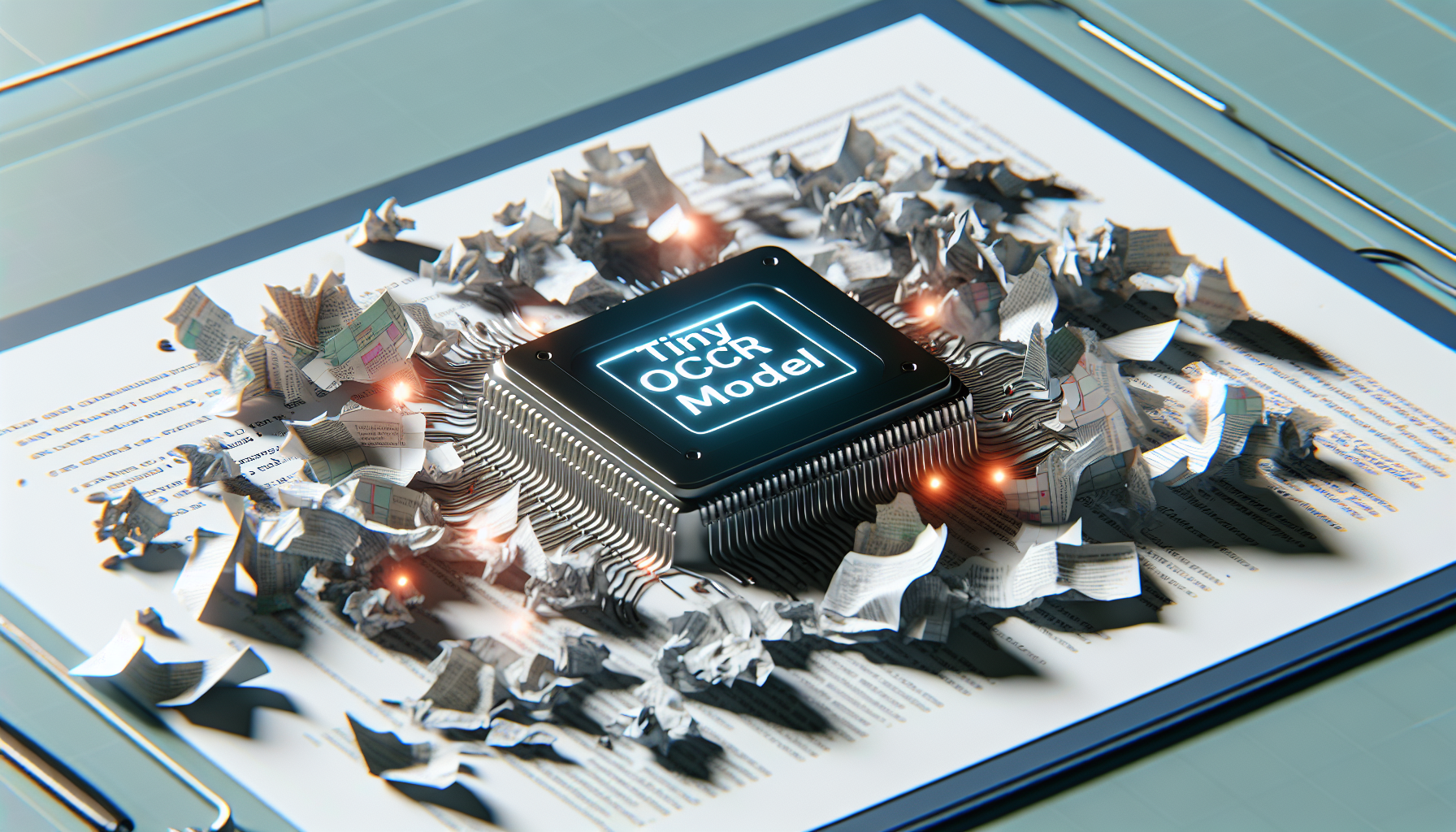
Most demonstrations of optical character recognition look deceptively clean. A crisp invoice, a neatly typed contract, a well-lit photograph of a printed page. The model reads it, the text appears, and everyone applauds. The harder truth, which anyone who has tried to automate document workflows at scale already knows, is that real documents are chaotic. Tables bleed into footnotes. Formulas sit inside scanned PDFs that were themselves printed from a fax. Handwritten annotations crowd the margins of typed forms. This is the problem that Zhipu AI is now directly targeting with GLM-OCR, a 0.9 billion parameter multimodal model built specifically for document parsing and key information extraction.
The model's most striking feature is not its capability but its size. At 0.9 billion parameters, GLM-OCR sits in a category of models that researchers sometimes call "compact" or "efficient," a polite way of saying it is designed to run without demanding the kind of GPU infrastructure that makes enterprise deployment a budget conversation. The significance of this is easy to underestimate. Large language and vision models have demonstrated impressive document understanding, but running them continuously across thousands of documents in a production pipeline is expensive. Every token processed at scale costs money, and inference costs compound quickly when you are parsing millions of invoices, receipts, or medical records per month. A model that can handle structured extraction, table parsing, and formula recognition at under one billion parameters changes the economics of the problem considerably.
Key information extraction, or KIE, is the specific challenge that separates useful OCR from mere text transcription. Transcription tells you what words are on a page. KIE tells you that a particular number is a total amount due, that a string of digits is a patient ID rather than a phone number, and that a table cell belongs to a specific row and column header. This requires the model to understand layout, spatial relationships, and document semantics simultaneously, not just pixel patterns. It is, in systems terms, a multi-constraint problem where errors in one layer cascade into failures in every downstream application that depends on the extracted data.
Zhipu AI's approach with GLM-OCR reflects a broader trend in the field toward multimodal architectures that treat the visual structure of a document as meaningful information rather than noise to be stripped away before language processing begins. By integrating vision and language understanding within a single compact model, GLM-OCR attempts to preserve the relational context that pure text extraction destroys. A formula is not just a sequence of symbols; it has a spatial grammar. A table is not just rows of numbers; the headers give those numbers meaning. Losing that structure at the parsing stage means no amount of downstream intelligence can recover it.
The broader implication of a capable, lightweight OCR model is worth sitting with for a moment. Document processing has historically been one of the most persistent bottlenecks in enterprise automation. Industries like insurance, healthcare, logistics, and legal services generate enormous volumes of unstructured or semi-structured documents that require human review precisely because automated systems could not reliably extract structured data from them. If models like GLM-OCR can close that reliability gap while remaining cheap enough to deploy at scale, the second-order effect is a significant reduction in the category of knowledge work that involves reading, classifying, and transcribing documents.
This is not a distant scenario. It is already happening incrementally, and GLM-OCR represents one more step along that gradient. The more interesting systemic question is what happens to the quality of extracted data when the cost of extraction falls close to zero. Historically, high extraction costs created a natural filter: only high-value documents were worth processing carefully. Cheap, automated extraction removes that filter entirely, which means organizations will process far more documents, surface far more data, and face entirely new challenges around what to do with it all. The bottleneck does not disappear; it moves downstream, from extraction to interpretation and governance.
Zhipu AI is a Beijing-based company with deep roots in the GLM family of language models, and GLM-OCR extends that lineage into the document intelligence space at a moment when competition in efficient multimodal models is intensifying globally. Whether the model's performance on genuinely difficult real-world documents matches its architectural ambitions remains to be tested at production scale. But the direction of travel is clear: the era of OCR as a specialized, expensive capability is ending, and what replaces it will reshape how organizations relate to their own paper trails.



Discussion (0)
Be the first to comment.
Leave a comment