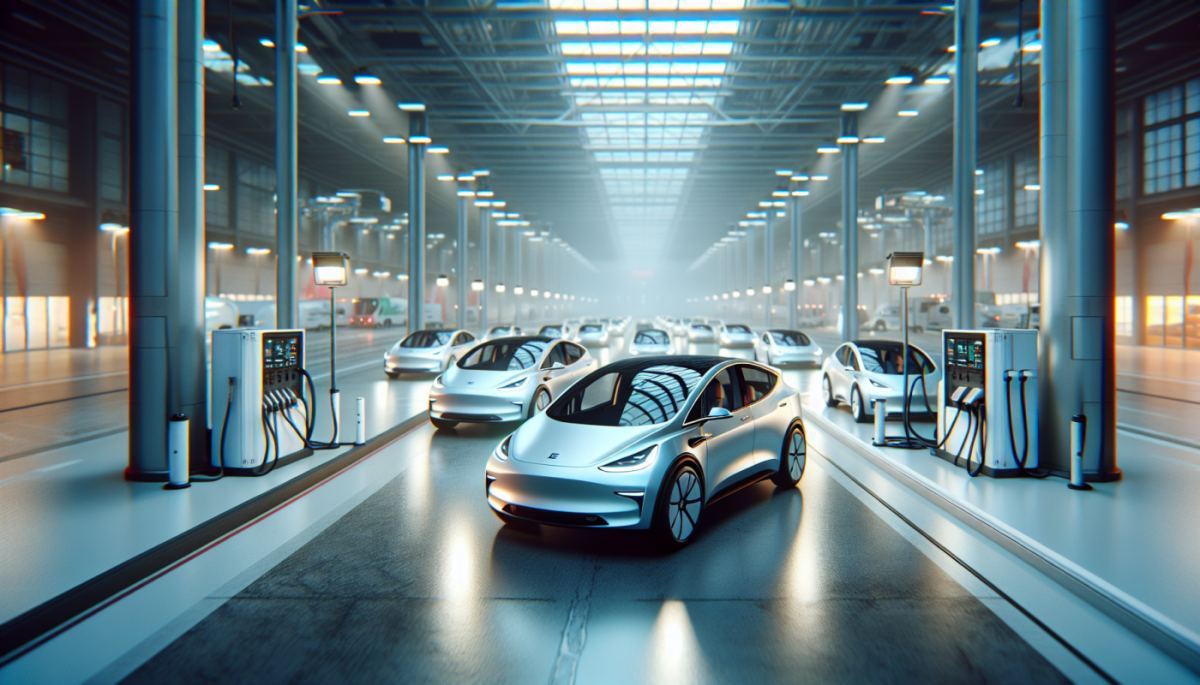
The threat of war in the Middle East has a way of concentrating minds on oil. Every time tensions flare around the Strait of Hormuz, markets twitch, gas prices spike, and governments scramble to reassure nervous publics that supply chains are secure. But a quieter revolution has been unfolding in the background, one that is slowly, structurally eroding oil's grip on the global economy. According to new analysis, the world's electric vehicle fleet avoided oil consumption in 2025 equivalent to roughly 70 percent of Iran's total oil exports. That number deserves more attention than it's getting.
Iran exports somewhere between 1.5 and 1.7 million barrels of oil per day, depending on sanctions enforcement and smuggling routes. The fact that EVs are already displacing a demand volume approaching that scale is not just a curiosity. It is a signal that the geopolitical leverage embedded in oil is beginning to erode from the demand side, not just the supply side. For decades, the strategic conversation around oil security has focused almost entirely on who controls the wells, the pipelines, and the chokepoints. The EV transition is quietly rewriting that equation.
The vulnerability of the global economy to oil shocks has always been a function of dependency. Countries that import oil are exposed to price volatility, supply disruptions, and the political whims of producing nations. The standard policy response has been to build strategic reserves, diversify suppliers, and maintain military presence near critical infrastructure. None of those approaches actually reduce the underlying dependency. They manage it. EVs, by contrast, eliminate it at the point of consumption.
When a driver plugs in rather than filling up, that barrel of oil simply doesn't get burned. Multiply that across tens of millions of vehicles globally and the cumulative displacement becomes geopolitically meaningful. The International Energy Agency has tracked this dynamic closely, noting that EV adoption has been one of the primary forces suppressing oil demand growth in recent years. What was once a niche technology argument is now a mainstream demand-side force that OPEC has had to factor into its own production calculations.
The Iran scenario makes this concrete. If military conflict were to disrupt Iranian exports entirely, the global market would need to absorb a shock of roughly 1.5 million barrels per day. The EV fleet is already displacing a comparable volume. That doesn't mean EVs are a perfect hedge against a war premium in oil prices, because markets price on fear and futures as much as on physical supply. But it does mean the structural floor of oil demand is lower than it would have been in any previous decade, and it is falling further every year as EV adoption accelerates.
There is a second-order consequence here that most coverage misses entirely. As EV adoption grows and oil demand softens, the fiscal pressure on oil-dependent states intensifies. Countries like Iran, Venezuela, and even Saudi Arabia have national budgets that are deeply sensitive to oil price levels. When demand destruction from EVs keeps a ceiling on prices even during supply disruptions, the revenue available to those governments shrinks. That fiscal pressure can constrain military adventurism, reduce subsidies that prop up domestic political stability, and accelerate internal reform pressures.
This is not a linear or immediate effect. Oil markets are complex, and producers have shown remarkable resilience in managing output to defend prices. But the directional pressure is real. The more EVs displace demand, the harder it becomes for any single producer or cartel to engineer a sustained price spike. The geopolitical leverage that oil has provided to certain governments for the better part of a century is not disappearing overnight, but it is being gradually hollowed out from below.
For policymakers in Washington, Brussels, and Beijing, this dynamic should be shaping infrastructure investment decisions right now. Every charging station built, every grid upgrade completed, and every EV subsidy deployed is not just a climate policy. It is a national security investment that reduces exposure to exactly the kind of Middle East volatility that has destabilized energy markets repeatedly since the 1970s.
The world has spent fifty years trying to secure oil supply. The more interesting question, as the EV transition accelerates, is what happens to the political economies built entirely around selling it.

Discussion (0)
Be the first to comment.
Leave a comment