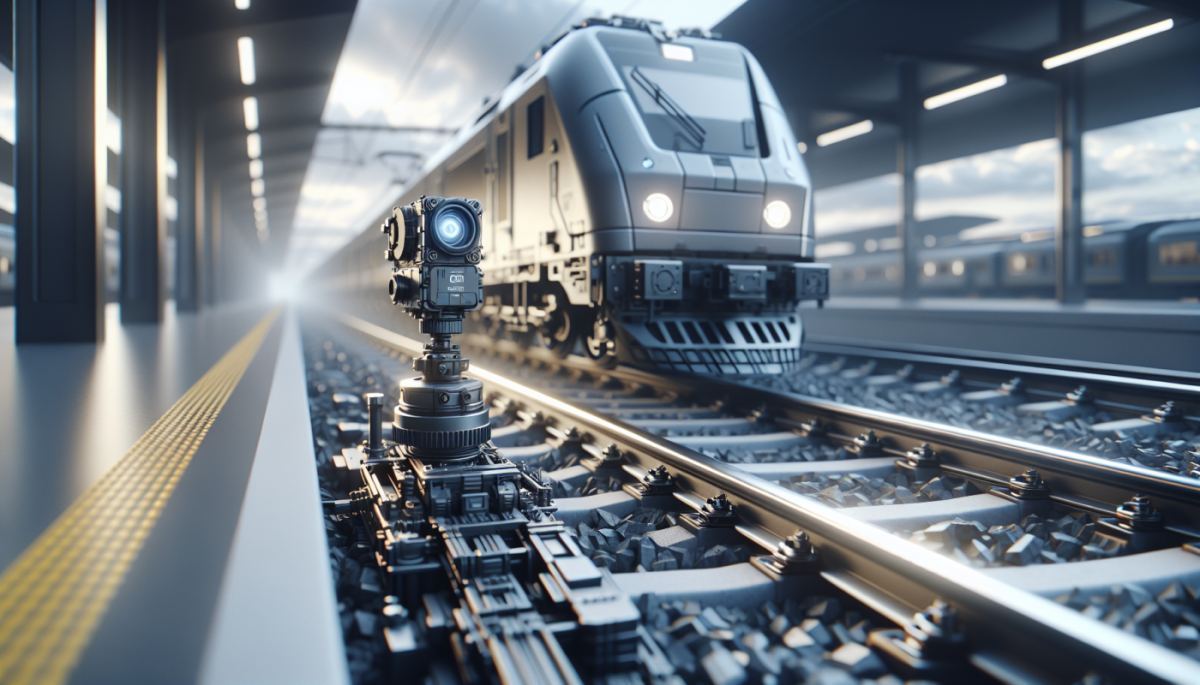
Rail Vision has cleared a significant legal milestone, securing a patent from the European Patent Office for a railway collision avoidance system that combines artificial intelligence with electro-optical imaging. The technology is designed to detect obstacles on or near tracks in real time, giving trains the ability to respond to hazards faster than any human operator could. It is a quiet but consequential development in a sector where the cost of getting safety wrong is measured in lives.
The patent covers both a method and a system, meaning Rail Vision holds protected rights not just over the hardware but over the underlying process logic that governs how the AI interprets what it sees. Electro-optical imaging, which captures visual data across multiple light spectrums including infrared, allows the system to function in conditions that defeat ordinary cameras: fog, darkness, heavy rain, and glare. These are precisely the conditions under which rail incidents are most likely to occur and most difficult to prevent.
Europe's rail network is under enormous pressure right now. The European Union has been pushing hard to shift freight and passenger traffic from road to rail as part of its broader decarbonization agenda, with the European Green Deal explicitly targeting a doubling of high-speed rail traffic by 2030 and a 50 percent increase in rail freight. More trains on the same infrastructure means tighter scheduling, higher speeds, and less margin for error. The demand for automation and intelligent safety systems is not just a technology trend; it is a structural necessity.
At the same time, rail operators across the continent are grappling with aging signaling infrastructure. Many lines still rely on systems designed decades ago, and the cost of wholesale replacement is prohibitive. AI-based collision avoidance mounted on the train itself, rather than embedded in the trackside infrastructure, offers a compelling workaround. It does not require ripping up existing signaling networks. It layers intelligence on top of what already exists, which is exactly the kind of pragmatic, incremental upgrade that cash-strapped national rail operators can actually deploy.
Rail Vision, an Israeli technology company, has been developing this system with a focus on what the industry calls "last mile" detection, the short-range, high-stakes zone directly ahead of a moving train where reaction time is most critical. Securing a European patent is not just a legal formality. It establishes a territorial moat around the technology at the precise moment European rail is most receptive to adopting it.
The second-order consequences here extend well beyond train safety statistics. If AI collision avoidance systems become standard equipment on European rolling stock, they will generate an enormous and continuous stream of trackside data. Every journey becomes a sensor run, capturing the state of the infrastructure, the presence of unauthorized persons, vegetation encroachment, and structural anomalies. That data, aggregated across thousands of trains and millions of kilometers, could become one of the most detailed real-time maps of rail infrastructure ever assembled.
This creates a feedback loop with significant implications for maintenance planning. Rail operators currently rely on scheduled inspection cycles, which are expensive and imperfect. A fleet of AI-equipped trains that passively monitors the network as a byproduct of normal operations could shift the industry toward predictive, condition-based maintenance. The safety patent, in other words, may be the seed of a much larger data economy.
There is also a competitive dynamic worth noting. Rail Vision's European patent puts pressure on incumbent signaling giants like Alstom, Siemens Mobility, and Thales, all of whom have their own automation and safety portfolios. A protected AI imaging method in the hands of a nimble specialist firm complicates their product roadmaps and may accelerate acquisition interest. The history of industrial technology is full of moments where a well-timed patent reshaped the competitive landscape before most observers noticed it happening.
The deeper question is whether the regulatory frameworks governing European rail safety will evolve quickly enough to let this technology reach its potential. The European Union Agency for Railways sets the technical standards that determine what safety systems can be certified for operational use. How fast that agency moves will determine whether Rail Vision's patent translates into deployed systems or sits on a shelf waiting for approvals that take longer than the technology cycle itself.
The trains of the next decade will almost certainly see better than their drivers. The race now is to make sure the rules of the road catch up.

Discussion (0)
Be the first to comment.
Leave a comment