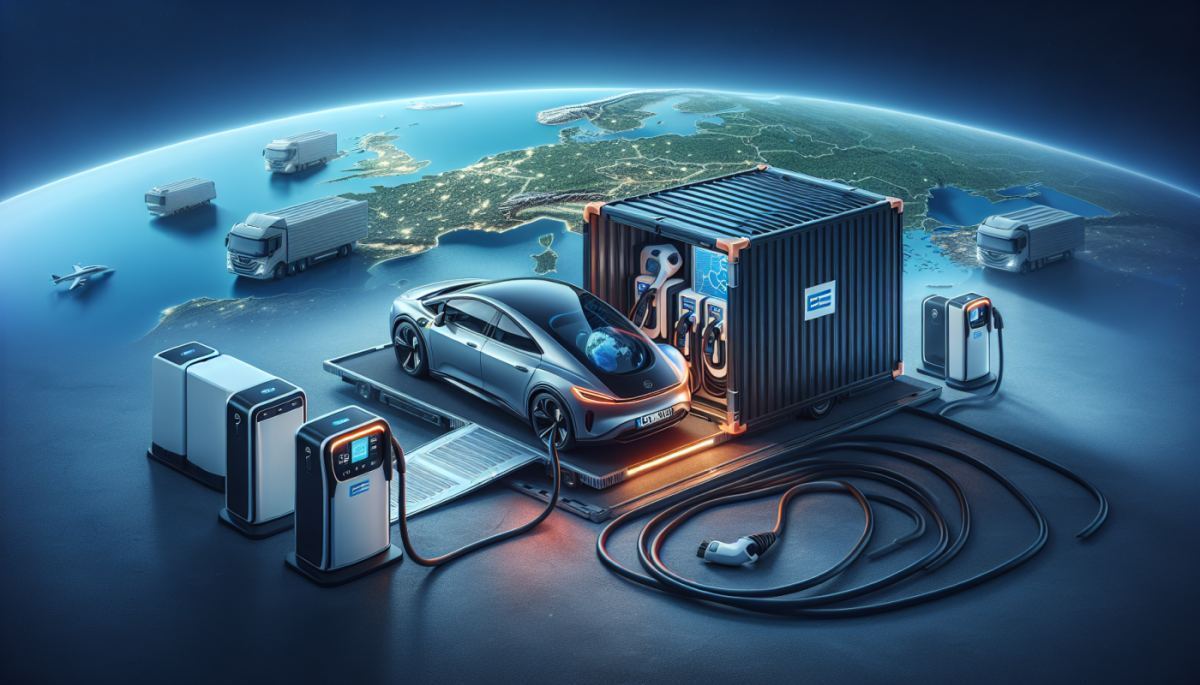
The anxiety that has long shadowed electric vehicle adoption, range anxiety, may finally be giving way to a new and more solvable problem: charging speed. BYD, the Chinese automaker that has quietly become one of the most consequential forces in global transportation, is now preparing to bring its Flash Charger technology to Europe. With a peak output of 1,500 kilowatts delivered to a single vehicle, these chargers do not merely compete with existing European infrastructure. They reframe what charging infrastructure is supposed to be.
For context, Ionity, the pan-European fast-charging network backed by BMW, Ford, Hyundai, Mercedes-Benz, and Volkswagen, currently operates chargers that top out at 350 kilowatts per station. That figure was considered ambitious when Ionity launched in 2017. BYD's Flash Charger delivers more than four times that output. The practical implication is a charge time that drops from the current industry benchmark of roughly 20 to 30 minutes down to approximately five minutes for a meaningful range top-up. That is, for most drivers, closer to a petrol station stop than a coffee break.
Europe has spent years building a charging network that was designed around the capabilities of the vehicles and technology available at the time. That is a reasonable way to build infrastructure. The problem is that the technology did not wait. BYD and other Chinese manufacturers have been developing battery and charging systems at a pace that European legacy automakers and their affiliated charging networks have struggled to match. The result is a growing mismatch between what European charging stations can deliver and what next-generation vehicles are capable of absorbing.
This is not simply a hardware problem. It is a systems problem. Charging networks like Ionity require significant capital investment, grid connection agreements, planning permissions, and long-term site leases. These are not assets that can be upgraded overnight. When BYD rolls Flash Chargers into European markets, it will not just be offering faster charging. It will be exposing the structural lag embedded in infrastructure that was built to yesterday's specifications. Ionity and its backers will face a choice between expensive retrofits and the reputational cost of operating what will increasingly look like slow infrastructure.
The grid implications deserve attention too. Delivering 1,500 kilowatts to a single vehicle is an extraordinary demand event. Scaling that across dozens of simultaneous charging bays at a busy motorway service station creates load spikes that current grid connections at many sites are not designed to handle. BYD will almost certainly need to pair its Flash Chargers with on-site battery storage systems to buffer demand, a solution that adds cost and complexity but also, interestingly, creates a new role for stationary storage in the energy transition.
The competitive pressure here extends well beyond the charging network operators. European automakers have spent billions developing their own proprietary battery platforms and charging architectures. If BYD's Flash Charger ecosystem becomes a meaningful part of European infrastructure, it creates a gravitational pull toward BYD's own vehicles, which are engineered to take full advantage of that charging speed. A Volkswagen or a Renault plugged into a Flash Charger will not charge at 1,500 kilowatts. It will charge at whatever its onboard system allows, which for most current European EVs is a fraction of that ceiling.
This creates a feedback loop that is worth watching carefully. Faster charging infrastructure makes BYD vehicles more attractive. More BYD vehicles on European roads creates demand for more Flash Chargers. More Flash Chargers make the gap between BYD-compatible vehicles and everything else more visible to consumers. It is the kind of self-reinforcing dynamic that, once established, is very difficult for incumbents to interrupt without matching BYD's pace of development rather than simply responding to it.
European regulators have already shown willingness to use tariffs as a brake on Chinese EV imports, with the European Commission imposing additional duties on BYD, Geely, and SAIC vehicles in 2024. But tariffs on vehicles do not obviously extend to charging hardware, and infrastructure investment is precisely the kind of market entry that is harder to block without appearing to obstruct the clean energy transition that European policy is otherwise committed to accelerating.
The five-minute charge is not just a technical achievement. It is a strategic wedge, and Europe's charging landscape may look very different by the time the continent finishes debating how to respond.

Discussion (0)
Be the first to comment.
Leave a comment