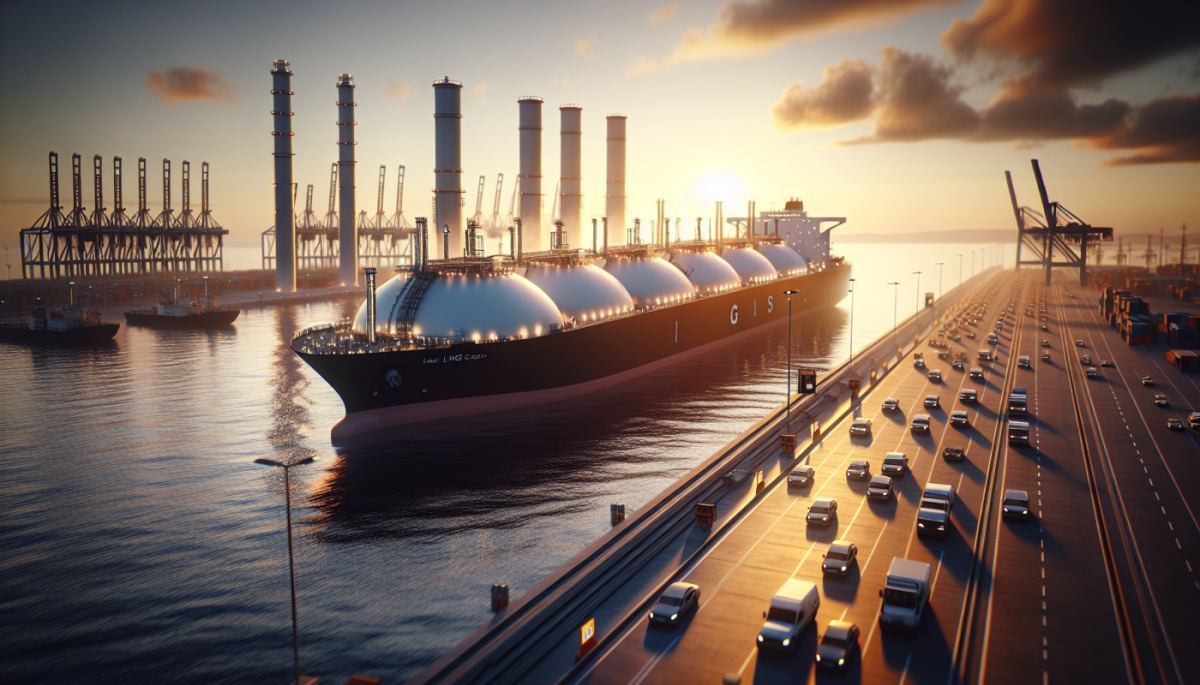
The tankers are already at sea. They left before the missiles flew, loaded with liquefied natural gas from the Middle East, and they are now threading their way toward European and Asian ports with roughly ten days left on the clock. Once they dock and offload, the pipeline of Gulf LNG that markets have quietly depended on will go quiet, at least temporarily, and the world will get its first real test of how fragile the global gas supply chain has become.
Iran's missile attacks have introduced a level of geopolitical disruption that energy traders had long modeled as a tail risk but never quite priced in with full seriousness. The Strait of Hormuz, through which roughly a fifth of the world's LNG passes, is not just a shipping lane. It is a pressure valve for global energy markets, and right now that valve is under direct threat. The carriers currently en route represent the last undisturbed wave of supply from the region, and their arrival will mark the end of what might be called the pre-escalation buffer.
What makes this moment particularly sharp is the timing. Europe spent the better part of two years rebuilding gas storage after Russia's invasion of Ukraine upended its energy architecture. Storage levels across the continent climbed back toward comfortable territory, but that recovery was built on a diversified import strategy that leaned heavily on Middle Eastern and Qatari LNG as a substitute for Russian pipeline gas. Qatar, the world's largest LNG exporter, ships the overwhelming majority of its product through the Strait of Hormuz. Any sustained disruption to that corridor does not just inconvenience traders. It structurally undermines the post-Ukraine energy pivot that European governments staked enormous political capital on.
The deeper systems problem here is not the immediate supply gap, serious as that is. It is the feedback loop that a prolonged disruption could trigger across interconnected markets. Higher gas prices feed directly into electricity costs, which then ripple into industrial production costs, which then slow the very manufacturing recovery that central banks in Europe and Asia are counting on to justify easing monetary policy. Energy price shocks have a well-documented history of arriving just as economies think they have turned a corner, and the current moment carries that same uncomfortable symmetry.
Asian buyers face a different but equally acute version of this problem. Japan, South Korea, and Taiwan have all rebuilt their LNG import infrastructure with the assumption of relatively stable Gulf supply. Spot market prices in Asia were already elevated heading into this period, and a supply cliff arriving during the shoulder season, before peak summer cooling demand, gives utilities very little room to absorb the shock before it becomes visible to consumers and industries alike.
There is also a second-order consequence that deserves more attention than it is currently getting. Insurance and shipping rates for vessels willing to transit the Strait of Hormuz are almost certainly going to spike, and some operators will simply refuse the route regardless of the premium on offer. That self-imposed market withdrawal can amplify a physical supply disruption far beyond what the actual missile threat would justify on its own. The perception of danger, in shipping markets, often does more work than the danger itself.
The ten-day window before the final pre-escalation cargoes arrive is not just a countdown to a supply problem. It is a countdown to a pricing and political reckoning. Governments that have been managing public expectations around energy costs will face renewed pressure the moment spot prices begin reflecting the new reality. The United States, which has dramatically expanded its own LNG export capacity over the past three years, will face calls to redirect more supply toward allied markets, a move that carries its own domestic political complications heading into an already volatile electoral environment.
The longer this disruption persists, the more it will accelerate conversations that were already underway about the structural overdependence on any single chokepoint in global energy logistics. The Strait of Hormuz has always been the system's most obvious single point of failure, and every serious energy security analysis has flagged it as such for decades. What is different now is that the theoretical has become operational, and the ships still at sea are carrying more than LNG. They are carrying the last few days of a stability that markets had quietly assumed would hold.
References
- U.S. Energy Information Administration (2024) — World LNG Trade and the Strait of Hormuz
- International Energy Agency (2023) — Global Gas Security Review
- Oxford Institute for Energy Studies (2024) — European Gas Storage and LNG Import Trends
- Reuters (2024) — Qatar LNG Exports and Hormuz Strait Exposure
Discussion (0)
Be the first to comment.
Leave a comment