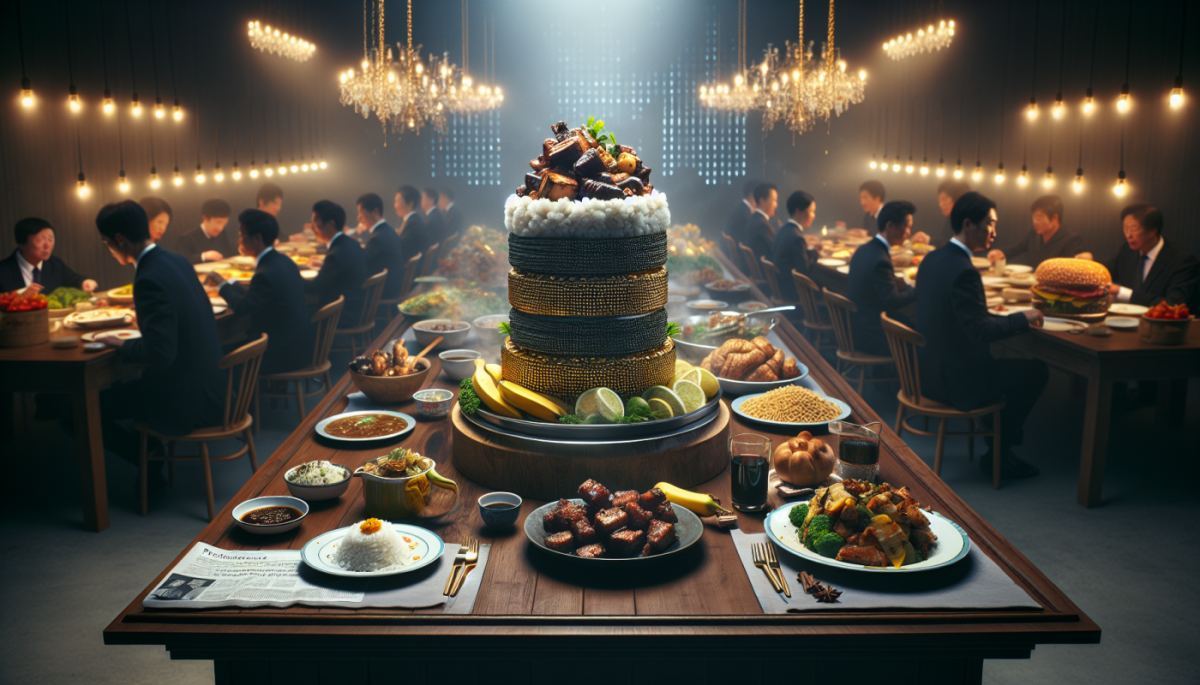
There is an old Chinese greeting that translates roughly as 'Have you eaten yet?' It was never really about food. For generations, it was a way of asking whether someone was surviving, whether the day had been kind, whether the most basic threshold of human dignity had been met. That question carries centuries of famine memory, and it helps explain something that puzzles Western economists when they first look at Chinese household spending data: Chinese families spend a remarkably high proportion of their income on food, even as the country has grown dramatically wealthier.
This pattern is, in fact, a 21st-century test of a 19th-century observation. In 1857, the Prussian statistician Ernst Engel proposed what became known as Engel's Law: as household income rises, the share of that income spent on food tends to fall. Wealthier people still eat, of course, but food becomes a smaller slice of a larger pie. The law has held up remarkably well across most of the industrialised world. China, however, presents a more complicated picture, one that reveals how culture, history, and the specific texture of economic development can bend even the most durable statistical regularities.
China's relationship with food scarcity is not ancient history. The Great Famine of 1959 to 1961, caused in large part by the failures of the Great Leap Forward, killed tens of millions of people. Scholars at institutions including the University of California have estimated the death toll at anywhere between 15 and 55 million. That trauma did not simply evaporate when China's economy began its extraordinary expansion after 1978. It was encoded into family behaviour, passed down through grandparents who remembered rationing, through parents who were taught never to waste a grain of rice. The cultural weight of food in China is not merely sentimental. It is a form of institutional memory.
But history alone does not explain the numbers. China's Engel coefficient, which measures food expenditure as a share of total household spending, has been falling, as the law would predict, dropping from above 50 percent in the 1980s to around 30 percent by the early 2020s according to China's National Bureau of Statistics. Yet that figure still sits higher than comparable income-level peers, and the absolute amount Chinese households spend on food has surged. What is happening is not a violation of Engel's Law so much as a transformation of what 'food spending' actually means in a modernising society.
In China, food is not merely nutrition. It is the primary medium of social exchange. Business deals are sealed over banquets, family relationships are maintained through shared meals, and social status is communicated through where you eat and what you order. This is not unique to China, but the intensity and formality of food-based social ritual in Chinese culture means that spending on food functions partly as spending on social capital. When a family in Shanghai books a private room at a high-end Cantonese restaurant to celebrate a child's university entrance, they are not simply buying calories. They are investing in relationships, signalling success, and participating in a cultural grammar that has no real equivalent in, say, a German household's grocery budget.
This dynamic has been supercharged by urbanisation and the rise of the middle class. As hundreds of millions of Chinese citizens moved from rural areas into cities over the past four decades, food spending shifted from home-grown subsistence toward purchased meals, restaurant dining, and premium packaged goods. The food delivery industry alone, dominated by platforms like Meituan and Ele.me, processed hundreds of billions of yuan in transactions annually by the early 2020s, representing an entirely new category of food expenditure that did not exist a generation ago.
The second-order consequence worth watching is this: as China's population ages and its economic growth moderates, the cultural premium placed on food spending may increasingly collide with financial pressure on younger generations. A cohort already squeezed by high urban housing costs and a difficult job market may find the social obligation to spend lavishly on food a source of genuine financial stress rather than pleasure. If that tension grows, it could quietly reshape not just household budgets but the entire ecosystem of restaurants, food platforms, and agricultural supply chains that have been built on the assumption that Chinese consumers will always prioritise the table above almost everything else.
Discussion (0)
Be the first to comment.
Leave a comment