
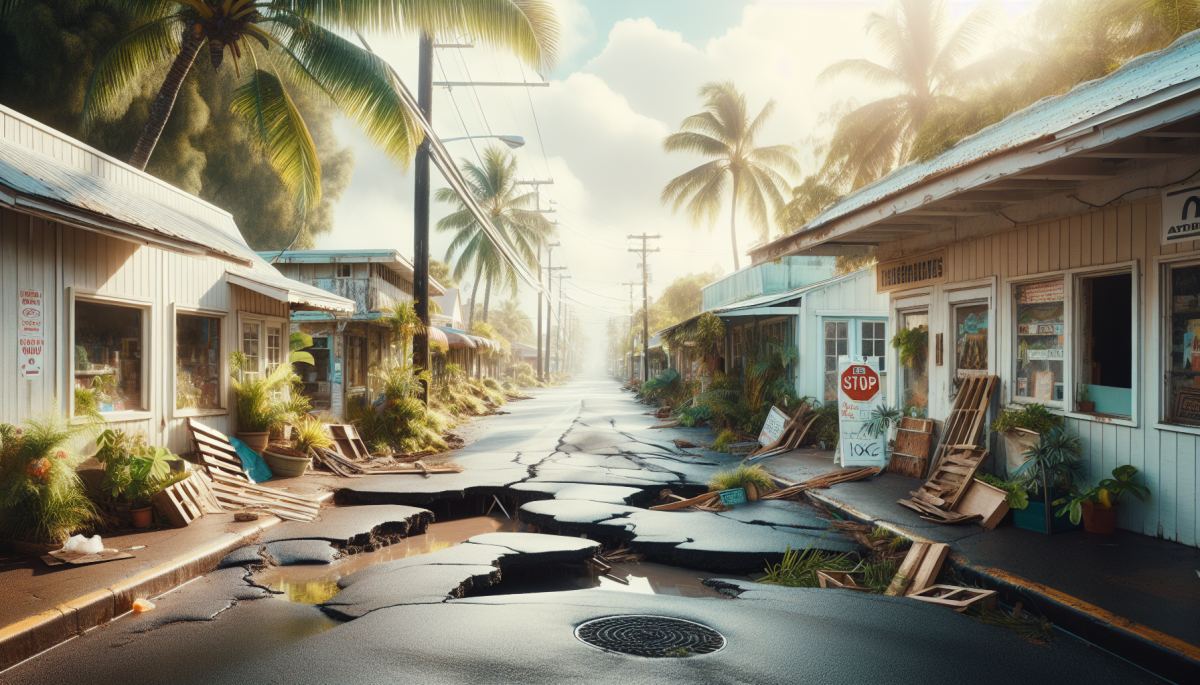
The ground in Lahaina has been unstable for a long time now, in more ways than one. Nearly three years after the August 2023 wildfires killed at least 100 people and erased much of the historic town, residents are still fighting to reclaim what remains. In March, two back-to-back storms brought the worst flooding Hawaii had seen in two decades, turning streets into rivers, opening sinkholes that swallowed cars, and carving new channels through land that was already stripped bare by fire. The timing felt almost cruel. But for the people who stayed, or who never left, the response was familiar: neighbors helping neighbors, community networks activating before any official aid arrived.
That instinct, captured in the phrase locals have repeated since the fires, "In Hawaii, we take care of one another," is not just cultural sentiment. It is the operating system of a community that has learned, repeatedly, that outside institutions will not prioritize them. The 2023 fires exposed how catastrophically that assumption plays out when warning sirens fail, evacuation routes collapse, and emergency management systems designed for tourist-season logistics buckle under the weight of a genuine disaster. What followed was not just grief but a slow, grinding negotiation over who Lahaina would be rebuilt for.
That negotiation has never been straightforward. Maui's economy runs on tourism, and Lahaina, with its historic Front Street and waterfront charm, was one of the island's most visited destinations. Within weeks of the fire, residents and housing advocates were raising alarms that the disaster would accelerate what had already been happening for years: the displacement of Native Hawaiian and working-class families by rising property values, short-term rental conversions, and outside investment. The fear was not abstract. After major disasters on the U.S. mainland, from New Orleans after Katrina to parts of Puerto Rico after Maria, recovery dollars and policy decisions have repeatedly reshaped communities in ways that served developers and tourism interests more than the people who actually lived there.
Maui County officials and Hawaii's state government have made public commitments to rebuild Lahaina as a community for residents, not a resort destination. But commitments made in the immediate aftermath of disaster have a way of softening under the sustained pressure of economic incentives. Land in Lahaina is extraordinarily valuable. Insurance payouts, federal recovery funds, and private capital are all circulating in a landscape where longtime residents, many of them renters, have limited legal leverage and even more limited financial resources.
Then, in early 2025, a new pressure arrived. ICE enforcement operations in Hawaii, part of a broader national surge in immigration enforcement, created a chilling effect in communities where undocumented workers and mixed-status families had long been part of the social fabric. In a place still trying to stabilize after fire and flood, the added fear of immigration raids disrupted the informal labor networks and mutual aid systems that communities like Lahaina depend on during recovery. People stopped showing up to volunteer sites. Families pulled back from public assistance programs. The social infrastructure that had been holding things together became more fragile.
What is unfolding in Lahaina is a case study in compounding system shocks. Climate scientists have long warned that disasters do not arrive in isolation. They arrive in sequences, each one eroding the resilience that might have absorbed the next. The 2023 wildfire was driven by drought, high winds, and the spread of invasive grasses that had replaced native vegetation across large parts of Maui. The March 2025 flooding hit land that had lost its topsoil and root systems to fire, meaning water moved faster and with more destructive force than it would have otherwise. The sinkholes were not bad luck. They were the predictable consequence of destabilized ground.
The second-order effect worth watching is what happens to community cohesion under this kind of sustained, multi-vector stress. Research on disaster recovery consistently shows that social trust and local networks are among the strongest predictors of long-term community resilience. But those networks are not infinitely elastic. When the same community faces fire, flood, economic displacement, and immigration enforcement within a span of roughly two years, the cumulative load can fracture even the most tightly knit social systems. The people of Lahaina have shown remarkable solidarity. The question is whether the broader systems surrounding them, policy, investment, federal recovery infrastructure, will reinforce that solidarity or quietly work against it.
The storms of March 2025 did not make the national news the way the fires did. That asymmetry in attention is itself a kind of systems failure, one that tends to repeat until the community in question is too depleted to recover on its own terms at all.
Discussion (0)
Be the first to comment.
Leave a comment