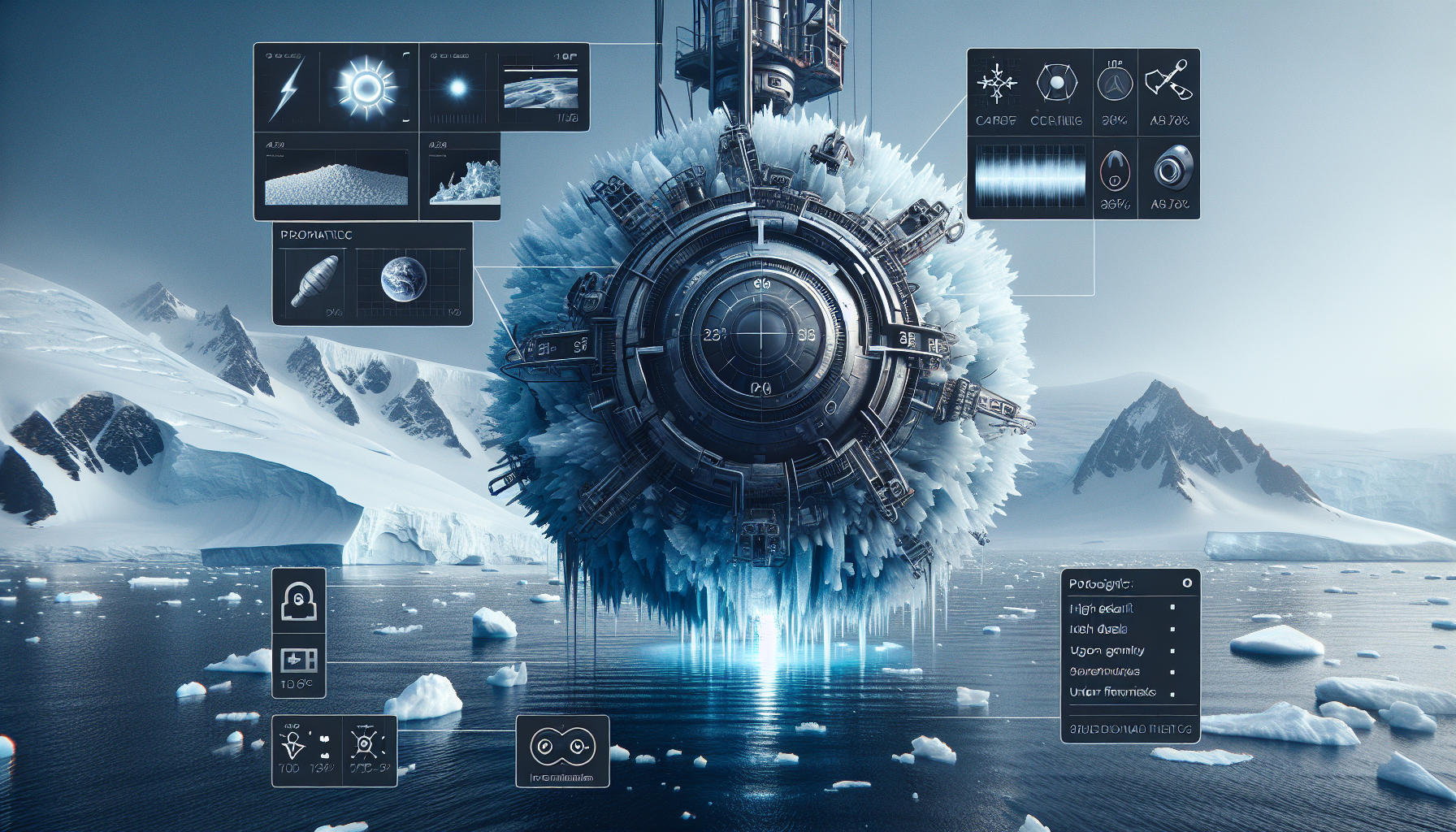
For years, one of the more elegant ideas in climate science held that melting Antarctic glaciers might carry within them a kind of self-correcting mechanism. As ice sheets dissolved, the theory went, they would release iron into the Southern Ocean, feeding blooms of phytoplankton that would in turn absorb carbon dioxide from the atmosphere. It was a feedback loop that offered a rare sliver of optimism in an otherwise grim body of climate literature. New field data from West Antarctica suggest that optimism was misplaced.
Researchers collecting measurements directly from Antarctic meltwater have found that glacial runoff delivers far less bioavailable iron to the Southern Ocean than models and laboratory studies had previously suggested. The iron is there, but not in the quantities or forms that would meaningfully stimulate large-scale phytoplankton growth. More significantly, the data point to a different origin story for the ocean's iron supply altogether: most of it appears to come from deep ocean upwelling and seafloor sediments, not from the melting ice itself.
This is not a minor recalibration. The iron fertilization hypothesis had become something of a load-bearing pillar in discussions about natural carbon sequestration in polar regions. It shaped how scientists modeled the Southern Ocean's capacity to act as a carbon sink, and it quietly influenced how some researchers and policymakers thought about the long-term feedback dynamics of Antarctic ice loss. If the glaciers were quietly seeding the ocean with carbon-hungry algae, then accelerating melt carried at least one unintended upside. That framing now needs to be retired.
The Southern Ocean is one of the most iron-limited marine environments on Earth. Phytoplankton require iron to photosynthesize, and in vast stretches of the Southern Ocean, nutrients like nitrogen and phosphorus are abundant while iron remains the binding constraint on biological productivity. This is why the region has long attracted attention from researchers interested in both natural carbon cycling and more controversial proposals around deliberate ocean iron fertilization.
What the new West Antarctic field data clarify is that the ocean's iron budget in these regions is being sustained primarily by processes that have little to do with surface ice melt. Deep water masses, rich in iron leached from continental shelves and seafloor sediments over long timescales, are being pushed upward through circulation patterns driven by wind and density gradients. This upwelled iron is biologically available and reaches the sunlit surface layer where phytoplankton live. Glacial meltwater, by contrast, delivers iron in forms that are often chemically bound and less accessible to marine organisms.
The distinction matters enormously for projections. If deep ocean circulation is the dominant iron source, then the rate of Antarctic ice melt becomes largely decoupled from the Southern Ocean's biological productivity. Faster melting does not translate into more algae, more carbon drawdown, or any meaningful natural buffer against rising atmospheric CO2.
There is a subtler and more troubling implication buried in this finding. Accelerating ice melt from West Antarctica does not just fail to help, it may actively interfere with the circulation systems that currently deliver iron to the surface. Freshwater from melting glaciers is less dense than saltwater, and large volumes of glacial runoff can stratify the upper ocean, suppressing the vertical mixing that brings iron-rich deep water to the surface. In other words, the very process that was once theorized to boost phytoplankton growth may instead be weakening the mechanism that actually sustains it.
This kind of feedback reversal, where a process assumed to be neutral or beneficial turns out to suppress a critical natural function, is exactly the sort of dynamic that gets lost when climate systems are modeled in isolation rather than as interconnected networks. The Southern Ocean's carbon sink capacity is already showing signs of stress under changing wind patterns and warming temperatures. If increased meltwater stratification further reduces iron availability by dampening upwelling, the ocean's ability to absorb CO2 could diminish at precisely the moment the atmosphere needs it most.
Science corrects itself, and this correction is genuinely valuable. But it also strips away one more assumption of resilience from a system that has fewer and fewer of them to spare. The question researchers will now face is not just where Antarctic iron comes from, but how long the circulation patterns delivering it will remain intact as the climate continues to shift beneath them.
References
- Arrigo et al. (2017) — Impact of glacial meltwater on phytoplankton dynamics in the Southern Ocean
- Boyd et al. (2007) — Mesoscale Iron Enrichment Experiments 1993–2005: Synthesis and Future Directions
- Sarmiento et al. (2004) — Response of ocean ecosystems to climate warming
- Rignot et al. (2019) — Four decades of Antarctic Ice Sheet mass balance from 1979–2017



Discussion (0)
Be the first to comment.
Leave a comment