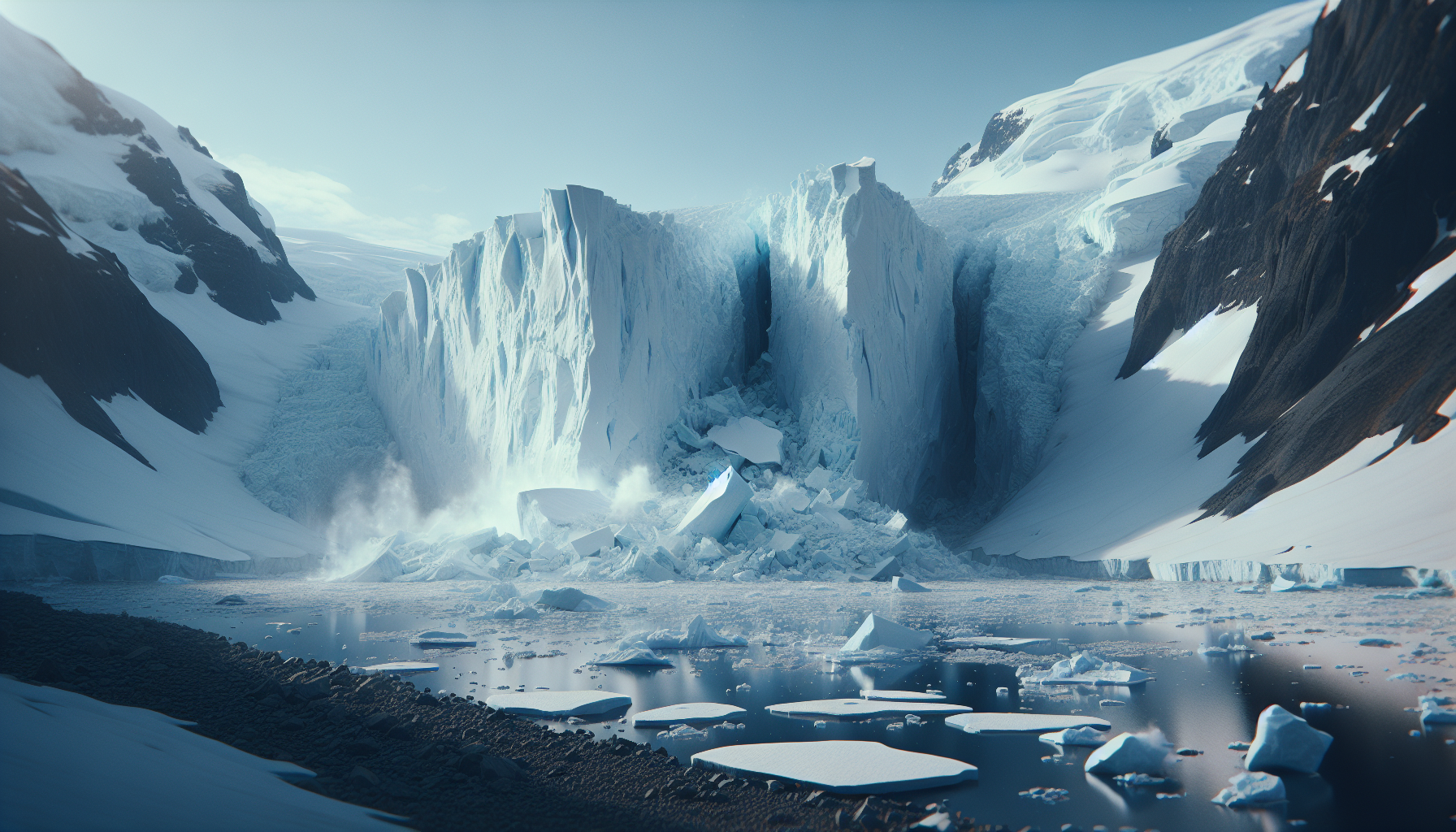
The Hektoria Glacier on Antarctica's northeastern peninsula did not retreat gradually. It did not thin slowly over decades in the way climate models have long assumed glaciers behave. Instead, over the course of roughly two months, it pulled back eight kilometers, with nearly half of its mass fracturing and collapsing in what researchers are now calling the fastest glacier retreat ever recorded. The event has forced a reckoning not just with what happened, but with how poorly existing models account for the speed at which ice systems can tip.
What made Hektoria's collapse so sudden, and so scientifically significant, was the geometry hiding beneath it. The glacier sits atop an unusually flat underwater bedrock surface. That flatness, which might seem geologically unremarkable, turned out to be catastrophic. As warming ocean water crept beneath the ice, the flat bed allowed the glacier to lift and float far more easily than it would have on a sloped or irregular surface. Once buoyancy took hold, the ice lost the friction and grounding that had kept it stable. The fracturing that followed was not a slow unraveling. It was a chain reaction, captured in near real time through a combination of satellite imagery and seismic monitoring that recorded the structural failures as they cascaded across the glacier's body.
Scientists were able to watch the collapse unfold in a way that was previously impossible. The convergence of high-resolution satellite data and seismic sensors gave researchers an almost forensic view of how the ice broke apart, which fractures triggered others, and how quickly the system moved from stressed to shattered. That observational clarity is itself a relatively new development in glaciology, and it is already changing what researchers believe they know about ice sheet dynamics.
The flat-bed mechanism at Hektoria is not unique to that glacier. Across Antarctica, and particularly in the vulnerable West Antarctic Ice Sheet, large glaciers sit on similarly flat or reverse-sloped beds, where the ground beneath the ice slopes downward as you move inland. This configuration, known as a marine ice sheet instability, means that once a glacier begins to retreat, the retreating edge encounters deeper and deeper water, accelerating the process rather than slowing it. Thwaites Glacier, sometimes called the "Doomsday Glacier," is the most discussed example, but it is far from the only one.
What Hektoria demonstrates is that the trigger for rapid collapse does not require decades of gradual warming to build up. The right bedrock geometry, combined with ocean temperatures that have already been rising for years, can produce a sudden, irreversible event. The word "irreversible" carries real weight here. Once a glacier loses its grounding and begins to float, the dynamics that stabilized it are gone. There is no known natural mechanism that refreezes and re-anchors a glacier on the timescales relevant to human civilization.
The findings raise an uncomfortable question for climate science: how many other glaciers are sitting on similarly flat beds, absorbing heat quietly, waiting for the same threshold to be crossed? The answer is not fully known, partly because mapping the detailed topography of the seafloor beneath Antarctic glaciers remains technically difficult and expensive. The data gaps are not trivial. They represent genuine uncertainty about where the next Hektoria might be.
The deeper systems consequence of this event is not just physical. It is epistemic. Climate projections used by policymakers, including the sea level rise estimates embedded in the Intergovernmental Panel on Climate Change reports, are built on models that have historically underestimated the pace of ice loss. Those models were not designed to account for the kind of abrupt, geometry-driven collapse that Hektoria just demonstrated. If rapid-collapse dynamics are more common than previously understood, the upper-end sea level rise projections, already alarming, may themselves be too conservative.
Sea level rise projections shape everything from coastal infrastructure investment to mortgage lending in flood-prone areas to the negotiating positions of small island nations at international climate talks. A systematic underestimation of collapse speed does not stay contained to glaciology journals. It propagates through risk models, insurance pricing, urban planning timelines, and ultimately through the political calculus of how urgently governments treat the problem. The second-order effect of getting the ice physics wrong is that societies build to the wrong standard, in the wrong places, on the wrong timeline.
Hektoria was not the largest glacier in Antarctica. It was not the one scientists were most worried about. That may be precisely the point. The glaciers that collapse first are rarely the ones at the center of attention, and by the time a Thwaites-scale event begins, the window for meaningful preparation may already be closing faster than the models predicted.
References
- IPCC (2021) — The Physical Science Basis: Summary for Policymakers
- Rignot et al. (2014) — Widespread, rapid grounding line retreat of Pine Island, Thwaites, Smith, and Kohler glaciers, West Antarctica
- Mercer, J.H. (1978) — West Antarctic ice sheet and CO2 greenhouse effect: a threat of disaster
- DeConto & Pollard (2016) — Contribution of Antarctica to past and future sea-level rise



Discussion (0)
Be the first to comment.
Leave a comment