
For decades, the story of Yellowstone has been told in a particular way: a column of superheated rock, called a mantle plume, punches upward from deep within the Earth, melting the crust above and fueling one of the most geologically restless places on the planet. It is a clean, dramatic narrative. A new paper suggests it may also be wrong.
Researchers are now arguing that the volcanic fury beneath Yellowstone is not the product of a deep, persistent plume at all, but rather the lingering geological consequence of an ancient tectonic plate that has long since vanished. The Farallon Plate, which once stretched across much of the Pacific and spent tens of millions of years diving beneath North America, left behind a fractured and thermally altered crust. According to the new hypothesis, those old wounds in the lithosphere are what allow heat and magma to reach the surface today, not a plume punching up from the mantle.
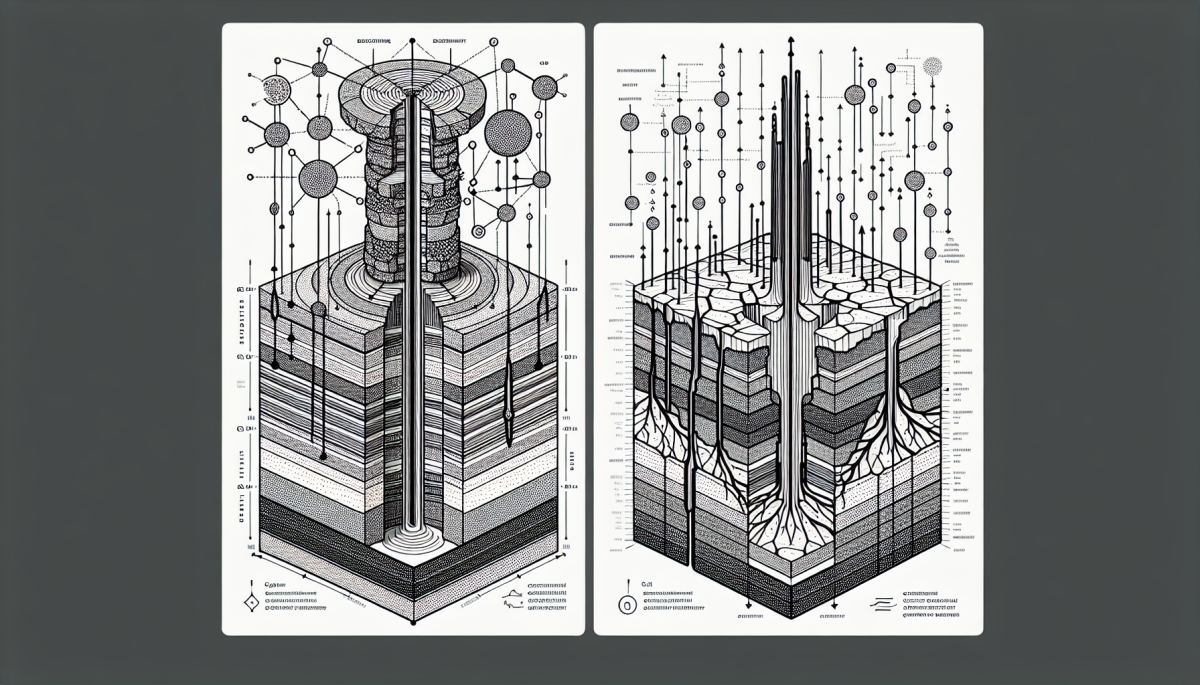
This is more than an academic dispute about underground geology. The mantle plume model has shaped how scientists interpret Yellowstone's past eruptions, predict its future behavior, and communicate risk to the public. If the plume model is wrong, or even significantly incomplete, then the frameworks built on top of it deserve scrutiny too.
The Farallon Plate is one of geology's great vanishing acts. Once a massive oceanic plate, it was almost entirely consumed by subduction beneath the North American continent over roughly 150 million years. What remains are fragments, including the Juan de Fuca Plate off the Pacific Northwest coast, still slowly diving beneath Oregon and Washington. But the bulk of the Farallon is gone, absorbed into the mantle, leaving behind a complex scar tissue of deformed rock and altered thermal gradients across the western United States.
The new paper argues that this scar tissue is the key. As the Farallon subducted, it introduced water into the mantle wedge above it, lowering the melting point of surrounding rock. It also created zones of structural weakness in the overlying crust. The hypothesis holds that Yellowstone sits atop one of these ancient zones, and that what looks like a plume signature in seismic data is actually the expression of this inherited, plate-driven architecture. The heat source, in other words, is historical rather than actively driven from below.
This reframing matters because mantle plumes, if they exist in the classical sense, are thought to originate from the core-mantle boundary, nearly 1,800 miles down. A process rooted in shallow crustal inheritance operates on entirely different timescales and with different implications for longevity and eruptive potential.
The systems-level consequences of this debate extend well beyond volcanology. Yellowstone sits inside a national park visited by more than 4 million people annually, and its geothermal features, from Old Faithful to the Grand Prismatic Spring, are directly tied to the subsurface heat budget that this debate is really about. How that heat is generated and sustained determines how it might change over time.
If the Farallon model is correct, Yellowstone's heat source is essentially a depleting inheritance rather than a continuously fed pipeline. That would suggest the system is gradually winding down over geological time, though "gradually" here means millions of years. But it also means the standard plume-based models used to simulate future eruptive scenarios may be systematically miscalibrated. Hazard assessments, which inform everything from emergency planning in Wyoming and Montana to federal land management decisions, rest on those simulations.
There is also a second-order effect worth watching in the scientific community itself. The mantle plume hypothesis has been contested in various forms since the 1990s, with researchers like Don Anderson at Caltech arguing for what he called "plate hypothesis" alternatives. Yellowstone has often been cited as one of the cleaner examples of plume activity. If that example erodes, it could accelerate a broader reassessment of how many other so-called hotspots around the world are being explained by a model that may be over-applied.
Science rarely moves in straight lines, and the Yellowstone debate is unlikely to be resolved quickly. Seismic tomography, the primary tool for imaging what lies beneath the surface, has improved dramatically in recent years, but interpreting those images remains as much art as science. What the new paper does is force a more honest accounting of what the data actually shows versus what the prevailing model has trained researchers to expect to see.
The deeper question, one that will take years of fieldwork and modeling to answer, is whether Yellowstone's future looks more like a fading ember from a long-dead plate or a live wire still connected to the planet's interior engine.
Discussion (0)
Be the first to comment.
Leave a comment