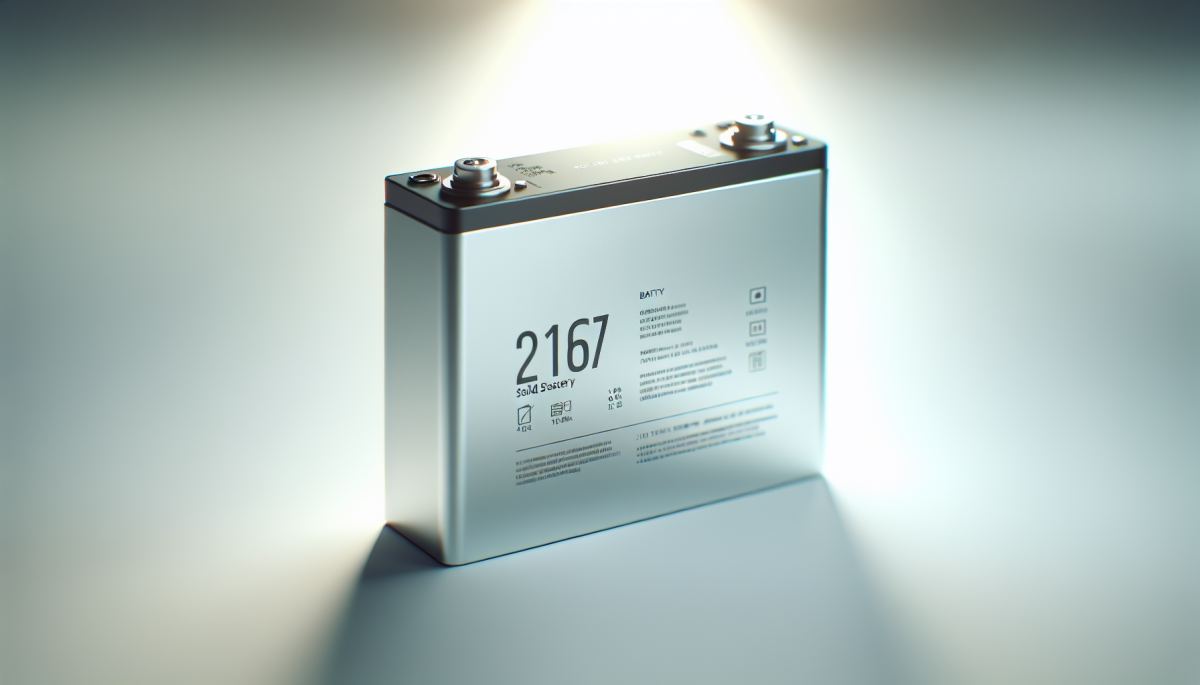
A small Finnish startup most people have never heard of is making one of the boldest claims in energy technology. Donut Lab, a spinoff of electric motorcycle company Verge Motorcycles, announced earlier this year that it had solved solid-state batteries and planned to move into production. If true, this would represent a genuine turning point in how the world stores and moves energy. If not, it joins a long line of announcements that promised to deliver the so-called "Holy Grail of batteries" and quietly disappeared.
Solid-state batteries have carried that "Holy Grail" label for good reason. Unlike conventional lithium-ion batteries, which use a liquid electrolyte to shuttle ions between electrodes, solid-state designs replace that liquid with a solid material. The theoretical advantages are significant: higher energy density, faster charging, longer cycle life, and far lower risk of fire. For electric vehicles, consumer electronics, and grid storage, those properties would be transformative. The problem is that the gap between laboratory promise and manufacturable reality has proven extraordinarily stubborn. Cracking the chemistry is one challenge. Building a process that can produce these cells at scale, consistently, and at competitive cost is an entirely different mountain.
Donut Lab is entering a field littered with cautionary tales. Toyota has been announcing imminent solid-state breakthroughs for the better part of a decade. QuantumScape, backed by Volkswagen and valued at billions during its SPAC-era peak, has faced repeated delays and seen its stock collapse from early highs as production challenges proved more stubborn than investors hoped. Solid Power, which counts BMW and Ford among its partners, is still working through pilot-line production. The pattern is consistent: the science advances, the press releases multiply, and the timelines slip.
What makes Donut Lab's announcement unusual is its origin. A spinoff of a motorcycle company is not the typical vector for a battery breakthrough. Verge Motorcycles itself is a niche player in the electric two-wheeler market, known for a distinctive hub-motor design. That unconventional lineage could mean Donut Lab approached the problem from a different angle, unburdened by the assumptions baked into larger programs. Or it could mean the announcement is outpacing the evidence. The company has not, as of this writing, published peer-reviewed data or invited independent verification of its claims.
The broader context matters here. Governments and automakers are under enormous pressure to accelerate the energy transition, and that pressure creates a market for optimism. Startups that can credibly claim proximity to a solid-state solution attract venture capital, partnership interest, and media attention. The incentive structure rewards bold announcements, and the consequences of overpromising are often absorbed slowly, long after the initial headlines fade.
Set aside skepticism for a moment and consider what a genuine, manufacturable solid-state battery would actually do to interconnected systems. The most immediate effect would fall on electric vehicle range anxiety, which remains one of the most cited barriers to EV adoption. Higher energy density means more range per kilogram of battery, and faster charging means less time tethered to infrastructure that is still being built out. Both effects would accelerate adoption curves in ways that current lithium-ion chemistry simply cannot.
But the second-order consequences reach further. A durable, high-density battery changes the economics of grid storage, making it more practical to buffer renewable generation at the local and utility scale. That shifts the calculus on wind and solar investment. It also puts pressure on the existing lithium-ion supply chain, which has attracted hundreds of billions in investment over the past decade. Gigafactories built around liquid-electrolyte chemistry do not automatically convert to solid-state production. The transition, if it comes, would strand some of that capital while creating new chokepoints around whatever materials solid-state cells require in volume.
There is also a geopolitical dimension. China currently dominates lithium-ion battery manufacturing, controlling a substantial share of cell production and the upstream processing of key minerals. A technology shift opens a window, however narrow, for other regions to establish footholds in the next generation of energy storage. Finland, with its engineering culture and proximity to European automotive supply chains, is not an implausible place for that kind of disruption to begin.
Whether Donut Lab's announcement holds up under scrutiny remains to be seen. The history of this field suggests patience is warranted. But the fact that a motorcycle spinoff from Helsinki is now part of this conversation at all says something about how broadly the search for better batteries has spread, and how much pressure the world is placing on whoever finds the answer first.
Discussion (0)
Be the first to comment.
Leave a comment