
For most of physics history, antimatter has been one of the most fragile and temperamental things humans have ever managed to create. Produce it, trap it, study it briefly, and watch it annihilate the moment it touches ordinary matter. The idea of loading it into a truck and driving it somewhere would have seemed absurd not long ago. But that is precisely what a team of physicists just did, and the fact that it worked matters far more than the novelty of the stunt.
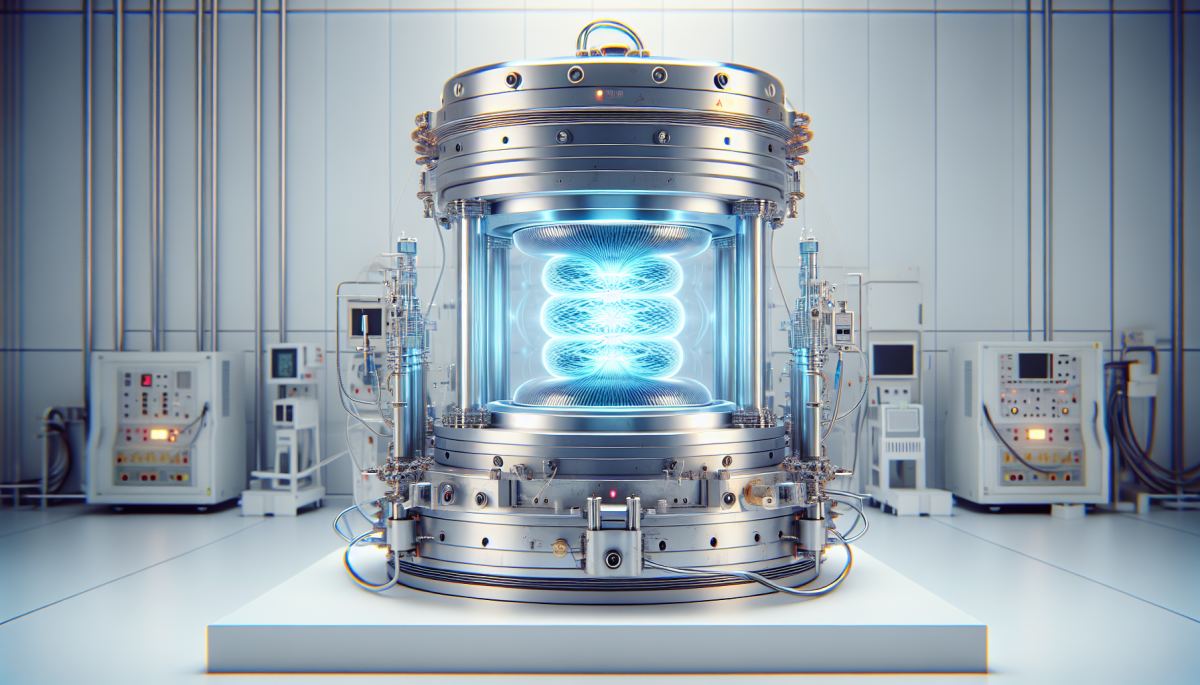
Researchers successfully transported antiprotons in a specially prepared vehicle, demonstrating for the first time that antimatter particles can survive the mechanical vibrations, electromagnetic interference, and general chaos of road travel. The antiprotons were kept confined in a portable magnetic trap, the kind of device that has to maintain extraordinarily precise field conditions to prevent the particles from drifting into contact with normal matter and disappearing in a flash of energy. That the trap held during an actual drive is a meaningful engineering milestone, not just a headline.
The significance here is not the joyride itself but what portability unlocks. Until now, antimatter research has been almost entirely tethered to the large particle accelerator facilities capable of producing it, places like CERN's Antiproton Decelerator in Geneva. Scientists who want to study antiprotons have to go there, run their experiments on-site, and accept the constraints that come with shared, expensive infrastructure. The ability to move antimatter, even short distances, begins to break that dependency.
This matters because some of the most compelling proposed uses for antimatter require it to exist outside a laboratory. Antimatter has been theorized as a potential tool in cancer treatment, specifically in precision tumor imaging and possibly targeted radiation therapy, where its annihilation properties could be exploited to destroy malignant cells with extraordinary accuracy. Medical facilities are not particle accelerators. If antiprotons can travel, the gap between production and application starts to close in ways that were previously theoretical.
There is also a deeper physics motivation. One of the most persistent and genuinely unsettling mysteries in modern science is why the universe contains matter at all. The standard model of particle physics predicts that the Big Bang should have produced equal amounts of matter and antimatter, which should have annihilated each other completely, leaving nothing but energy. Clearly that did not happen, since galaxies, planets, and people exist. But physicists have not been able to identify the asymmetry that tipped the scales. Experiments that can be conducted in more varied environments, away from the electromagnetic noise of a major accelerator complex, could help isolate subtle differences in how antimatter behaves compared to matter.
The systems-level consequence that deserves attention here is what happens to antimatter research as a field if portability becomes routine. Right now, the scarcity and immobility of antimatter acts as a natural bottleneck, concentrating expertise and resources at a handful of institutions. CERN's facilities are genuinely irreplaceable for production, but if experiments can be decoupled from production sites, the research ecosystem could decentralize in ways that historically accelerate scientific progress. More institutions, more experimental designs, more independent replication of findings.
There is also a feedback loop worth considering on the engineering side. Building a trap robust enough to survive road transport required solving problems that laboratory-grade equipment never had to face. Those engineering solutions, better vibration damping, more resilient magnetic field control, more compact power systems, feed directly back into the design of next-generation laboratory traps. The constraints of portability often produce innovations that improve stationary systems too, a pattern visible across everything from military technology to space hardware.
The caution worth holding onto is that transporting antiprotons in a controlled experiment on a prepared route is a long way from any kind of routine antimatter logistics. The quantities involved are minuscule, the infrastructure required is still enormously specialized, and the energy cost of producing antiprotons remains staggeringly high relative to what you get. But the history of physics is full of demonstrations that seemed merely clever until they weren't.
The more interesting question now is not whether antimatter can be moved, but how quickly the engineering required to move it will become cheap enough to matter outside a physics department.
References
- CERN (2024) — Antiproton Decelerator Overview
- Ahmadi et al. (2017) — Observation of the 1S-2S transition in trapped antihydrogen
- Charman et al. (2013) — Description and first application of a new technique to measure the gravitational mass of antihydrogen
- Smorra et al. (2017) — A parts-per-billion measurement of the antiproton magnetic moment


Discussion (0)
Be the first to comment.
Leave a comment