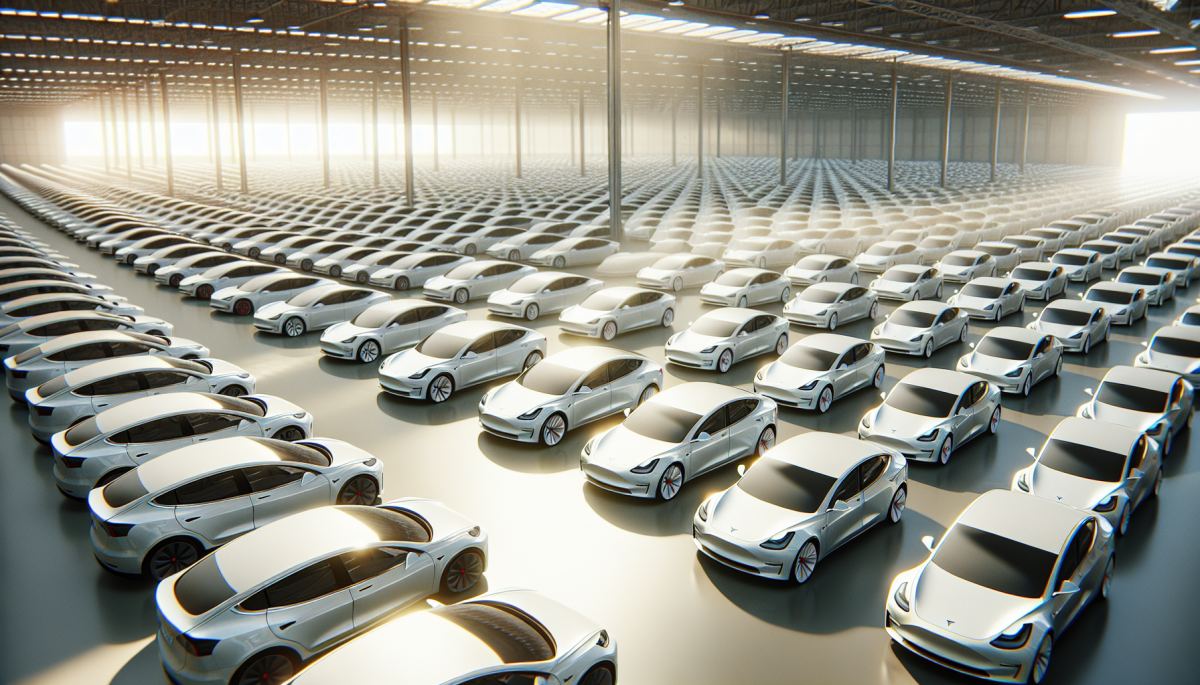
Tesla ended the first quarter of 2025 with roughly 50,000 unsold vehicles sitting in inventory, a record high for the company that has long prided itself on a build-to-order model with lean stockpiles. The figure arrives at an awkward moment: the company had just reported a sales rebound after a bruising 2024, and executives were eager to frame the quarter as a turning point. Instead, the inventory number is quietly telling a different story.
For most automakers, a few weeks of unsold inventory is unremarkable. Ford, GM, and Stellantis routinely carry 60 to 80 days of supply on dealer lots. But Tesla operates without a traditional dealership network, which means its inventory accumulates at company-owned lots and delivery hubs. When those numbers swell, there is no buffer of independent dealers absorbing the overhang. The risk sits entirely on Tesla's own balance sheet, and the pressure to clear it falls directly on the company's pricing desk.

Tesla delivered approximately 336,000 vehicles in the first quarter of 2025, a meaningful improvement over the fourth quarter of 2024, which had been the company's worst quarterly performance in nearly three years. On the surface, that looks like recovery. But production outpaced deliveries again, which is precisely how inventory builds. Tesla manufactured more cars than it handed over to customers, and the gap between those two numbers is what fills parking lots in Nevada, Texas, and across its European logistics hubs.
The underlying demand question is harder to answer than the production math. Tesla has spent the past 18 months cutting prices aggressively across its lineup in an attempt to stimulate volume, and those cuts have worked, to a point. They have also compressed margins significantly, with automotive gross margins falling well below the levels that once made Tesla the envy of the industry. The problem with repeated price cuts as a demand lever is that they train buyers to wait. If a Model Y was cheaper last month than it was six months ago, the rational consumer strategy is to delay purchase and see whether prices fall further. That expectation, once established, is genuinely difficult to unwind.
Elon Musk's increasingly polarizing public profile has added another layer of complexity. Brand perception surveys conducted in early 2025 showed measurable deterioration in Tesla's favorability among the college-educated, higher-income consumers who make up the core EV-buying demographic in the United States and Western Europe. Whether that translates directly into lost sales is difficult to isolate, but anecdotal evidence from Tesla forums and owner communities suggests some prospective buyers are actively reconsidering. A brand that once carried aspirational weight is navigating something it has never really faced before: reputational friction.
The second-order effect most analysts are underweighting is what a sustained Tesla inventory glut does to the broader EV market. Tesla still commands somewhere between 45 and 55 percent of U.S. EV sales depending on the quarter. When Tesla discounts aggressively to clear inventory, it does not just affect its own margins. It resets the price expectations consumers bring to every other EV on the market. Rivian, GM's Ultium-based vehicles, Hyundai's Ioniq lineup, and Ford's Mustang Mach-E all compete in a market where Tesla's sticker price functions as an informal ceiling. If Tesla keeps cutting, every other manufacturer faces a choice between matching those prices and bleeding margin, or holding firm and watching conquest sales evaporate.
This dynamic is particularly punishing for legacy automakers that have spent billions retooling factories for EV production and are only now beginning to see volume. They cannot afford a price war with a company that, whatever its current struggles, still carries far less legacy cost structure per vehicle.
There is also a quieter feedback loop forming around consumer confidence in EVs generally. If the dominant EV brand is visibly struggling to move product, it reinforces hesitation among the large segment of buyers who are still on the fence about making the switch from internal combustion. Perception of demand weakness can itself suppress demand, a classic reflexivity problem that is easy to dismiss and hard to reverse.
Tesla has navigated inventory problems before, and it has tools available, from targeted regional discounts to enhanced financing offers to accelerated software feature unlocks. But the record 50,000-unit figure suggests those tools are being outpaced by the accumulation rate. The more interesting question for the months ahead is not whether Tesla can clear this particular backlog. It almost certainly can. The question is what price, in dollars and in brand equity, it will have to pay to do it.
References
- Reuters (2025) — Tesla deliveries rise in Q1 2025 but miss analyst expectations
- Bloomberg (2024) — Tesla Cuts Prices Again as EV Competition Intensifies
- The Guardian (2025) — Elon Musk's political turn is hurting Tesla's brand, surveys suggest
- Financial Times (2025) — EV price war puts pressure on legacy automakers

Discussion (0)
Be the first to comment.
Leave a comment