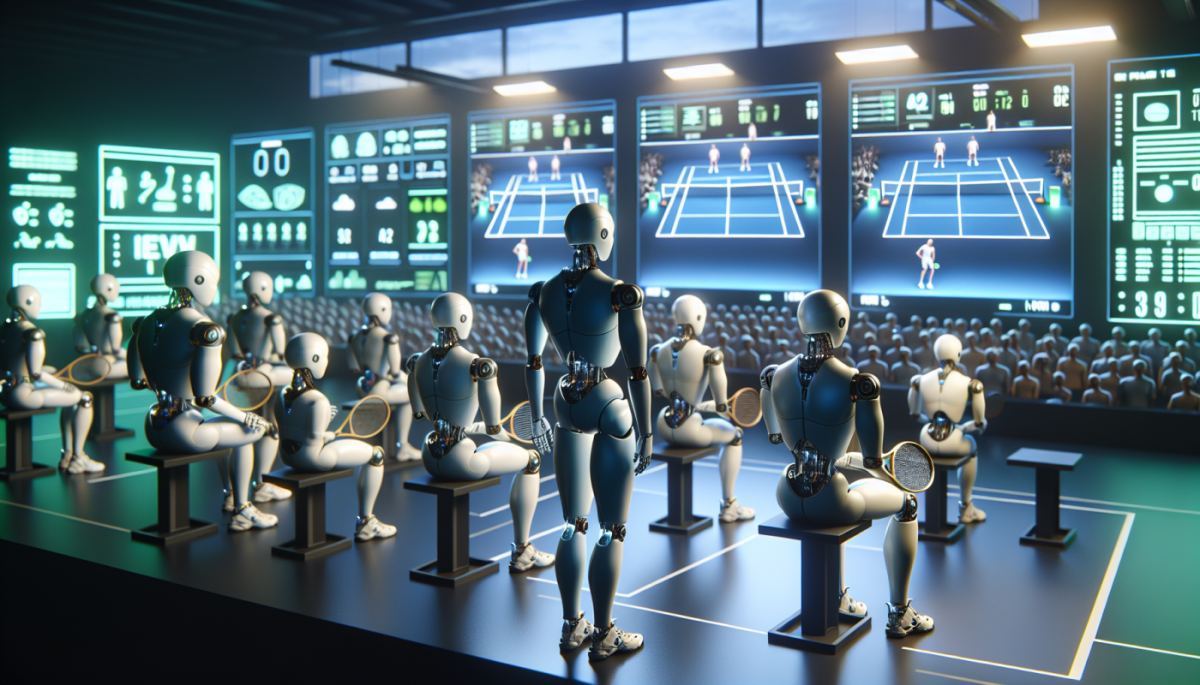
There is something almost philosophical about a humanoid robot learning to play tennis by watching humans do it first. The motion is fast, the physics are unforgiving, and the margin for error is measured in milliseconds. Yet that is precisely the frontier that robotics researchers are now pushing into, as demonstrated in recent footage circulating through the IEEE Spectrum robotics community showing a humanoid system developing tennis skills through direct interaction with human athletes.
The robot in question is not just swinging at stationary balls on a tee. It is engaging in competitive rallies, tracking high-speed trajectories, and adapting its movements in real time to match the unpredictable nature of a human opponent. That distinction matters enormously. Most robotic manipulation research still takes place in controlled environments where variables are minimized and outcomes are scripted. Tennis, by contrast, is a sport built entirely on chaos management. Every serve, every return, every bounce off the court surface introduces new information that the system must process and respond to faster than conscious thought.
To understand why this development is significant, it helps to think about tennis not as a sport but as a feedback loop. A player reads incoming ball spin and velocity, generates a motor response, executes a stroke, and then immediately begins reading the next incoming signal. The loop runs continuously, with each output becoming the input for the next cycle. For a human, years of embodied practice wire this loop into muscle memory. For a robot, replicating that loop requires solving several hard problems simultaneously: computer vision fast enough to track a spinning ball, joint actuation precise enough to generate controlled racket angles, and a learning architecture flexible enough to generalize from one rally to the next.
The approach being demonstrated here, where human athletes physically demonstrate skills to the robot rather than relying purely on simulation, reflects a broader shift in the field toward what researchers call imitation learning or learning from demonstration. The intuition is straightforward. Humans have already solved the biomechanical optimization problem of hitting a tennis ball. Rather than deriving that solution from scratch through trial and error, a robot can use human motion as a prior, a starting point that dramatically compresses the learning timeline. The challenge is transferring that knowledge across the gap between biological and mechanical bodies, what researchers sometimes call the embodiment gap.
The immediate story here is impressive enough on its own terms. But the more consequential development is what this class of research signals about where humanoid robotics is heading as a field. For years, the dominant criticism of humanoid robots was that their form factor was a vanity choice, that a robot shaped like a human was not actually better at most tasks than a purpose-built machine. That criticism is losing ground fast. The reason humanoid form factors are suddenly attracting serious investment and serious research is precisely because the world is built for human bodies. Tools, vehicles, sports equipment, and workplaces are all designed around human proportions and human movement ranges. A robot that can learn from watching humans play tennis can, in principle, learn from watching humans do almost anything.
The second-order effect worth tracking is what happens to the training data economy as this approach scales. If humanoid robots learn by observing human motion, then high-quality human movement data becomes a strategic resource. Athletes, surgeons, skilled tradespeople, and dancers all possess embodied knowledge that has never been formally encoded anywhere. That knowledge, once capturable at scale, becomes an input to machine learning pipelines in ways that raise genuinely novel questions about compensation, consent, and intellectual property. A tennis player whose strokes train a commercial robot system is contributing something of value. Whether the current legal and economic frameworks are equipped to recognize that contribution is a question the industry has not yet seriously confronted.
Robotics events like ICRA 2026 in Vienna and the Summer School on Multi-Robot Systems in Prague will almost certainly feature this class of research prominently, as the field moves from asking whether humanoids can perform dynamic tasks to asking how quickly they can learn new ones. The pace of that learning curve, more than any single demonstration video, is what should hold our attention.
References
- Argall et al. (2009) — A survey of robot learning from demonstration
- IEEE Spectrum Robotics (2025) — Video Friday: Humanoid Learns Tennis Skills Playing Humans
- Peng et al. (2018) — DeepMimic: Example-Guided Deep Reinforcement Learning of Physics-Based Character Skills
- Duan et al. (2017) — One-Shot Imitation Learning
Discussion (0)
Be the first to comment.
Leave a comment