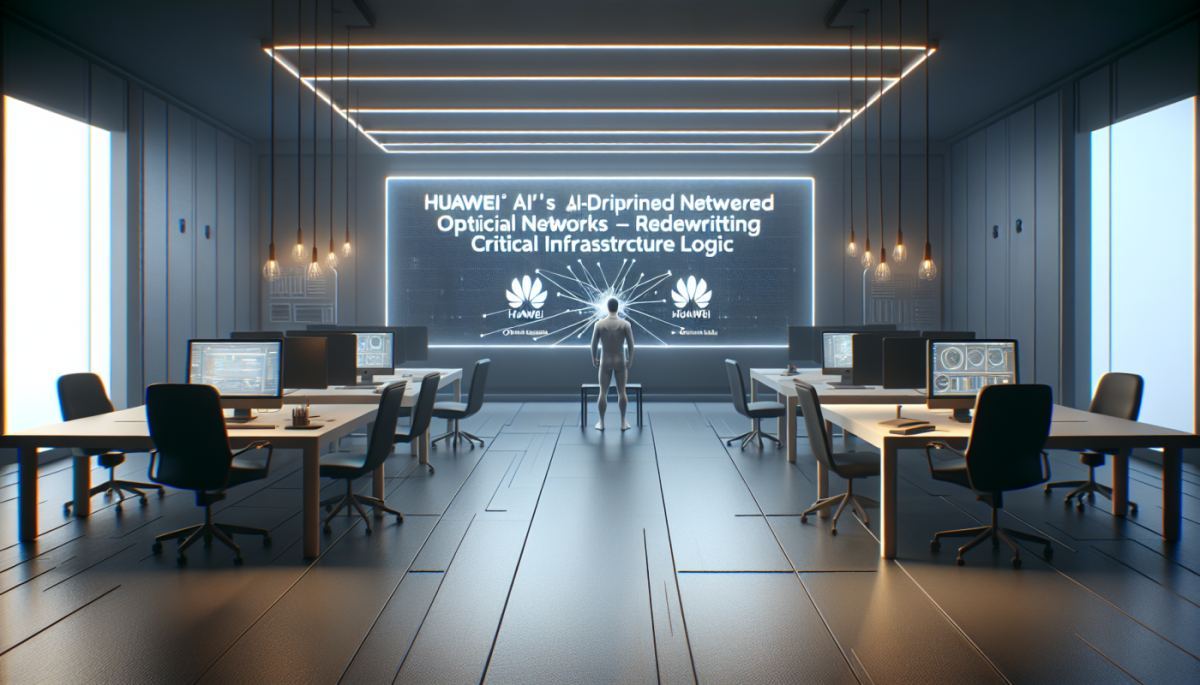
For decades, optical transport networks operated as the invisible plumbing of the digital world — reliable, fast, and almost entirely passive. Data moved through them the way water moves through pipes: efficiently, but without any awareness of what it was carrying or why. What Huawei unveiled at MWC Barcelona 2026 signals something fundamentally different. The company's next generation of optical transport networks, or OTNs, are being repositioned not as conduits but as intelligent platforms capable of sensing, adapting, and integrating across the most demanding sectors of modern society — power grids, rail systems, and government communications among them.
This is not a minor product refresh. It represents a philosophical shift in how network infrastructure is conceived. Where traditional OTNs were engineered for throughput and uptime, the new generation layers artificial intelligence directly into the network's operating logic. The network, in other words, begins to think about what it is doing — monitoring traffic patterns, predicting failures before they cascade, and dynamically reallocating capacity in response to real-time demand. For sectors like rail and electrical utilities, where a communication failure can translate almost immediately into physical danger, that distinction carries enormous weight.
Rail operations offer a particularly instructive case. Modern signaling systems, particularly those built around communications-based train control, depend on continuous, low-latency data exchange between trains, trackside equipment, and control centers. A network that simply carries data is adequate during normal conditions. A network that can anticipate congestion, reroute traffic around a degraded fiber segment, and maintain guaranteed service levels without human intervention is something categorically more valuable. Huawei's framing of OTNs as "integrated platforms" rather than pipelines speaks directly to this need.
The power sector faces a parallel challenge. As electrical grids incorporate more renewable generation — sources that are inherently variable and geographically dispersed — the communications infrastructure coordinating them must become correspondingly more sophisticated. Grid operators need real-time telemetry from thousands of nodes simultaneously, and they need that data to arrive with enough reliability and speed to inform automated switching decisions. An AI-enhanced OTN that can prioritize grid-critical traffic during a weather event, for instance, is not a luxury feature. It is increasingly a prerequisite for grid stability.
Government communications add yet another dimension. Sovereign networks handling sensitive data have always demanded high availability, but the threat landscape has grown considerably more complex. Intelligent networks that can detect anomalous traffic patterns and isolate compromised segments autonomously offer a meaningful security advantage over static architectures that require human analysts to identify and respond to intrusions.
The systems-level implications of this shift extend well beyond the technical. When AI is embedded into the network layer itself, the boundary between infrastructure and application begins to dissolve. Historically, a railway operator or a utility company purchased connectivity as a commodity and then built intelligence on top of it through their own software systems. If the network itself becomes intelligent, those operators become dependent not just on bandwidth but on the decision-making logic embedded in the hardware they do not control. That is a meaningful transfer of operational leverage — and, potentially, of risk.
There is also a geopolitical dimension that cannot be ignored. Huawei occupies a uniquely contested position in global infrastructure markets. Its equipment has been excluded from telecommunications buildouts in the United States, the United Kingdom, and several other countries over national security concerns. The company's pivot toward AI-enhanced OTNs for critical sectors — power, rail, government — will intensify scrutiny in markets where it remains active. The more indispensable the network becomes to physical infrastructure, the higher the stakes of the question of who built it and under what conditions.
For the broader industry, Huawei's announcement at MWC Barcelona 2026 will likely accelerate a competitive response from rivals including Nokia, Ciena, and Infinera, all of whom have been developing their own AI-assisted network management capabilities. The race to make optical infrastructure intelligent is already underway. What Huawei has done is raise the visibility of the finish line.
The deeper question, and the one that will define the next decade of infrastructure investment, is whether governments and operators are prepared to govern intelligent networks with the same rigor they apply to the physical systems those networks now underpin. A railway signal that fails is investigated, regulated, and redesigned. An AI network decision that contributes to a failure is far harder to audit — and that gap between capability and accountability may prove to be the most consequential infrastructure challenge of all.

Discussion (0)
Be the first to comment.
Leave a comment